Following our stay at Malaysia’s Mt. Kinabalu, a trip described in the Nov. 2 issue of the Press, we headed to Deramakot Forest Reserve. The trip entailed a two-hour minibus drive on a paved road to a small town where we switched to four-wheel-drive vehicles for another two-hour drive, this time on rough dirt roads. The first half of the drive was through a vast area of palm oil plantations, an area of little diversity. After about an hour we were relieved to reach the reserve checkpoint and be surrounded by the rainforest.
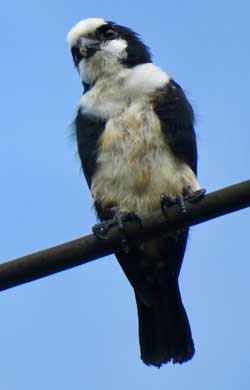
A Bornean falconet. (Photos by David Durrant)

A brown wood owl.
That evening we took a safari-type truck out for a night ride, hoping to find some nocturnal animals. The clouded leopard was a target species for us. The smallest of the “big cats,” this animal is shy and rarely seen; it rests in trees during the day and hunts at night. We hoped to see other wild cats, too, like the leopard cat, marbled cat, or flat-headed cat.
The guides used powerful lights to find animals by the reflection in their eyes. The first animal we saw was a brown wood owl sitting on a sign about a quarter of a mile from the lodge. Continuing on the dirt road, we were surprised to see a leopard cat cross the road and quickly disappear into the dense vegetation along the road. Although we were unable to get a photo, it was exciting to see one of these wonderfully patterned cats. They are about the size of a domestic cat but longer legged, and they have round, black splotches on a yellow/orange background.
After about a mile, Mike, our guide, picked up eye reflection and found our elusive clouded leopard right by the side of the road. The big cat walked around the back of the vehicle, allowing me to get a couple of camera shots, and then headed back to the forest. Mike had a sense of where she might be headed, so we turned around and took a small sidetrack where we saw her. We followed her down the track for about a quarter mile. Mike surmised that she had kits and was leading us away from them. We thought, wow! If this is just the first night what else is in store?
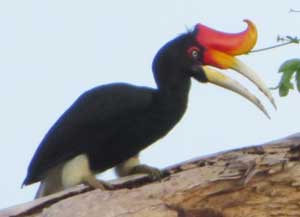
A rhinoceros hornbill.
Returning to the lodge, we found a sleeping chestnut-crested yuhina and a greater mouse deer slinking off into the forest. The greater mouse deer is the second smallest deer, weighing around 4.25 kg (approx. 9 pounds.).
Other mammals we saw on our four-day stay included Malay, island palm, and Bornean striped civets. Of the 34 species of squirrels found in Borneo, we saw the Sunda giant squirrel, which is the largest, and the Bornean pygmy squirrel, which is one of the smallest. Probably the cutest was the Whitehead’s pygmy squirrel, which has distinctive white tufted ears.

An orangutan perches in a tree to eat.
It was here at Deramakot that we got our first good looks at the Bornean orangutans. Males of these magnificent animals can weigh up to 90 kg (almost 200 pounds). Because they are solitary and hard to find, it was indeed a treat to see a male slowly making his way through the upper canopy, where he will spend most of his time searching for fruits. We also encountered a family of gibbons noisily swinging through the trees. Along the side of the track was a group of long-tailed macaques.
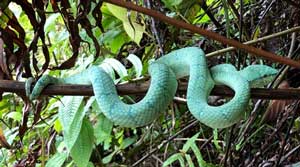
A pit viper in the forest.
On a late afternoon trip we got our first look at a couple of rhinoceros hornbills. These large birds (100 cm) are hard to miss with their large orange bill and orange and yellow casque curling back on top of their bill. It is believed the casque is largely decorative and although it appears heavy sitting there on top of the bill, it is in fact quite light as it is made of sponge-like material covered by a tough layer of keratin (the same thing our fingernails are made of). You can hear the “whoosh” of their wings when they fly over you. Returning to the lodge, we saw a blue-eared kingfisher, which is vibrant blue with an orange chest, and a stork-billed kingfisher with its enormous bill. There are 14 species of kingfisher in Borneo, most of them living in deep forest or near rivers. Our belted kingfisher is usually seen only by waters and not in deep woods. Before we reached the lodge, we saw what we think is one of the prettiest swifts and maybe our favorite bird of the trip so far—the whiskered tree swift.
On our last full day, we took our open truck to a wet forest area where a pit viper had been spotted and there were many pitcher plants. Pete, our trip leader, has an interest in snakes, and Pam had requested the pitcher plants so off we went. We found the pit viper, a gorgeous green, curled up on a large leaf not 5 feet from the road.
The morning we were to leave for our next lodge, a guide alerted us to a family of Bornean falconets. This tiny endemic bird is the world’s smallest bird of prey (about the size of our tufted titmouse). What a way to wrap up our visit to Deramakot.
Next: On to Sepilok and Kinabatangan
David and Pamela Durrant live on East Bare Hill Road at Micheldever Farm, where they watch their own peacocks and chickens as well as visiting wild birds.