
On Monday, Oct. 29, 146 third- and fourth-graders sat closely together on the Hildreth Elementary School cafeteria floor. Peggy Bragg, language arts curriculum coordinator, clapped for attention and asked the students for a thumbs up if they’d heard of the book “Little Women.” A roomful of thumbs waved in the air. She met with a similar response when she asked if they knew the name Louisa May Alcott. Then she asked them to envision what things were like 150 years ago when Alcott wrote her book. “Were there cars?” A chorus of “NO.” “Were there video games?” Again a “NO” and a bit of chatter as a number of kids bemoaned how dreadful that would be. “Did they dress like we do?” Giggles and shaking of heads.
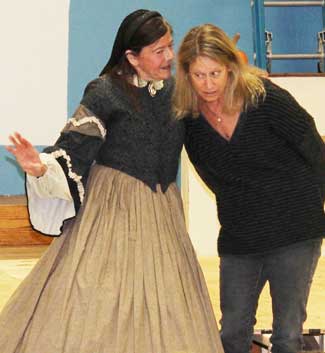
Jan Turnquist (left), in her second appearance of the day as Louisa May Alcott, whispers a secret to fifth-grade teacher Debby Walker.
(Courtesy photo)
Bragg asked the students to imagine that very different time and put themselves back there. They were about to have a visitor from the 1800s whose carriage had broken down. She asked them to close their eyes and count to 10. When they opened their eyes, there stood Louisa May Alcott in a high-necked, hoop-skirted dress and a black net holding her hair at the back of her neck.
Actually, it was Jan Turnquist, director of the Orchard House in Concord,* who has been doing one-woman performances of Louisa May Alcott for a couple of decades. She has even performed in Japan, where they love Louisa May, she said. Turnquist’s Monday performance—and three others, tailored to different grade levels—was made possible through a grant from the Harvard Schools Trust.
Bragg said the original idea had come from Superintendent Linda Dwight, who wanted to make an educational connection to the filming of “Little Women” and give kids an opportunity to be in on the buzz in town. She had gathered a group of school curriculum leaders who had in turn taken the proposal back to teachers. Brainstorming led to the idea of an outside speaker, which led to Young Audiences of Massachusetts and to Turnquist. Bragg wrote a grant request and said she received a letter from the Schools Trust saying they enthusiastically supported the proposal.
Back in the Hildreth cafeteria, Louisa was explaining to her young audience that her carriage wheel had come off and while her driver fixed it, she would be staying with them. She said how delighted she was that they were children. “I love children,” she told them.
She said she herself had been very active as a child, running and climbing trees. She never thought she was doing anything wrong, but she often found herself the object of raised eyebrows and disapproving words. Fussy older women would say, “Girls can’t do . . . This isn’t proper . . . Go do needlework.” Fortunately, her parents were different from most other adults, and they understood her.
A different kind of teacher
Louisa explained that her father was a teacher, but he was very different from other teachers of the mid-1800s. Then, most teachers believed that you must hit a child if he or she misbehaves and that it is only a very rude child who asks questions of a teacher in class. They thought that, since children are not very smart, they can learn only by repeating things the teacher says—for instance, the letters of the alphabet.
To show how innovative her father’s methods were, Louisa chose eight students to come to the front. Singly or in pairs, she made them into letters: two girls for an A, one boy for an I, two for an L. The boy who was Y said his brother’s name began with that letter, to which Louisa declared that this Y was in honor of him.
Asking the audience if they knew what a utopia was—and they had some good ideas!—Louisa talked about the time her father wanted to create a utopia in Harvard that he called Fruitlands. The goals there were to be unselfish and kind but to always be yourself. Louisa said she held to those principles throughout her life.
Louisa chose 10 or so students and teacher Dawn-Marie Ayles to act out a chapter in “Little Women” called “Amy’s Valley of Humiliation.” After checking that the audience knew the word “humiliation,” she set up the scene: an old-fashioned schoolhouse with the “students” kneeling with backs straight to look as though they were sitting on two benches. Louisa assigned parts and whispered the character’s lines to each one.
No making faces, no passing notes
Mr. Davis was the teacher and on his blackboard were the rules: No making faces; no passing notes; no drawing pictures; and no bringing in pickled limes (a treat that was all the rage at the time). Louisa reminded Mr. Davis, “Of course you do not suffer questions from the children.” When “Mr. Davis” called the names of a few “students,” the girls stood up in turn, curtsied and said, “Present, Mr. Davis.” The boys gave a bow before their response. There was much delighted giggling from the audience.
The school superintendent (Mrs. Ayles) arrived and walked around to check the maps the children were engaged in drawing. She pronounced them “terrible; sloppy handwriting; wrong; wrong; wrong”—all except Amy’s map, which was declared excellent. One of the mean girls (Ah, yes, then too. ) raised her hand, stood up, and said, “Amy March has pickled limes.” Mr. Davis made Amy throw out the limes from her bag and hold her hand out for punishment. The audience made a sharp clap each time the ruler came down on Amy’s hand. As further humiliation, Amy had to stand in front of the class until dismissal.
Soon Louisa announced that her carriage wheel had been fixed and that the horse and driver were waiting for her. Before departing, she confessed that sometimes, after she was famous for “Little Women,” when she saw a stranger coming to her door for an autograph, she put on an apron and threw flour on her dress. When she opened the door she said with a maid’s accent, “Miss Alcott’s not at home.” But if any of you come to see me, she told the children, I will remember you and welcome you.
As a thank-you to Jan Turnquist for her help with scenes of Orchard House, Columbia Pictures put her name on a shop in Harvard’s set of downtown Concord. Did you see it?