The automated bells of the Unitarian and Congregational churches began tolling at exactly 11 a.m. this past Sunday, marking the 100th anniversary of the armistice that ended World War I—the Great War, the War to End All Wars. By then more than 150 residents had gathered on the Common to rededicate the town’s monument to the 64 citizens known to have fought in that conflict, and to honor Edward Enoch Thomas, Harvard’s only WWI fatality.
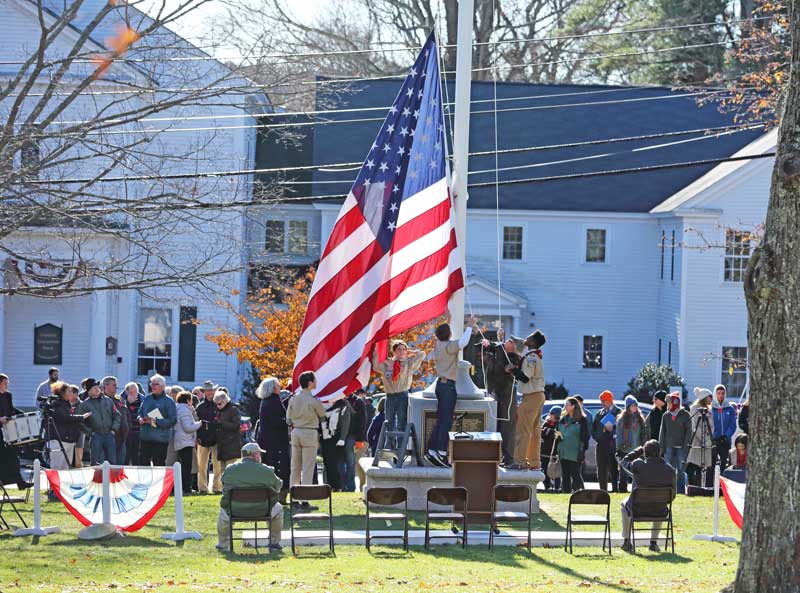
Boy Scouts from Troop 1 get the flag in place for raising as a crowd gathers before the World War I Memorial rededication ceremony on the Common to honor the 64 soldiers who fought in that war and the town’s one fatality, Edward Enoch Thomas. Nov. 11 marked the 100th anniversary of the end of WWI. (Photos by Lisa Aciukewicz)
The morning was clear but chilly with a slight breeze and a wisp of cirrus across an otherwise dazzling blue sky. Attendees were handed red paper poppies created by students at the Bromfield School, along with programs stamped with the town’s seal, replicas of those distributed in 1933 on the occasion of Harvard’s 150th anniversary. Red poppies have come to be worn as symbols of the sacrifices of WWI soldiers, while more recently (and controversially), white poppies have been adopted by some in remembrance of all victims of all wars, not just those who have served in the armed forces.
Jon Schoenberg, chair of Harvard’s War Monument Restoration Committee, in Air Force dress blues, presided over the ceremonies.
There was patriotic music from a half-dozen members of the Nashoba Valley Concert Band and from the St. Benedict Center Band, which arrived by bus from Still River. Bromfield senior Phoebe Clark sang the national anthem as Scouts from Harvard Troop 1 raised an outsized American flag, which unfurled dramatically against the azure sky as Clark hit her final notes. The flag was on loan from Harvard’s American Legion Post 119.

Bromfield senior Phoebe Clark sings the national anthem as dignitaries behind her salute. From left: Rev. Ed Koonz, Maj. David King, Lt. Col. Jon Schoenberg, Clark, state Rep. Jen Benson, state Sen. Jamie Eldridge.
Following an invocation by Rev. Ed Koonz, interim pastor of the Congregational Church, attendees heard a tribute to Enoch Thomas by retired Maj. David King, chair of the Fort Devens Museum Center. He was followed by Paul C. Roberts, grandson of Paul B. Roberts, who lived for many years in Harvard and is among those listed on the monument. State Sen. Jamie Eldridge and Rep. Jennifer Benson took turns reading the names of all 64 known WWI veterans; Bromfield students Dylan Ashe and Liam Wang read from poems written during the war; and Rev. Jill Cowie of the Unitarian Universalist Church offered a benediction.
A restored monument
The restored monument, with its cleaned up cast-concrete base, its new granite midsection milled in Vermont, its refurbished brass plaques and repainted 50-foot flagpole, is the work of the six-member War Monument Restoration Committee. The estimated $25,000 cost was paid for with town money, grants from the 100-Cities-100 Memorials initiative, Harvard Help, private donations, and contributions from two movie studios recently filming in town.
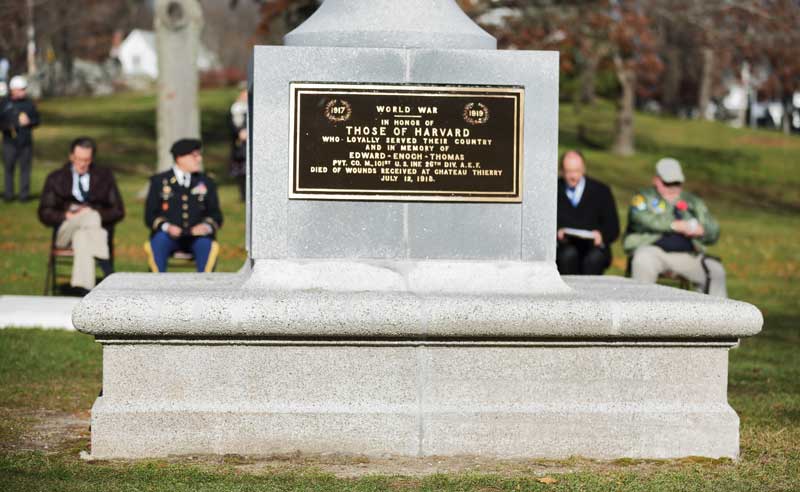
The rededicated monument features a restored cast-concrete base, a granite midsection milled in Vermont, and refurbished brass plaques below a repainted 50-foot flagpole.
The memorial was erected in 1921 and “has served as a testament to Harvard’s World War I veterans over the generations,” said Schoenberg in his introduction. The monument has been on the Massachusetts Historical Commission Registry since 1972, he noted, but in recent years had fallen into disrepair as weathering took its toll. The site was recently designated a “100 Cities-100 Memorials” monument by the National World War One Centennial Commission. “We gather here today to rededicate the memorial for its next century and to reflect upon the service and sacrifice of our town veterans,” said Schoenberg.
Remembering Thomas and Roberts
In remembering Pvt. Enoch Thomas, King noted that Enoch and his brother had been Stow Road residents when they entered the war. Enoch served as a mechanic with the rank of private in M Company of the 101st Regiment of the 26th Yankee Division. He died, said King, of injuries sustained July 10, 1918, at Château-Thierry, one of the first battles of the American Expeditionary Forces. He had been serving overseas since September 1917.
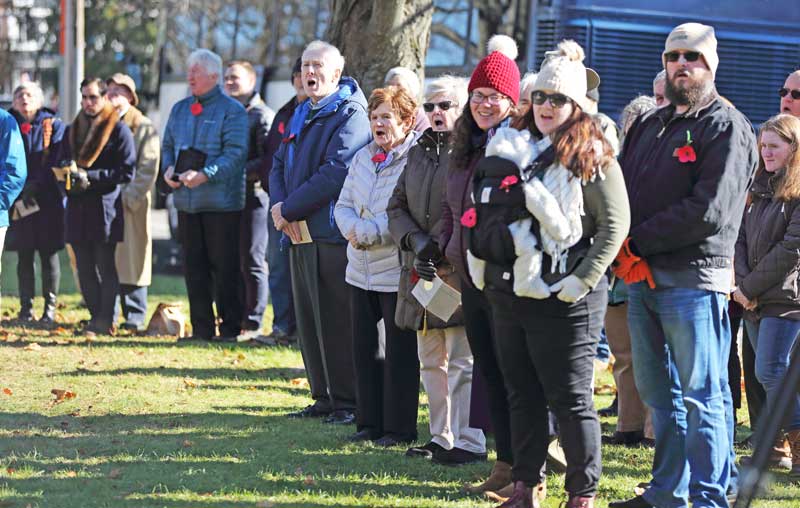
Harvard residents join in with the St. Benedict Center Band to sing “America the Beautiful.”
The life of another veteran, Paul B. Roberts, was recalled by his grandson, Paul C. Roberts, whose memories of his grandfather bore witness to the mental and physical injuries suffered by returning veterans. Paul B. Roberts, an ambulance driver during the war, survived a gas attack and later contracted rheumatic fever, “which ravaged his heart” and led to his early death in 1951 at age 58, according to his grandson. “I ask the good Lord’s most precious blessings on these men of Harvard, and likewise on the men and women of our military today,” as well as first responders, police, and firefighters, “who put their lives in harm’s way every day,” he concluded, saluting the monument as he did so.
Roberts’ remembrance was followed with readings of three wartime poems by Bromfield junior Dylan Ashe and senior Liam Wang. Ashe read “There Was a Great Calm,” written in 1918 by Thomas Hardy; Wang read the well-known “In Flanders Field,” by Canadian soldier and doctor John McCrae (omitting the bellicose first line of the final stanza), and concluded with a reading of the first stanzas of “Peace,” a poem written by Gretchen Osgood Warren on the first Armistice Day, November 11, 1918. (For the text of “Peace” and “In Flanders Field,” see below).
In her benediction, Rev. Cowie acknowledged that those who have not served cannot fully imagine the experience of war. “But we do know war’s aftermath and the toll that it can take on the human heart,” she said. “We pray that in our presence today, we share in their suffering and help heal the woes of hearts and minds so that all beings live in peace.”
In Flanders Fields
In Flanders fields the poppies blow
Between the crosses, row on row,
That mark our place, and in the sky,
The larks, still bravely singing, fly,
Scarce heard amid the guns below.
We are the dead; short days ago
We lived, felt dawn, saw sunset glow,
Loved and were loved, and now we lie
In Flanders fields.
Take up our quarrel with the foe!
To you from failing hands we throw
The torch; be yours to hold it high!
If ye break faith with us who die
We shall not sleep, though poppies grow
In Flanders fields.
—John McCrae, 1872-1918
From ‘Peace’
PEACE, battle-worn and starved, and gaunt and pale,
Rises like mist upon a storm-swept shore,
Rises from out the bloodstained fields and bows her head,
Blessing the passionate dead
Who gladly died that she might live for evermore.
Unheeding generations come and go,
And careless men and women will forget,
Caught in the whirling loom whose tapestried Today
Flings Yesterday away,
And covers up the crimsoned West whose sun has set.
—Gretchen Osgood Warren