
Those new to town most likely take the Harvard General Store for granted. It’s a lively spot most times of the day, and it’s a fun place to run into people you know and to meet up with friends for a cup of coffee. The food is excellent; the young people who work there are very friendly; and it’s a life-saver when you need something for a spur-of-the-moment occasion. But those in town who remember when the General Store was closed up—and sat empty for three years—cherish the store in a way newcomers can’t. That was a grim time when the center of town had no daily gathering place and the whole community felt scattered. Owners Adam and Lyn Horowitz and then Scott Hayward were heroes when they brought the General back to life.

Ted Reinstein. (Courtesy photo)
Harvard’s story is similar to that of many others that Ted Reinstein will relate at the Warner Free Lecture on Friday, Oct. 26, at 7 p.m. in Volunteers Hall at the public library. Reinstein’s stories appear in the 2017 book he co-authored with his wife, Anne-Marie Dorning, titled “New England’s General Stores,” in which he talks to store owners from Maine to Rhode Island. Their voices and details are varied, but their bottom line is pretty much the same: A general store is a wonderful thing for a town to have, but for the owner it’s a struggle to make ends meet.
For the past 23 years, Reinstein has been a reporter for Boston’s WCVB-TV’s “Chronicle,” the nation’s longest-running, locally produced nightly newsmagazine. He has been the host of shows on several other stations as well, among them the Discovery Channel and HGTV.
Reinstein was part of the Chronicle team that won awards for its coverage of Boston’s Big Dig.
This is the third book Reinstein has written, all of them about the unique characters, special places, and endearing oddities of New England. When asked how he got the idea for the most recent book, Reinstein replied in an email, “The idea was actually my wife’s. She knows how much I love general stores and found that very little has actually been written about them. So I had the longtime interest, she had the eureka moment.”
An endangered species
Reinstein and Dorning call general stores an “endangered species” and tell of many stores forced to close because they couldn’t compete with the growth of giant chain stores. Those who hang on often do so because of a family commitment passed down through generations. In one case a man bought a store where he had worked with his father as a teenager and now his own daughter wipes dust off the shelves. Stores are also saved through townspeople who refuse to let go of a connection with a collective past and to lose a gathering place that unites the community.
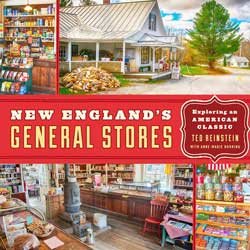
The authors show how general stores that do survive struggle to keep the locals happy but also have something for people passing through. And they have to continually think of new ideas to stay in business. For some the answer is good food, for others a giant cheddar cheese wheel, and others a collection of relics from owners past—a large cash register, a century-old scale, and a carefully handwritten ledger. For the Old Country Store in Moultonborough, New Hampshire, it’s a good, old-fashioned, simple, maple slingshot with a rubber and leather catcher on it. “We go through 12 dozen a year,” the owner is quoted as saying. And that same store has “licorice like you wouldn’t believe.”
The book makes these old stores endearing in part by personifying them. Of the Moultonborough Old Country Store: “It has seen couriers on horseback stop at its door, relating news of General George Washington’s election as the nation’s first president.” When the store in Colebrook, Connecticut, closed after 215 years of operation, townspeople brought flowers for the pots on the front porch and hung a new flag—not wanting the empty store to look like “an abandoned child.”
Reinstein and Dorning capture the uniqueness of each store owner but also generalize them to say they have to love it or they wouldn’t do it. The man who bought Fishbones, formerly named Blood and Temple, changed the name to Mont Vernon General Store after its location, which he felt would be better for business. Vermont store Dan and Whit’s has no technology and still uses a 200-year-old scale. One owner has put a large X on a rug by the register to mark the spot where, as a young man working for his father, he first saw the woman who would become his wife.
Anecdotes and tidbits
The book is full of wonderful anecdotes—how Henry Ford closed down a store for seven years; tidbits of history—why Southwick, Massachusetts, dips into Connecticut; authentic dialogue, humorous asides, and wonderful photographs, both old and new. Every page makes it clear that Reinstein and Dorning, like the proprietors they write about, loved what they were doing. The book will make the reader nostalgic for those more simple, wholesome days of the country store, and it will also inspire one to join efforts to preserve great old buildings and keep struggling general stores in business.
When asked about his visit to the Harvard General Store, Reinstein wrote, “My first impression was, wow—this wonderful old historic building houses two of my favorite things: a general store and an independent newspaper. I returned after that first visit and spent three hours one Saturday winter afternoon just sitting, watching, and loving the relaxed, upbeat community atmosphere along with the unique ‘indoor’ farmers market. Loved it.”
Copies of the book will be for sale and signing.

The Kerley, Reed, and Bryant General Store, a predecessor to the Harvard General Store. From left: Edna Robinson, Bill Kerley, and Reuben Reed. (Courtesy photo)