Editor’s Note: This column was first published in the Harvard Press on Nov. 9, 2012, another year in which New England’s rodent population boomed. Here, naturalist Mary Holland explores the causes of that year’s explosion. Now, in 2018, squirrels, chipmunks, and their ilk seem to be everywhere once again, their carcasses dotting the highways of Harvard and neighboring towns as reported in this Tuesday’s, Sept. 25, issue of the Boston Globe (see “Here’s why there are dead squirrels all over the place,” by Dugan Arnett). The conditions that have led to the 2018 rodent explosion are not identical to those described by Holland in her 2012 column, but the underlying dynamic is the same: an abundance of food last summer and fall that allowed more rodents to survive the winter, and their offspring to flourish.

Red squirrel. (Photos by Mary Holland)
It has been fairly evident since last spring [i.e., spring 2011] that New England’s rodent population is booming. Eastern chipmunks and red squirrels, in particular, have been omnipresent through the summer and judging from the activity in most houses this fall, mice have also been doing well. To what do we owe this population explosion, and is it likely to continue? One need only look at the hard mast (acorns, hickory nuts, beechnuts, etc.) production to find the answers to these questions.
A key determinant of animal numbers is food availability. Small rodents typically respond very quickly to the presence or absence of hard mast. Last year, in the fall of 2011, we experienced an unusually high production of beechnuts and, in some areas, of acorns as well. Squirrels, chipmunks, and mice were able to feed to their heart’s content and to store an ample winter’s food supply, if so inclined. As a result of the availability of food in the fall and through the winter, these species were healthy and able to produce high numbers of offspring.

Eastern chipmunk.
The Adirondack Ecological Center records show a 20-fold increase in live-caught mice from 2011 to 2012 and the highest mouse population in over 10 years.
Eastern chipmunks breed when they are one year old and produce two litters of one to eight young chipmunks during the summer. Red squirrels also breed at about the age of one and have one or two litters per year, with one to seven young in each litter. White-footed mice produce two to four litters a year, each consisting of one to seven young.
Ample food equals larger litters
An ample food supply means that the litter size is likely to be on the large end of the spectrum, and the survival of the young, due to the good health of the mother, should be higher than average. Thus, in a summer following a good mast year (and a mild winter), two chipmunks, two squirrels and two mice could produce 58 offspring, each of which could potentially produce 58 more offspring (a total of 3,364) every year mast production is high. (Predation would necessarily decrease these numbers.)

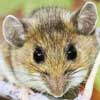
White-footed mouse.
Thus, the soaring number of eastern chipmunks, red squirrels, and white-footed mice this summer and fall is the result of last fall’s (2011) excellent crop of nuts and seeds, as well as the mild winter we had. Oaks and American beeches do not maintain a steady production of seeds year after year, however. Many plants produce seed periodically; oaks are well-known for a two- to five-year cycle of acorn production. American beech trees produce a nut crop about every two years. No one is sure, but this cyclical mast production may be an adaptation to the short growing season in New England that makes it difficult to put energy into seeds every year rather than into plant growth.
Just as the number of nut-eaters increases the summer after a healthy mast production, it decreases and often crashes after a poor mast production year. This correlation is so strong with black bears (avid consumers of beechnuts) that in any given year, black bear cub production across New England and Canada can be predicted by the size of that fall’s beechnut mast.
This fall [i.e., 2012], as the oak and beech mast cycles trended down, there are very few beechnuts to be found, and acorns dropped early and were fairly small. This does not bode well for the chipmunks, squirrels, and mice that depend on these nuts, nor for other mast-eaters, such as wild turkeys, ruffed grouse, black bears, and porcupines. It is possible, and even probable, that the rodent population will crash as a result of the lack of this primary source of food, and next summer we will see far fewer chipmunks, squirrels, and mice. In turn, this will affect the populations of species that prey on small rodents, as well as the species that small rodents prey upon, such as insects and songbird nestlings.
If you’re getting tired of setting mouse traps every night and refilling squirrel-raided bird feeders every time you turn around, know that this time next year you probably won’t have to be nearly as vigilant.
Mary Holland, a former Press columnist, is the author of “Naturally Curious: A Photographic Field Guide and Month-by-Month Journey Through the Fields, Woods, and Marshes of New England” and “Milkweed Visitors.” She has a natural history blog, which can be found at www.naturallycuriouswithmaryholland.wordpress.com.