I could point to the orange ball in the sky, and it rested on my fingertip.
Fellow sky walkers, if you have had this experience in the past few weeks, the orange ball that you touched was Mars. Since early summer, Mars has been looming in the southern skies, and if you’ve been out after 10 p.m. or so, you may well have been tempted to stretch your hand out and see whether our planetary neighbor was close enough to touch.
In fact, on July 30–31, Mars was about as close to us as it has been since its last close encounter, 15 years ago, which in turn was as close as Mars had been in 60,000 years. The term “close” has to be taken with a grain of astronomical salt, however, as we’re still talking distances measured in the millions of miles. At its closest, Mars was 35.78 million miles away this time around, and 34.65 million miles back in 2003.
But who’s counting a million miles between planetary friends?
Observing Mars
With Mars so close, this ought to be an ideal time to reach for your telescope, or to borrow the library’s StarBlast lend-a-scope. Indeed, because Mars appears this large only once every 15 or 17 years (more on this below). Mars at any other time tends to be a big disappointment in the eyepiece. Or more accurately, it’s a small disappointment, just a little dot in the sky, even under high magnification, with little surface detail discernible to amateur telescopes. This should have been our time, fellow sky walkers, to get that once-in-a-decade-or-two good look.
Alas! Just as Mars was coming into close proximity to Earth, Murphy’s Law struck in the form of a planet-sized dust storm that swept for weeks across the entire surface of Mars in May and June. It may well be months before all the dust settles out of Mars’ thin atmosphere, and until then, even Mars-orbiting space probes will show Mars as only a rather featureless orange blob.

Figure 1. Mars, as seen by the Mars Reconnaissance Orbiter. Left: May 2018, with Syrtis major on left edge. Right: July 2018, obscured by dust storm. North is up. (Credit:
NASA/JPL – Caltech/MSSS)
Mars mis-observed
If we weren’t faced with all this dust, the surface of Mars would appear to us as a patchwork of red and dark-grey areas, as shown in the left side of the figure. The darker regions are now understood to be large volcanic shields, which are exactly what they sound like: gently sloping shield-like formations created by volcanic activity. The scale of these shields can be immense: On Earth, half of Canada is one such shield, stretching from the Great Lakes to the Arctic Ocean. On Mars, these shields rise gradually above the rest of the planet, emerging from the ruddy plains where dust tends to settle. Because the volcanic shields are formed by black basaltic rock, they appear as continent-sized dark patches on the surface of Mars.
Nineteenth-century astronomers tried to interpret these features in Earth-like terms. Dark areas were thought at first to be oceans, but there was a catch: The outlines of these oceans seemed to change over time. We now understand this to be a result of localized dust storms hiding portions of the basaltic shields—yes, there’s those pesky dust storms again. Later 19th-century astronomers, however, speculated that the dark regions might be grassy plains, with their shifting contours due to seasonal changes in “Martian vegetation.” One of the largest basaltic areas on Mars still reflects this notion in its name: Syrtis Major Planum, the great (and presumably grassy) plain of Syrtis.
There is of course neither water nor widespread plant life on the surface of Mars. To dispel these notions, however, took the advent of larger telescopes equipped with astronomical cameras. Scientific observations from Earth-based telescopes, and later from space probes, eventually showed Mars to be as we know it now: barren, dusty, dry, and with an atmosphere less than 1 percent that of Earth.
What about those canals?
But this did not happen before an even greater degree of speculative invention. To some 19th-century observers, Giovanni Schiaparelli among others, the dark areas on Mars appeared to be linked by thin straight lines. Schiaparelli’s interpretation was that these lines were canals, presumably dug by intelligent inhabitants of Mars. The following figure reproduces a map of Mars based on his observations, with canals convincingly catalogued and named.

Figure 2. Portions of a map of Mars, based on Schiaparelli’s putative observations of Martian canals. Syrtis Major is at extreme left. North is down. (Credit:
unidentified late 19th century atlas, printed in Leipzig, Germany.)
As with oceans and vegetations, Mars’ canals proved illusory. Indeed, photographic images of Mars never showed the canals that appeared to naked-eye observers. As far as we understand it, those observers who saw canals had experienced an optical illusion, wherein point-like features on the Martian surface were assembled by the eye into seemingly straight lines.
Last call
Fellow sky walkers, don’t completely give up on seeing Mars through a telescope in 2018. Though closest approach is now several days behind us, Mars will remain larger than usual through the end of summer. All that dust will eventually settle, and as we go to press, the view through my scope at 171x already shows hints of grey areas below the dust. Perhaps the remaining dust will settle while Mars is still comparatively close: We can always wish upon a shooting star, of which the Perseid meteor shower has already started to bring us a few (peak was the night of August 12–13).
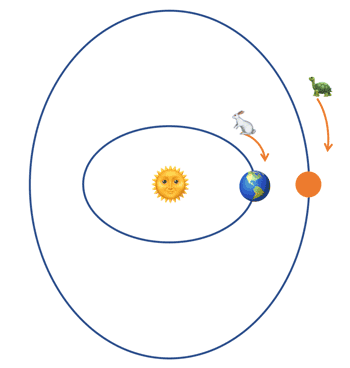
Figure 3: Why Mars looks so large right now: (i) Earth catches up to slower-orbiting Mars; (ii) Earth is at a far point from the sun in its orbit; (iii) Mars is at a near point. Orbits are shown as exaggeratedly elliptical. Sun, planets, rabbit, and turtle are not to scale. (Drawing by Marc Vilain) CLICK IMAGE TO ENLARGE
If not, we will have to put our Mars observation notebooks away for another 17 years, because the next time Mars will appear this large in the sky will be in 2035. Indeed, what makes Mars appear so large right now are several factors conspiring together (see the orbital figure). First is the fact that Earth has just caught up to Mars in their respective orbits: Mars completes an orbit every 688 Earth days, so Earth ends up lapping Mars in their orbital race every not-quite two years. In addition, when Earth catches up to Mars, it periodically does so at around the same time as Earth is farthest from the sun and Mars is nearest to the sun (both planets have elliptical orbits with a near point and a far point). When all these factors happen at once, Mars is brought especially close to Earth, and hence looms so large in the night sky. This convergence of factors happens in alternation every 15 or 17 years—2018 happens to be one such year.
Fellow sky walkers, may Mars clear itself of dust and continue to beckon your pointing finger through the remainder of these warm summer days.
Marc Vilain tries to touch Mars from the roads and fields of Harvard.