
Try to remember the kind of September
When you were a young and callow fellow.
Try to remember and if you remember
Then follow (follow) follow (follow).
With this lyrical invitation from the nine-member ensemble, the audience followed the storytellers through comic and poignant tales of “Coming of Age: True Stories of Love, Loss, and Learning.” The June 9 event, sponsored by the Harvard Cultural Collaborative, was produced and directed by Bob Eiland who, among other things, is known for his 10 years of producing highly entertaining radio theater through Harvard Friends of the Arts at the public library. Eiland said he wanted to bring a new kind of storytelling experience to Harvard, one that emphasized performance values as it captured universal human experiences through highly personal stories.
All of the storytellers were excellent, and they provided interesting variations based on their ages. They were all experienced performers whom Eiland knows through local theater or playwrights group. Though they presented individually, they interacted with one another at certain points in the evening. The evening was a combination of “more conventional storytelling and what you might call personal monologues, which were written, directed, and rehearsed,” said Eiland.
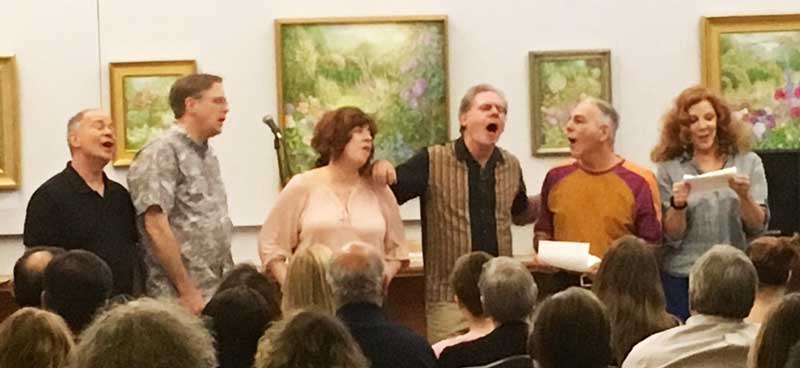
Members of the June 9 storytelling event at Harvard Cultural Collaborative open the evening with “Try to Remember” from “The Fantastiks,” against a background of Suzan Osborn’s paintings of Monet’s garden. From left: Richard Ballon, Tim Clark, Lynda Vernalia, Jerry Bisantz, Bob Eiland, and Joanna Rush. (Courtesy photo)
Many of the deliveries were punctuated by different voices and lots of physicality. Lynda Vernalia, who has appeared in most of Eiland’s radio theater productions, imitated two girls spreading a nasty rumor about her behind her 12-year-old back, and Jennifer Ehlert mimicked her own mean girls in her tale of puberty, popularity, and periods. She described the frustrating construction of a tampon as the “invention of a man who never had to test his own product.” In reliving his humiliation during a Q & A session following a sex-education film for fathers and sons, Eiland became his father as he said in a booming voice to the principal, “Would you please make sure these young men know the importance of wearing an athletic supporter?”
One of the most poignant tales of the evening was Richard Ballon’s “His Name Was Doug.” Ballon’s words and movements were lyrical as he described the young teenagers’ wrestling moves turned to embraces as the relationship developed. Forty years later, said Ballon, they made contact and “we opened the books of our lives,” only to part again.
The poetry of Dan Bacon, recited both before and after intermission, was a decided change of pace. Bacon’s style is a lot like rap in both rhyme and rhythm—but the words are intelligible and the language G-rated. Bacon believes a poem can “speak” to everyone, because “we are very much more the same than we are different.” One poem was particularly moving: “Sad, Sad Woman” told of the relentless cycle of alcohol, despair, and loneliness.
“Courageous” and “generous” are words that come to mind for these men and women who told their personal stories to a roomful of mostly strangers. Joanna Rush began, “The first time I was raped, I was 17,” and she went on to tell how she struggled to overcome feelings of guilt for her own sensuality. At times the audience could feel that even though an event took place decades ago, the speaker’s emotions were still raw. If it was cathartic for them to tell their stories, it was cathartic for the audience to hear them. People could identify with the losses, the insecurities, the self-loathing, the fears, and the confusions of growing up, and they could feel the bonds of our common humanity.
Tim Clark, familiar to Harvard residents, recounted a parent’s bearing witness to a child’s inevitable loss of innocence. He and his wife had encouraged the imagination of their older daughter and supported her belief in the tooth fairy, Astrid. The moment when his daughter learned the truth, “a little flicker of light left the room.” Alissa Luckey planned an elaborate scheme to lose her virginity to a summer crush at theater camp but called it off at the last minute. In Boston during the ’70s, Jerry Bisantz suffered humiliation at the hands of an acting teacher, but he was vindicated by his own assertion of self-confidence.
The ensemble ended the evening by singing—under the direction of Jerry Bisantz—“In My Life,” written by John Lennon and Paul McCartney.
There are places I’ll remember
All my life though some have changed
Some forever not for better
Some have gone and some remain.
Given that the goal of storytelling is to celebrate our shared culture and to find universal feelings expressed in ways to which people can relate, the evening was a huge success. Eiland said numerous people came up afterward to the storytellers, including him, and made comments such as, “That made me remember the time …” and “I could so relate to that!”