“This position used everything I ever learned in psychology; I never knew what the day would bring,” said Harvard resident Dr. Susan Downing about the Bromfield School psychologist position from which she is retiring after nine years. In an interview, she talked about her career path and the mental health issues she sees at Bromfield and the steps the school is taking to address them.
Downing’s “end of career” position at Bromfield has been quite different from her previous jobs. Much of her time had been spent in hospitals, including Gaebler Children’s Center in Waltham, a state psychiatric hospital for children and adolescents. She worked at UMass Medical Center, where she had a joint appointment in the departments of pediatrics and psychiatry. She then went into private practice, and at the same time, she volunteered her expertise at Bromfield. One of the things she liked best throughout her career was neuropsychological assessment.
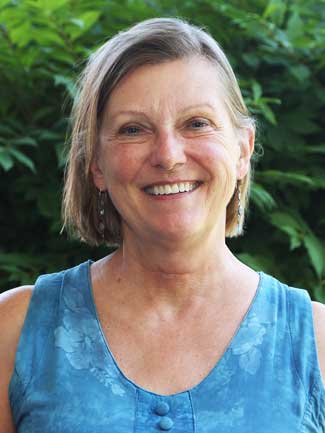
Susan Downing. (Photo by Lisa Aciukewicz)
When the economy tanked in 2008, Downing had to make an important decision, knowing that her private practice would be adversely affected and that she had to be making money for her retirement and college tuition for her kids. When the school psychologist position opened up at Bromfield, it seemed the perfect answer. Her work at the school was widely known and had “greased the wheel,” she said. In her years at Bromfield she has called upon her training and earlier experience, using both her psychology training and her clinical skills. While she had a regular schedule for seeing students with Individual Education Programs, Downing said her door was always open.
Low-level, persistent anxiety among the students is the most prevalent mental health issue at Bromfield, said Downing. It’s probably not new, but technology has exacerbated the problem, she added. Information is constant and immediate and contributes to the feeling that it’s impossible to keep up. Downing said the economy feels more competitive than in the past, and the worry about getting a job hits kids at an earlier age than it used to. Colleges have an increasingly high bar and kids feel they have to accomplish so much if they want to get into “a good school.” But, said Downing, they feel as though it’s never enough, that they’re never doing enough.
Although there are many advantages to a small high school, one of the downsides to everyone knowing one another is that the college acceptance anxiety filters down to the underclassmen. Downing said they see seniors who are really smart and in every club possible not get accepted at their top choices, and they worry that means there is no way they themselves have a chance.
No phones
The school has taken different steps to try to alleviate students’ anxiety and to equip them with healthy habits during stressful times. Downing said this year the school “outlawed” phones in classrooms, and it has made “a nice difference.” In the past, if someone goofed up in a class, a classmate would most likely text out, and the whole school would soon know. The no-phones rule has eased the anxiety of everyone knowing about a misstep, Downing said.
Since much of anxiety comes from uncertainty about the unknown, the school has strategies for helping to prepare kids for what’s coming up. On Your Own is a class for seniors where students learn about checking accounts, budgeting, resources in a crisis, and other practical matters that can build their confidence in handling their next step. Downing has a poster on the outside of her office door that lists tips for getting through the stress of a test. An emphasis on study skills aims to help kids sort out what’s most important. Downing urges teachers to put together the study packet for exams well ahead of time so students know what to expect and can try to study in a more focused way. And, Downing said, for exam stress, there’s always chocolate, which she has been busy handing out.
Yoga
Bromfield is working hard to insert more wellness classes and events as a balance to academics and a way of teaching kids coping strategies. Although teaching wellness is now a state mandate, the Harvard Schools vision statement underscores the schools’ commitment to it. Downing described Refresh Day, early in the spring, as a schoolwide day of no academics. Instead, baking, relaxation, crafts, meditation, and other activities were promoted. Kids could bring pets to school. The day was meant to make stress reduction accessible and to show the importance of never losing sight of the things that bring you calm and joy. “At first kids thought it was weird,” Downing said of wellness teacher Kaitlyn Russell’s yoga class, “but the next year, everybody loved yoga.” Susan Chlapowski, adjustment counselor, is another important resource for students with anxiety, Downing said.
Challenges: Juuling, absenteeism
Another concerning issue, not only at Bromfield but at Hildreth Elementary as well, is excessive absenteeism. “As a community, we value education, and yet we don’t make kids come to school? I don’t get it,” said Downing. Attendance is not a new problem, she said, but there doesn’t seem to be progress in solving it. Many kids are absent more than 10 percent of the school year. Downing said she doesn’t know if absenteeism is related to stress, parental attitude, lack of strong consequences, or what.
A new challenge is Juuling, or vaping, Downing said, which students are doing in school bathrooms. Juuling creates no odor, which makes it difficult to detect. In addition to the attraction of its being forbidden, it has a cool technology, Downing said. It’s a definite health problem because of its addictive nature, and because kids are sneaky about it, it sets up a bad dynamic between faculty and students.
Because school shootings are so horrific, “Could it happen here?” seemed a compelling, if not rhetorical, question to ask. “Mental health is an equal opportunist,” Downing said. But “a village exists here” and “our team has its finger on the pulse,” she said. The team is composed of Downing, members of the guidance department; Colleen Nigzus, school nurse; Scott Hoffman, Bromfield principal; Julie Horton, dean of students; and Robin Benoit, associate principal. They meet once a week and share names of students about whom they have concerns. Given the diversity of the team, one among them is likely to notice a change in a student’s behavior, Downing said. They conduct regular reviews and, when needed, create a plan of action.
It is the collegiality of this group, and all the other groups she works with, that Downing will miss. “It’s a lively place,” she said. She will miss being a part of kids’ lives and watching them grow. Downing listed a number of things she looks forward to doing in her retirement: gardening, kayaking, going to museums, volunteering, and reading—a stack of books awaits her. “I will do all these things,” she said.
Said Downing, “It was a demanding job but very rewarding and enjoyable because of the people I worked with.”