I haven’t lived in Harvard for a few years now, but I remember what used to be big news: the library moving from its former home to Old Bromfield; the ice storm that made half the town lose power; the liquor license granted to the General Store. I suppose that’s one of the charms of living in such a small town—the events that might be commonplace in cities can be given full attention, thanks to the relative scarcity of “bigger” news items. To live in Harvard is to have the luxury of knowing what’s going on and who’s making important decisions; the current events are happening right down the street, and the people in charge might be your neighbors.

Christopher Guest. (Courtesy photo)
That said, the current debate over rebuilding Hildreth Elementary School does feel bigger than the news stories from my time there. After all, this decision is worth millions of tax dollars, and it could literally reshape the town’s schools; it’s hard not to feel like this is one of the biggest issues to come along in a long time, even from 2,000 miles away. Which is why, rather than review a movie like “Avengers: Infinity War” (which cost as much to make as roughly 11 new Hildreth Elementary Schools), I’d like to focus this week’s column on a filmmaker whose body of work has tapped into small-town life with uncanny precision: Christopher Guest.
If you’ve never seen a Christopher Guest film, chances are you’ve seen an imitation. Guest remains the world’s most successful fictional documentarian, with movies that delve into worlds of niche obsession ranging from regional theater (“Waiting for Guffman”) to dog shows (“Best in Show”) to, most recently, sports mascots (the 2016 Netflix-exclusive “Mascots”). To put it in relative terms, there would be no “The Office” or “Parks and Recreation” without Christopher Guest and his regular ensemble of brilliant improvisational actors.

“Waiting for Guffman” and “Best in Show” are Guest’s most enduring directorial efforts, and the best places to start if you’ve never seen his movies. 1996’s “Guffman” follows a troupe of anxious thespians preparing for the biggest show of their lives, and it feels of a piece with 2006’s “For Your Consideration,” in which a group of nervous actors gets prematurely swept up in Oscar rumors. Meanwhile, 2000’s “Best in Show,” following an eclectic group of dog show entrants, sees Guest’s ensemble competing against one another for the blue ribbon, much the way characters in “Mascots” duke it out for the World Mascot Association’s coveted Gold Fluffy award.
What Guest so often gets right is perhaps best illustrated by his disdain for the word “mockumentary.” Rather than mock his characters, Guest takes them seriously, no matter how vain or silly their passions may seem; as he told the Los Angeles Times, “Mean doesn’t last.” So in “Waiting for Guffman,” when the town dentist auditions for a musical despite his extraordinary lack of talent, we can simultaneously register the absurdity of the situation and the utter sincerity with which he wants to succeed. The musical director, played by Guest himself, then remarks, “Oh, he’s good!”; in Guest’s universe, it’s truly the thought that counts.

These sorts of moments are why Guest’s films can be so refreshing, especially if, say, you live in a small town that’s about to make a big decision. No other director has so skillfully demonstrated that it’s possible to be invested in and passionate about something while still being able to step back and gain some perspective. So as Harvard decides this week on the future of HES, consider Christopher Guest. Consider the genuine humanity of the characters he’s created, and remember that everyone cares deeply about their town.
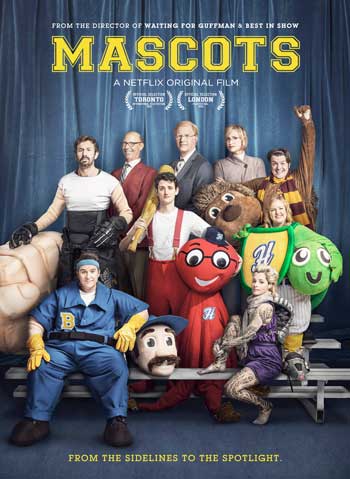
And think of “Mascots”—admittedly one of Guest’s lesser films, but one that ends in characteristically endearing fashion. Alone on his couch, a character looks into the camera and says, holding back a grin, “For me the glass is not half empty, and the glass is not half full. To me, the glass is full—it’s always full.” And then, before the credits roll, we cut to a scene in which the most foul-mouthed character in the movie, now a monk, strolls through a church talking about his vow of silence. Yes, the glass is full—and life, invariably, is funny.
Danny Eisenberg, a Bromfield graduate,
lives and works in Denver, Colorado.