Sharon Correnty, art teacher at Hildreth Elementary School, walked into school last August and completely rearranged her classroom. She moved tables, piled different materials on each, and spread books around. Starting last spring, she had been rethinking how art could be taught, and she had decided to make a “full leap” into an entirely different approach. Now, several months later, in an interview with the Press, Correnty is happy with that decision. She said she is helping kids to be creative, relaxed, and independent problem-solvers by providing opportunities for kids to find their own “visual voice” and “tap into their own creative artist.”

From left, Ayden Hill, Veneet Kuma, and Bowen Clarke work at a station called “rock, paper, scissors,” where students create objects that can float. (Courtesy photo)
Before this year, Correnty, who has taught in Harvard for 20 years, the last four at Hildreth, had given her students a strong foundation in art and art history. She had spent time discussing famous artists and taught students what to look for in a piece of art, how to talk about art, and how to critique it. Students went on “art walks” in which they would view each other’s work and comment on it. But Correnty was always a bit leary of this activity, saying she “didn’t want to be the kind of art teacher overly critical of work coming from someone’s soul.”
Toward the end of last year, looking at the accumulation of recycled “stuff” in her art room and knowing she needed to get rid of it, Correnty posed a challenge to students: Create life in a can. Each student was given a tin can to design and decorate as a place in which he or she might live. Correnty said she was delighted at how positively and creatively the students responded. She said one student’s comment during the project stayed with her. Current fifth-grader Brady Martel said, “I love the time to be creative.” At the end of the year when students shared what they had liked best, no one said Modigliani or Degas. The overwhelming response was “life in a can.”
Correnty found herself thinking more and more about that response and about Brady’s words. Last summer, when she took a continuing education course at Moore College of Art in Philadelphia, she told colleagues about how much Brady’s comment had affected her. Correnty found she was supported by a number of other teachers advocating a new approach to teaching art, one also endorsed by Massachusetts College of Art and Design in Boston. The approach is “teaching for artistic behavior,” said Correnty, and it involves having kids see that art is integrated into so many other aspects of life. “It’s really a lifestyle,” said Correnty.
An emphasis on process
The method uses a choice-based arts curriculum, where kids learn to be “open to receive all kinds of art,” and the emphasis is on the process; “kids develop a better long-term interest in art,” Correnty said. Rather than hearing about artists and their art, each kid is now the artist, creating his or her own art.
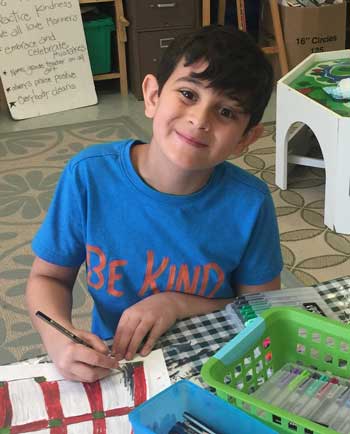
Third-grader Boden Lee-Feinberg.
With this affirmation of her own instinct for change, Correnty couldn’t wait to rearrange her classroom and set up stations, each one different in medium. Books and materials are spread out on several tables. One table is piled high with a variety of stuff; Correnty called this station a “hot mess” and likened it to a jar filled with penny candy. Tucked into a corner are a sewing machine and spinning wheel.
But beneath this assemblage of different materials is a well-planned series of opportunities. One table has a book on cartooning, where students are encouraged to create their own stick-figure character. If a student wants to continue with a character, he or she can move to the next table and sew and stuff a 3D version. Another table is the drawing station, equipped with crayons, oils, pastels, and woodless colored pencils, perfect for turning into watercolors. A weekly still-life arrangement—currently various teapots—is set up for inspiration, but students may choose their own subject. Origami and Legos provide other ways of making art, as do a book on optical illusions, a needlework center, and the materials on the “stuff” table.
Time on the rug
Correnty begins each class with a brief meeting time on the rug, where each student decides what he or she wants to work on that day. Students, who have art once a week, have a month to finish a project, which allows them to take breaks from their main focus. For kindergarten and first grade, choice is every other week, and things are a bit more structured. Correnty said she loves seeing the students so engaged in their creations. Sometimes she has to slow them down, making sure they are safe in all of their excitement to get to a station. She said she enjoys being an inspirer and facilitator rather than a lecturer. “And I’m a great scrounger,” she added.

Fifth-grader Alex Lem develops a character for his comic strip, which he will eventually animate using an application on his iPad.
Besides engaging kids in hands-on creativity, this approach counters the desire kids have for instant gratification, said Correnty. They see how long it takes to make a piece of art and that it is the process itself that is the adventure. The art room is a place to have time to create, to relax and enjoy the process. The approach also teaches patience, as students may not get their first choice of station every time. They know they will have a turn where they want to be, but they may have to wait. They also need to have good manners as Mrs. Correnty can’t answer everyone who wants her at the same time.
Correnty pointed out a couple of projects in the works. A while ago she had noticed that two of her fifth-grade boys, Ian Lebish and Tyler Proteau, sometimes brought tiny skateboards to school, and she suggested that they create a skateboard park. Using cardboard and figuring angles and heights, the boys created ramps and rails, occasionally giving up recess time to work on their creation. The park now awaits paint and graffiti art. Two girls have been finger knitting, and their work hangs up, one of white yarn, the other pink, and Correnty said she enjoys seeing them relaxed and quietly chatting as they work. A few days ago, two fifth-grade girls expressed a desire to initiate something with flowers that they could give to the Healing Garden.
‘I’m done’
At the words “Mrs. Correnty, I’m done,” she hands the student a blank “book” (one of many Correnty assembles in her “spare time”) and suggests that the student make a picture book with a particular theme. This activity introduces another kind of creative thinking.
An app on Correnty’s computer allows her to keep an online visual portfolio for every student. When a student finishes a project, he or she takes a picture with an iPad and it is then uploaded to the app. Students love taking a picture of something they created. Each portfolio can be shared only with that student and his or her parents.
Befitting the new approach, and in keeping with the introduction of “maker” spaces into schools, Correnty and her students will have a different kind of art show this year on June 4, highlighting how art intersects with STEM (science, technology, engineering, math). Called the Leonardo da Vinci Festival, it will be a workshop rather than an exhibit. Students will invite their parents to participate in a STEAM project with them that will consist of all aspects of da Vinci’s work: science, technology, engineering, art, and math.
“It’s been a very different kind of year,” said Correnty. “I wish I had more space.”