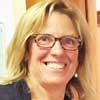
Charlotte Winchell, a Harvard resident and licensed clinical social worker, has been working as an outreach coordinator at the Council on Aging for a year and a half. She said it took her a year just to become familiar with how things work and get to know the seniors and their needs. But now she’s ready to take on new challenges. As she continues working with her clients, she wants to find even more ways to engage them and to reach those who aren’t being served. But she also wants to get younger seniors to come to Hildreth House and see all it has to offer and how they can enjoy it now and make connections that will be helpful later. Listening to Winchell, it’s clear she has the passion and the people skills to bring change. But can she convince the community that Hildreth House isn’t just, as many people perceive it, “a place for old people”?

Charlotte Winchell. (Courtesy photo)
One thing Winchell thinks would help is a new name for people who are getting older and for the place where they gather. Many people object to the word “senior” and see “senior center” as having a negative connotation. Fortunately, the name “Hildreth House” is neutral, and Winchell would like people to see it as a community gathering place, rather than a senior center. She likes the term “elder” because it conjures images of a community’s wise old leaders, like the elders of Native American culture. But, she said, people can’t seem to separate the word “elder” from “elderly.” It shouldn’t really matter, but names can influence attitudes.
Along these same lines, she wishes people wouldn’t think of the Council on Aging as synonymous with Hildreth House. The COA is part of a state agency, and it has legal and financial responsibilities. Winchell and her co-worker, Maria Holland (for whom Winchell has the highest praise), are employed by the COA. The offices of the COA are located in Hildreth House, which is convenient, but the place is different from the agency. When the town bought Hildreth House back in 1979, it had no particular purpose for it in mind. The Sixty Plus Club asked if it could use the house for social gatherings. That group took great care of the building and held many social and charitable events. Winchell said she wonders how coming to Hildreth House can be seen as “the beginning of the end” when it has potential to be seen as a place of active living.
Regulars and newcomers
Winchell would like to see people come to Hildreth House before they really need the social services the COA provides. If a younger group started coming to coffee or lunch and discussions and lectures, it would bring new energy for “the regulars” and rewards for the newcomers. Even if people have their own group of friends and are still very active, becoming familiar with Hildreth House and its offerings can add another dimension to their lives. “People could build what they want here,” said Winchell. Probably the most successful thing at Hildreth House is the weekly men’s coffee, which was started several years ago and has grown to 25 or 30 attendees. Winchell said they have a great time, and she admitted she is surprised and impressed by how committed the men are to the group.
Winchell is hoping a June program she is currently planning with a social worker from Nashoba Nursing will kick off a series of discussions that will attract a range of ages. The event will be partly social, but there will also be activities and discussions centered on the bestseller “Being Mortal” by Atul Gawande. She said it’s important to talk about mortality, and it’s less difficult to do it with a group of other people. Winchell urges people to read some or all of the book before the program. She said she’s planning for a good turnout, which means using the Hildreth House porch for space.
One program Winchell started in hopes of creating a more intergenerational community at Hildreth House is a group for adult children and their parent(s). She said Harvard has a high number of families where a parent has joined a child’s household. “It’s a wonderful thing, but it’s not without its issues,” said Winchell, and she hoped the group could talk openly about some of the joys and challenges. She said attendance has dwindled from the original 20 at the first meeting, but she thinks such a group is beneficial and she has ideas for recharging it.
Support for older clients steadfast
While much of her energy is currently focused on getting more 60-plussers to Hildreth House, Winchell’s commitment to helping her older clients is steadfast. A new outreach is to make phone calls to seniors 80 and up on their birthdays and, if they are willing, she delivers a card and stays for a short visit. She continually informs her clients of the resources available to them, from fuel assistance to referrals for different services.
One resource that Winchell said is under-utilized is the Meals on Wheels program. She said there’s a misconception that one has to be “destitute” to apply. She clarified that the program is need-based, not income-based. Older people who can’t drive or who are recovering from surgery or an illness should take advantage of the Meals on Wheels service.
Winchell’s passion for her work comes, in large part, from her personal experience taking care of her mother as she aged, including having her mother live in her home for two years. Winchell’s earlier career was in medical research at Dartmouth Medical School in Hanover, New Hampshire. She got her master’s degree in clinical social work, and she did home health care in Boston for a year. She and her family came to Harvard 14 years ago, and she was a full-time mom. She also joined the Harvard Family Association and was a member of the Parks and Recreation Commission.
Joining the sandwich generation
Winchell’s mother began to have some health issues but hated every assisted-living facility that she tried. Finally she came to live with Winchell, who said it was “a beautiful thing and also the hardest thing.” Winchell joined the sandwich generation. It was difficult to meet the needs of her son and also her mother, to “navigate all that—what a family wants vs. what an elder wants,” she said. During that time she didn’t take advantage of COA services or take her mother to events at Hildreth House. She said she sees now how useful it would have been had she done so.
It was the experience of those two years that her mother lived with her that made Winchell choose working directly with seniors when she was ready to return to a job. It was “a complete reversal” of her previous profession in medical research. She said the opening at the COA was perfect as she knew the town and she had relatable experience to bring to the job, in addition to her formal credentials.
There is abundant evidence that isolation negatively affects both physical and mental health.
“Some level of connection is essential,” Winchell said. She hopes that younger seniors will give Hildreth House a chance to show itself as a place where people can come together as a community for social interactions and stimulating activities and discussions.