

Amy Beach. (Courtesy photos)
The upcoming Warner Free Lecture March 23 at 7:30 p.m. in Volunteers Hall will introduce the audience to a little-known 19th-century American woman composer, acclaimed in her lifetime but unrecognized for decades until recently. The knowledge, expertise, and advocacy of the three women presenting the program—Liane Curtis, who has a Ph.D. in musicology, violinist Carol Cubberley, and pianist Sandy Lin—make them the perfect ones to talk about composer Amy Beach, play two of her compositions, and convince the audience “Why Amy Beach Matters.”
Among other positions, Curtis is president of the Women’s Philharmonic Advocacy, a nonprofit that encourages orchestras to program more music by women. Cubberley, while attending Boston Conservatory, became interested in uncovering music written by women. She was the first student to program music only by women for her master’s recital. Lin holds master’s degrees from the Manhattan School of Music and the Royal Academy of Music in London. Both musicians perform and teach in the Boston area.

Liane Curtis, musicologist.
Asked if she was also a musician, Curtis replied in an email to the Press, “Yes! I studied cello for many years, and am happy to have performed music by Beach and other amazing women. But as an amateur, not anywhere near the level you will hear from Carol Cubberley and Sandy Lin.”
Curtis will talk about Beach’s life and musical legacy and its relevance today. With Cubberley and Lin to perform them, Curtis will give special attention to two of Beach’s works. Curtis said the first work, Romance, Op. 23, was composed for Maud Powell, who she described as “one of the first female superstars of the violin.” Powell and Beach performed it together at the World’s Columbian Exposition in 1893, marking Beach’s ascent to a nationally recognized composer. The second piece is a movement of Beach’s Violin Sonata, Op. 34, which introduced international audiences to Beach’s music.
Amy Beach, a pianist and composer, was born in New Hampshire in 1867 and died in New York City in 1944. She was the first successful American female composer of large-scale “art music,” or Western classical, and came to be known as one of the most respected and acclaimed American composers of her era. But it was an uphill battle in a man’s world, and, although successful in her lifetime, Beach’s work ceased to be played by major orchestras after her death.
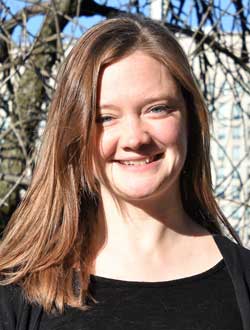
Carol Cubberley, violinist.
Curtis said that a number of factors had contributed to the rediscovery of Beach starting in the 1970s. One was “the rise of interest in women’s history as part of second-wave feminism, and the realization that women’s achievements had been erased and minimized throughout the past. Also the U.S. bicentennial year sparked interest in American music. But especially, certain individuals really worked hard to champion Beach—Virginia Eskin was one; she did several early and influential recordings, for instance in 1982 she recorded the Romance with Joseph Silverstein (who was concertmaster at the BSO).”
Curtis said nothing about her own role in the rediscovery of Beach, but a 2017 New York Times article said of her, “As the president of Women’s Philharmonic Advocacy, dedicated to supporting women in classical music, Ms. Curtis has helped organize several Beach commemorations for her anniversary season, including a coming academic conference at the University of New Hampshire as well as the website amybeach.org. Women’s Philharmonic Advocacy is also issuing new versions of Beach’s scores, including the first edition of her career-making ‘Gaelic’ Symphony since it was originally published in 1897,” the first symphony composed and published by an American woman.
In her email, Curtis said about Beach, “Her determination and resolve to teach herself composition is truly remarkable. While she had a great and remarkable natural talent, including both perfect pitch and an incredible memory, she had to plan her own course of study and follow it, with little outside help and guidance.” When the family moved to Chelsea, Beach’s mother allowed her daughter to continue with formal training on the piano, but she could take only one brief course in harmony. After that, according to Curtis, her parents consulted Wilhelm Gericke, the newly appointed conductor of the Boston Symphony Orchestra, about the next step in Beach’s course of study in composition. His advice—which they followed—was that she teach herself by studying the works of the great masters. “We cannot imagine such dismissive advice being given to a male student,” remarked Curtis.

Sandy Lin, pianist.
“Fortunately, she was amazingly disciplined and methodical at her rigorous course of self-study,” Curtis continued. Her husband, a Boston surgeon 24 years her senior, whom she married when she was 18, placed numerous restrictions on his wife, one being that she always go by his name, Mrs. H.H.A. Beach; he did, however, encourage her to continue to compose. “She was always full of resolve and optimism. She persisted!” said Curtis.
In 1910 her husband and then her mother died; her father had passed away earlier. Beach spent four years in Europe where she took back her name “Amy” and resumed her piano career. Her success in Europe enhanced her reputation in America, but by 1921 her music was no longer in fashion.
Beach became a music educator and helped many young musicians further their careers, but her own music fell into obscurity. There it would have remained, were it not for women like Curtis, Cubberley, and Lin, who are working to bring Beach’s work back “on stage” where it belongs.