As Harvard’s town clock struck 10 a.m. Wednesday, March 14, students streamed out Bromfield’s main door, joining a nationwide school walkout to remember recent school-shooting victims and to call for state and national laws to address gun violence. The walkout lasted 17 minutes, one minute for each of the 17 people killed in the Feb. 14 shooting at the Marjory Stoneman Douglas High School in Parkland, Florida.
Quite a few Bromfield students carried hand-lettered signs: “Parkland—How far will it go? Stop gun violence.” “Never again.” “Books, not guns.”
Well over half the students in school that day joined the walkout—perhaps 450 in all, according to Police Chief Ed Denmark, who was at the school throughout the event. Bromfield students from all grades took part, except for ninth-graders, who were on their class trip to Washington, D.C.
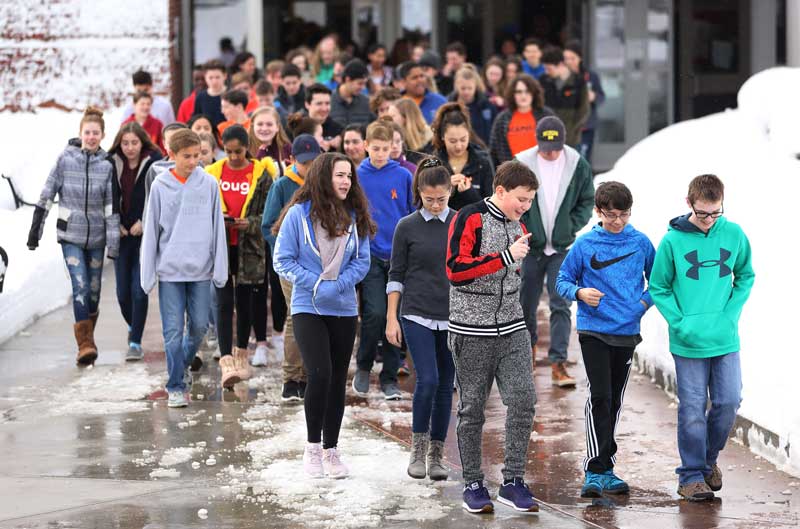
A steady stream of students heads out of the Bromfield School Wednesday, March 14, at 10 a.m. during the National School Walkout, a 17-minute student-led demonstration at schools across the country. (Photos by Lisa Aciukewicz)
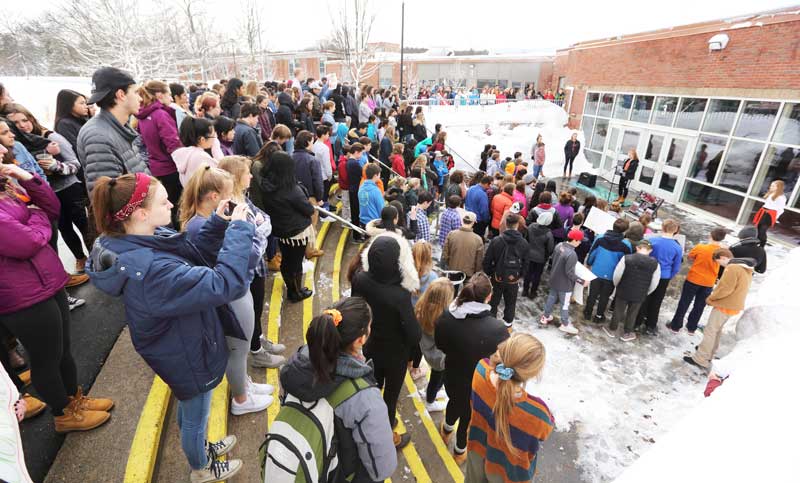
Hundreds of Bromfield students take part in the protest against gun violence.
In a letter to parents shortly before the planned demonstration, Bromfield Principal Scott Hoffman wrote, “Students should not feel pressured to participate in this student-led walkout, nor should they worry about punishment if they do.” Students who chose not to walk out stayed in their classrooms, and teachers remained in their rooms as well, unless their entire class had joined the protest.
Originally, walkout organizers expected participants to gather on the athletic field near the Bromfield rock, but Tuesday’s deep snow forced a change in plans. Instead students gathered in the open area outside the auditorium entry and on the curving steps around it, spilling over onto the sidewalks and driveway.
‘Enough is enough’
Sophomore Fiona Morrison opened the speeches, reading the names of those killed at Parkland and a sentence about each one. She then called for a moment of silence in their memory. Some students at the edge of the crowd seemed not to hear that request and continued to talk, but most stood in respectful silence.
Sophomores Allie Hunter and Anna Shlimak spoke next, reading a statement that began with numbers—240 school shootings since January 2014, 140 fatalities, an average of five such shootings a month*—and gradually built to a commanding cadence:
“Students should not hear gunshots in the hallway.”
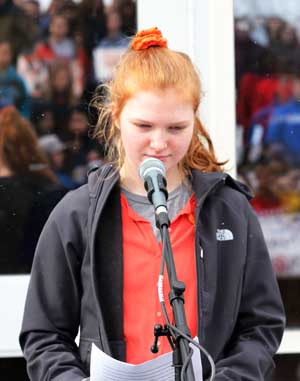
Katherine Worden, one of four speakers at the walkout.

Siena Stanten..
“Students should not hide behind their desks.”
“Students should not be texting goodbye to their loved ones.”
The two girls read their final line in unison: “Enough is enough!” It drew a burst of applause.
The next speaker, junior Katherine Worden, began with an unexpected apology. “I want to apologize to Courtlin [Arrington],” Worden said. “She was killed last week in a high school shooting in Birmingham, Alabama. As a nation, we decided that one death was not important enough. We allowed ourselves to become so desensitized to gun violence that the murder of a 17-year-old girl is swallowed up whole.” CBS News reported that Arrington was shot at her school March 7; a junior from the same school was charged in her death.
Measuring their lives in shootings
“Gen-z-ers are a generation of firsts,” Worden went on. “First to grow up with social media, first to have wireless internet and smartphones … We are also the first generation to grow up with active shooter drills and discussions of bulletproof backpacks. We are the first generation to grow up in a world where school shootings are not inconceivable.”
By this point, the crowd was listening in utter silence.
Worden followed with a grim timeline: “Some of us were newborns when 13 were killed at the Columbine High School massacre in 1999. We were in elementary school when 32 people were killed in the Virginia Tech shooting in 2007. In middle school, we watched, old enough to understand this time, as six adults and 20 6- and 7-year-olds were gruesomely murdered. Sandy Hook was supposed to be the turning point in school shootings.”
As the speakers made clear, the issue for those who joined the walkout was both personal and political. In her opening remarks, Morrison reminded students of political actions they could take, immediately or in the near future. “Students will be at lunches with letters to representatives that you can sign,” she said, “and voter preregistration. You can preregister if you are 16 and have a driver’s permit.” Some students are already 18 and eligible to vote.
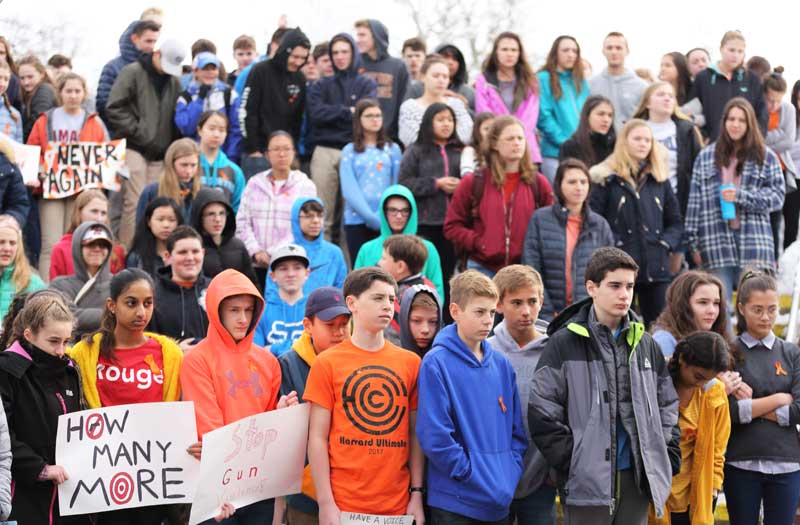
In foreground, from left: Julia Kimball, Sahara Suliman, Liam Morrison, David Wang, Tucker Madison, Jack Babcock, Sam Secor, Theo Bradley, John Wilkins, Amita Khurana, Amelia McManus, and Annie Anderson.
Worden called on lawmakers to take action—to ban bump stocks and assault rifles, raise minimum ages for gun ownership, establish universal background checks, and pass red-flag laws to keep guns away from domestic abusers. “If they ignore us,” she warned after each measure, “we will vote them out!”
Not all chose to walk out
A sizable minority of students chose not to join the walkout. Among them were juniors Jack Donaldson and Chris Hunter, both of whom were in their advanced placement chemistry class at 10 a.m. that day.
“A lot of kids just didn’t want the disruption,” Donaldson explained, noting that his chemistry class had already missed a couple of sessions for other reasons. He said his teacher made it clear that the decision to go or stay was entirely up to each student. About half the chemistry class remained inside, according to Donaldson.
Donaldson said it was unclear whether the walkout was a memorial for those who had died at Parkland or a political protest over gun laws, and the lack of clarity was part of what deterred him from participating. If he could not support the whole message, he concluded, he did not want to take part.
Hunter chose to stay in class, he said, because the protest “wouldn’t accomplish anything.” He pointed out that Massachusetts’ congressional representatives already support gun control, so there was little reason to put pressure on them, especially by students who could not yet vote. In his estimate, he said, the 17-minute walkout by thousands of students nationwide might have taken some 280,000 student hours that could have been better used for learning.
Rather than walkouts and demonstrations, Hunter said, legislators would more effectively be influenced by “protests that would incentivize action,” such as boycotts of corporations that contribute to the politicians.
Besides those who spoke at the walkout, Grace Acton, Julia Foley, Raiya Suliman, and J Woolcock also took part in organizing the protest. Some are veterans of the 2017 Women’s March, either in Washington, D.C., or in Boston. Morrison said the group used templates from the Women’s March Youth Empower online toolkit to help prepare letters to legislators. Some Bromfield students said they would also attend the March for Our Lives planned for March 24 in Washington, D.C. Another protest is scheduled for April 20, the anniversary of the school shooting at Columbine High School in Colorado. That event falls during Bromfield’s spring break.
At the end of the 17-minute walkout, the Bromfield students filed back into their classrooms. Throughout the event, Chief Denmark had kept watch in his squad car at the entrance to Bromfield’s driveway, while two other officers patrolled at the back of the school—because safety at school can no longer be taken for granted.
*These figures agree with those compiled by the Gun Violence Archive, a nonprofit group that has tracked school shootings since 2014.