They wore Mardi Gras beads and matching dark blue T-shirts with Mahatma Gandhi’s words: “The best way to find yourself is to lose yourself in the service of others.” Having just returned from their weeklong service trip to New Orleans, 17 Bromfield juniors and seniors, along with two students from North Middlesex Regional High School, could easily identify each other after school the Monday following February school-vacation week. “It definitely helped,” said Bromfield junior Nicole Lemieux, speaking of the powerful feelings that come after an intensive, group-bonding trip. “It helped to connect us after the trip.”
“We call it the NOLA blues,” said Bromfield science teacher and trip organizer Trish Nilan, referring to the shorthand for New Orleans, Louisiana. Nilan is also the faculty advisor of Bromfield Cares—the student-led service club that sponsored the trip. Co-leaders were Bromfield nurse Colleen Nigzus and Ray Kane, former service learning coordinator and educator from North Middlesex.
In a show of pride throughout the week, the students wore matching T-shirts designed by Lemieux and junior Beatrice Wig. One last shirt, a gift from Nilan, came from the host organization, United Saints Recovery Project, and featured a fleur-de-lis (a symbol of New Orleans) and a pair of wings. Said Nilan, “They earned their wings down there.”
900 service hours
If success lies in the motivation of staying connected with fellow classmates and in starting to plan for a return trip next summer—a trip already in the works, spearheaded by Lemieux and independent of school—then the nearly 900 service hours logged by students in February is its evidence.

Drew Femino screws in drywall for a ceiling.
United Saints Executive Director Chris Schottland outlined the breakout of service in an email to the group. More than 450 hours went toward helping two disadvantaged homeowners: Mr. Charles, a man in his 70s with dementia, whose bedroom ceiling had collapsed in his run-down six-room home; and Ms. Maria, whose home had to be gutted because of mold after losing its roof the previous year in a tornado. The damage was further compounded by a fire. The remainder of the students’ time went to helping seven struggling nonprofits in New Orleans, according to Schottland. (For a first-person account of the work, see “Bromfield students make a difference in New Orleans,” below.)
Reflecting on the work, Kane said, “Their commitment was impressive—these are high-powered students.”
‘Eye-opening’ experiences
All that energy may come from a sense of purpose, working together as a team, and making a real difference in the lives of the people, animals, and organizations they were helping. Kane, who has led service trips to New Orleans for 13 years, explained it best: “There is nothing more satisfying than committing really good work to people you know that will never be able to give back.” He continued, “That shows the real humanity in each one of those kids.”
Humanity was apparent at the Second Harvest food bank where the students packed 1,600 one-gallon baggies with food for elementary students to eat over the weekend—all of whom were in the free lunch program during the week. Nilan called the experience “eye-opening.” She couldn’t help noticing that each baggie contained what any one of her students might eat for a snack in one sitting.
There was also the surprise, explained Lemieux, when she and a fellow student talked with a Louisiana native who laughed when they said they were doing Hurricane Katrina repair work. After 13 years, he asked, isn’t the repair work done? Lemieux said that it “shocked us that even someone from the area still doesn’t know how much damage there is from Katrina.”

Nicole Lemieux and Missy Sturtz cut some boards.
The damage was most acutely evidenced in the 2005 Federal Emergency Management Agency report calling Katrina “the single most catastrophic natural disaster in U.S. history.” After Katrina struck in August, the U.S. Census Bureau reported that 80 percent of New Orleans was flooded after the levees failed.
The area hardest hit was the Lower 9th Ward, an area students toured. Kane explained that this ward also had one of the largest concentrations of black-owned properties in the U.S. He said that it wasn’t just the homes that were damaged by the hurricane winds and later flooding—the whole fabric of the community broke down. “It’s only because groups like ours keep coming and doing the work that these communities have a hope of coming back,” said Kane.
After working hard for a week, Bromfield senior Anthony Rosenthal and Lemieux were moved by how much volunteering had changed their lives. “It’s really amazing what service can do—not only for the people who are receiving service but for the people performing it,” said Rosenthal. “I had no idea how good it would be for me, and my classmates, to go on this trip.”
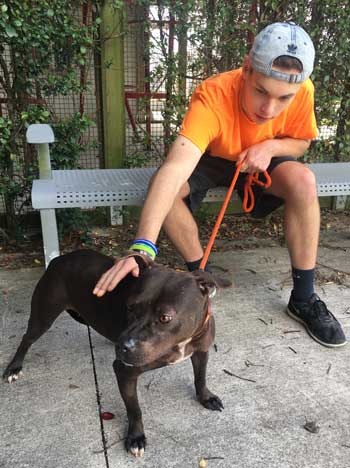
Georgie Hynes takes a shelter dog out for some fresh air.
Lemieux seconded this by saying she felt “a lot happier” doing service work. “I guess when you’re giving, you feel a lot more fulfilled to be helping someone else,” she said.
By all accounts, Lemieux surprised herself, her peers, and the teachers. “I had never before done this work or used these tools,” she said.
“Nicole just kind of took charge,” Rosenthal said. “This was very impressive considering she’s very quiet.”
Kane seconded this sentiment: “She was the girl that was out there with saws and nail guns. She did not cower from any job.” Her work using the saw to cut the molding for all the windows and door frames was not easy, noted Kane.
As for Lemieux, she summed up her experience through a favorite quote—one that is often attributed to Winston Churchill: “We make a living by what we get, but we make a life by what we give.”
Purposeful volunteering
Nilan, who has been to New Orleans six times as a chaperone on Kane’s service trips (in part because her children attended North Middlesex), considers Kane a close friend. Together they have worked on the concept of service learning, which is more than just community service. According to Kane, service learning is the integration of academics with real-life situations while doing volunteer work for others.
Kane explained that while on the job, the students were doing geometry and math and applying spatial concepts in their demolition and carpentry work. They were also learning to solve problems as a group. “In fact, a major concept of service learning is that mistakes and errors are not in fact problems; they are learning tools to help people become better,” said Kane.
Nilan, too, saw this call to action in the students. “The kids would have done anything, and anything that was asked of them, they did full force,” she said. “They were tired and dirty and sore and still smiling at the end of the day.”
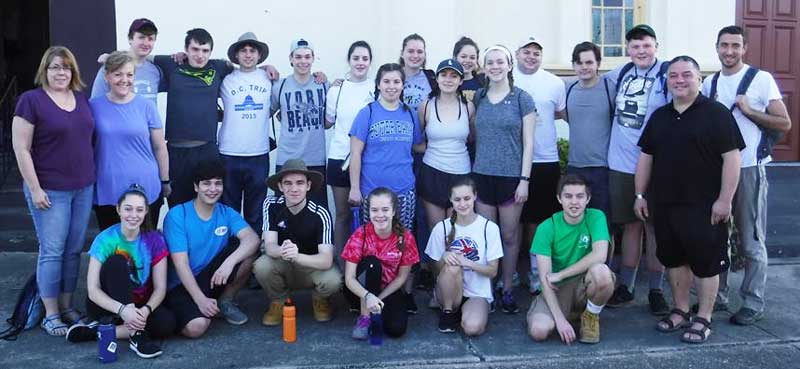
Back row: John Hawes, John Hart, Drew Femino, Georgie Hynes, Nicole Lemieux, Beatrice Wig, Madison Edmonds, Leo Farrell, Jackson Cullinan, Brady Dillis, and Chris Fletcher. Middle row: Trish Nilan, Colleen Nigzus, Chloe Cushing, Lily Shaw, Missy Sturtz, and Ray Kane. Bottom row: Sage McFarland, Anthony Rosenthal, Andrew Loveluck, India Bartram, Carley Weber, and Zach Libonate. (Courtesy photos)
Bromfield students make a difference in New Orleans
by India Bartram
On Friday afternoon, Feb. 16, 22 students, including this reporter, and chaperones loaded their bags into a school bus and headed to the airport. The final destination was New Orleans, Louisiana, for a service trip. Our mission was to work with numerous nonprofit organizations. The work would include repairing homes affected by Hurricane Katrina—the devastating 2005 storm whose effects linger 13 years later—and other natural disasters, and helping with distribution of food and taking care of animals.
The trip was led by Patricia Nilan, a science teacher and adviser to Bromfield Cares. The other 21 people on the trip consisted of 17 Bromfield juniors and seniors, two North Middlesex seniors, Bromfield nurse Colleen Nigzus, and Ray Kane, another chaperone.
Our group worked and stayed with an organization called the United Saints Recovery Project. The United Saints’ workweek started Monday, so we had two days in which to do other things. On Saturday we worked with a food bank called Second Harvest and an organization called Green Light, and on Sunday we toured the New Orleans area.
At Second Harvest, we volunteers packaged up food in plastic bags, which were delivered to local children who otherwise wouldn’t have food over the weekend. Green Light’s main mission is to replace citizens’ lightbulbs with energy efficient ones and to help install garden beds in people’s yards. Half of my group drove around New Orleans changing people’s lightbulbs. Green Light also has a garden of its own, so the rest of us helped weed and clean it up.
Sunday we explored the areas that had been most affected by the Hurricane Katrina: the Upper and Lower 9th wards. We were able to see the levee that broke during the storm and to visit the house of local legend Robert Green. Green experienced Hurricane Katrina firsthand, and he now tells his story to visiting volunteers.
Green explained how he and his family were on the roof of his house when the levee broke and the house floated away. His mother and granddaughter got caught on a tree and later died. After the storm, he lived in a trailer for many years, and that’s when he first began to talk with volunteers. His story was not only inspiring to us, but he made the point that being able to talk about the hardships he went through with people who wanted to help was a form of therapy for him.
No lack of projects
United Saints provided us with many projects to work on for the week. Before the trip, it was hard to say exactly what we were going to do because we didn’t know what United Saints was going to throw at us on any given day. At the beginning of each day, Monday through Friday, we were split up to handle the projects of that day.
One of the main projects was a New Orleans house that belonged to Maria. The house had been hit by a tornado that ripped through New Orleans a couple of years ago. Then, in the process of being repaired, her house caught fire. In order for her mother, daughter, granddaughter, and herself to live there again, we had to start by gutting the house. This meant pulling off chunks of drywall, pulling out insulation, cutting wires, taking out other fixtures, and sealing up windows. This work was in preparation for the mold remediation that would be done by other volunteers over the following couple of weeks.
The other house we worked on belonged to a man named Charles, who was living in one room for the time being, but was able to move back into his bedroom after our group was finished. The students who worked on this house measured, cut, and hung up drywall and ceilings, applied “mud” (a white, thick drywall compound) to the walls, and painted.
We also built a room at a Boys & Girls Club. The organization was in need of a teaching kitchen so children could learn skills such as cooking and cleaning. Volunteers at this site installed countertops, cabinets, sinks, and the like.
Food, clothes and animals
Later in the week, United Saints sent us out to a variety of other organizations in need of volunteers. One was Love in Action, which is both a food pantry and a thrift store. On the first day we worked there, we helped take people through the pantry and choose their food. Each of us was either with a client or at a station, making sure everything was running smoothly. On the second day, we organized clothes for their shop and quality-checked and stored incoming food deliveries.
At the two animal shelters where we volunteered, we walked dogs, cleaned cages, did laundry, and performed any other chores that needed to be done. With Arc of Greater New Orleans, our volunteers worked with mentally disabled citizens to clean up and organize beads from the previous week’s Mardi Gras festivities and recycle them.
Throughout the week we created bonds with each other and with everyone we worked with, who welcomed us into their communities. At the end of the trip, the feeling was unanimous: This was a truly unforgettable and life-changing experience. Although we were proud of our hard work, we realized there is still a ton of work to be done in so many places, and we look forward to continuing to serve in the future.
—India Bartram is a Bromfield junior.