“This is our 50th year,” beamed Deb Pierce, chairwoman of the Bromfield science department and organizer of this year’s Science Fair. Pierce has earned the right to beam. She has been running the event since 1989, taking over the directorial baton at that time from Dr. Dorothy Andrews, who first brought the program to Bromfield in 1968 and ran it for its first 20-odd years.
For five decades, several generations of Bromfield science faculty have breathed life into the Science Fair, cajoling and mentoring young scientists to bring the scientific method to bear on interesting problems, while encouraging them to present their work to the public. Chemistry teacher Kristen Vanderveen explained the process: “The biggest part is that they come to a project that’s manageable, that they can do to completion, and that interests them.”

Bromfield sixth-graders Lauren Prouty and Julia Riddle explain their experiment, “Battle of the Bottles,” to School Committee judges Mary Traphagen and SusanMary Redinger. (Photos by Lisa Aciukewicz)
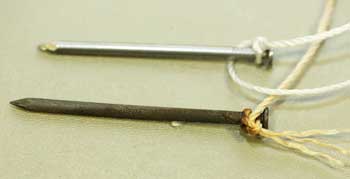
Much to the surprise of sixth-grade scientists Julia Riddle and Lauren Prouty, a nail soaked in cola (foreground) grew 65 mm as compared to an untreated nail.
That scientific interest was on display throughout the Bromfield gym Friday, March 2, with table after table of posters and demonstrations staffed by young scientists eager to explain their work. “We have 103 projects,” noted Pierce, “from grades six through 12, and covering all the scientific disciplines.”
Some of the more eye-catching presentations came from some of the youngest presenters. Sixth-graders Julia Riddle and Lauren Prouty wanted to find out what happened to metal nails when they were soaked in various kinds of soda. The students thought they could dissolve nails in soda outright, given soda’s reputation for ruining one’s teeth. What happened next was not what they expected: The nails grew larger. The explanation, they hypothesized, was that the finely pitted surfaces of the nails absorbed liquids under carbonation pressure, and thereby swelled. “It makes me kind of not want to drink soda anymore,” said Prouty.
An engineering dimension
New to the Science Fair this year was an emphasis on engineering. Pierce noted that interest in the subject has grown with the introduction of an engineering class to the Bromfield curriculum. Building on this, the Science Fair organizers added a new engineering category, which drew multiple projects that were assessed on engineering terms. Even projects in the traditional experimental and research categories showed interest in engineering. “The kids are really into it,” said Pierce.
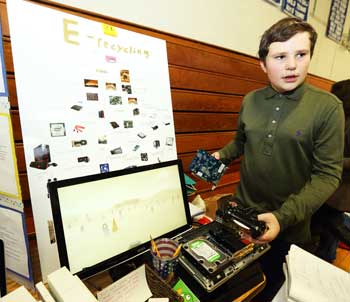
Grisha Bykhovsky and his partner Chase Donahue (not pictured) built a gaming computer entirely of recycled parts and then raffled it off.
Among those who were “into it” was seventh-grader Michael Arata, who displayed a pressurized air cannon designed to launch baseballs. Looking very much like it meant business, Arata’s project was also a classic case of purpose-built engineering. “All the wood and tubes were scraps from the basement,” said Arata. He hypothesized that flight distance would vary as a function of air pressure and exit angle, and he had the data to confirm this, with the highest pressure and highest exit angle propelling baseballs as far as 110 meters. “That’s more than a football field,” he said, while also emphasizing the safety protocol of his experiment.
“I’m not destroying anything this year,” chimed in Matt Zobbi from one booth over. Zobbi, who with his brother John, had previously set fire to things or dropped them from heights, presented an experimental demonstration of the Bernoulli principle. A consummate engineer, he did so by modeling the wacky arm-waving tube men that are ubiquitous at used car lots. He built his tube men from strips of garbage bags, varying in width and height. “They were hard to manufacture,” said Zobbi. What’s required to make them sway and wave? “External variable wind,” said Zobbi, “and that’s why you never see them inside.”
Focus on the environment
Many of Bromfield’s young scientists showed a keen interest in environmental science, with projects focusing both on the effects of human activity and on what to do about it.
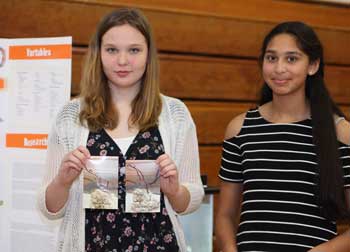
Savannah McManus and Diya Nookala studied the effects of pollution on coral.
Seventh-graders Diya Nookala and Savannah McManus were concerned with the health of coral reefs, and in particular with the effects on corals of environmental degradation and climate change. Coral reefs serve as the home of a wide array of marine creatures, so coral health is important not just to the corals. Nookala and McManus exposed aquarium coral to several factors linked to human activity—UV irradiation (related to ozone depletion), elevated temperatures (global warming), and diesel oil (from ships)—and measured the degree to which these factors bleached the coral. They expected diesel to have the most profound effect on coral health, but to their surprise, increased irradiation was actually the most deleterious, followed by elevated temperature. Diesel oil actually showed less bleaching than a control group. This was absolutely not what the oung scientists expected, but in retrospect, they realized that for the duration of their experiment, the diesel oil floated on the surface of the tank and screened the coral from damaging natural UV light. Is the Woods Hole Oceanographic Institution in our young scientists’ future? “Maybe,” they both answered.
Among forward-looking projects that aimed to remediate human impact, topics included studies of solar and wind power, water filtration, hydroponic farming, and reduced-impact building techniques. Tenth-graders Magnus Miller and Thon Khun, for instance, explored compacted dirt as an alternative to poured concrete. They layered sand with various configurations of materials such as fiberglass screens and landscaping fabric, and then measured the surprisingly high load-bearing capability of their sandwiched dirt. There are practical implications for the developing world, as only small quantities of engineered materials are required to transform common soil into a stable material. “It’s almost as strong as concrete in the vertical direction,” said Miller.
Human health
Health science was the focus of many projects, with several drawing from personal inspiration. With her little brother having a severe peanut allergy, Chloe Fitzgibbons looked at whether food allergies could be predicted by fingerprints (she found correlations, but needed more subjects to really tell). Annelise Anderson wanted to do something about her grandmother’s glaucoma-related vision loss, so she developed a prototype object recognition system (see description below).
And then there were a pair of disquieting studies. Celeste Keep wondered whether Wi-Fi radiation had any effect on living organisms. She found that a tray of garden cress grown in proximity to wireless routers developed noticeably less well than another tray grown away from the routers. Katherine Worden looked at vape fluid from e-cigarettes, and found that common household chemicals added to e-cigarettes promote antibiotic resistance in bacteria (see description below). This did not come as good news to a local health professional. “Yikes,” said Dr. Laura Silk, a physician in attendance with her children.
A physics art gallery
As the fair drew to a close, students, parents, and faculty filed out of the gym past a display of photographs, the work of students in Cynthia Fontaine’s photography class. “They took photos and wrote up the science they saw,” said Vanderveen, the chemistry teacher. Pierce would like to involve art more fully in the Science Fair, she said, starting this year with sending 15 of these photos to a national competition of physics photography sponsored by the American Association of Physics Teachers.
And so it’s not just scientists but also artists who are nurtured by the Bromfield Science Fair. The spirit of creativity, inquiry, and innovation encouraged by Pierce and the science faculty will serve these young scholars well, whatever their future careers.
Houston, we solved a problem
Seniors Anya Begue, Pilar Vallente, and Reema Abdelghany presented a mock-up of the lithium hydroxide filters that the Apollo 13 astronauts improvised to scrub carbon dioxide from the air in their hobbled spacecraft. Inspired by many viewings of the film starring Tom Hanks, they listened to actual ground control recordings of the mission and captured the detailed instructions that were given to the astronauts to adapt the filters originally intended for the shuttered command module, repurposing them for the lunar module. What especially impressed the students was that the Apollo crew could use only what components they had on board: household items like socks, tape, waste bags, and the plastic cover from their flight plan.
The vapes of wrath
Eleventh-grader Katherine Worden studied the promotion of antibiotic resistance in E. coli, as spurred on by e-cigarette fluid. Worden explained that exposure to nicotine was already known to make bacteria antibiotic-resistant. For her study, she turned to the inactive components of e-cigarette fluid: vegetable glycerin and ethylene glycol (automotive antifreeze, a toxin; its presence in an inhaled product is itself a chilling thought). She found that any concentration of either product produced resistance to antibiotics in her cultures of E. coli. “This is [potentially] bad news for vape smokers if they should get a lung infection,” said Worden. Aside from her title that deserved best in show for puns, her project won first place in the biochemistry category for her grade.
SAD in zebrafish? Really?
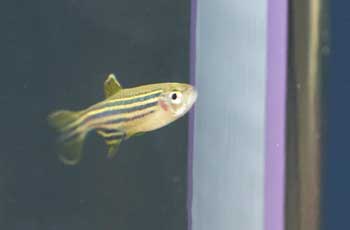
A zebra fish swims to the edge of its tank at the science fair. No word on its state of mind.
Kate Selig, an 11th-grader, studied seasonal affective disorder (SAD) in zebrafish. “Zebrafish are used as a model for human brain disorders,” she explained, “because of their similar brain chemistry.” Selig induced SAD in a population of zebrafish by keeping them in the dark for 23 hours out of the day. When they were introduced to a new and unfamiliar tank, they swam dejectedly in circles, compared to the active exploration of a control population that had received normal light exposure. The light-deprived fish showed all the signs of SAD. Good news, however: Exposure to bright light cured the zebrafish of their mood disorder, just as it does for humans. Not so lucky was a separate population of zebrafish that Selig exposed to ethyl alcohol (booze). These fish became hopelessly despondent and could not be helped. “A good part of the ethanol fish perished after the experiment,” said Selig with some remorse.
Paint-on circuits
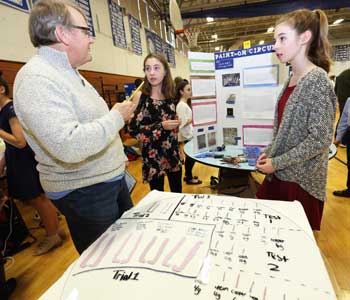
Judge Austin Franklin asks Claire Kelley and Imogen Slavin about their project “Paint-On Circuits.”
Seventh-graders Claire Kelley and Imogen Slavin wondered whether they could make electrical circuits by painting them onto a surface. They considered various kinds of metal powder, passing over highly conductive silver (pricey at $1 per gram) in favor of copper and iron (pennies per gram). They mixed various concentrations of copper and iron powder with leftover household paint suspiciously close in color to bubble gum: “It’s the color of my room,” said Kelley. The different paints were coated onto a board, and their electrical conductance was then assessed with continuity testers and a volt-ohm meter. While the painted circuits did conduct, the young scientists also discovered that the paint base was surprisingly resistive, leading to significant heat generation.
Object recognition with machine learning
Inspired by her grandmother’s failing eyesight, Annelise Anderson had a vision for how to help the visually impaired. Point a smartphone camera at some hard-to-tell object, and have the phone come back with a description of the scene. This vision sent her into the wondrous world of Amazon Web Services (AWS), a collection of cloud-based packages that includes a state-of-the-art image recognition system based on machine learning. Teaching herself the Python programming language, Anderson patched together various components of AWS, enabling her to upload a photo to the cloud and have it scanned by the image recognition software. The results were sent back to the phone by text message. Although this may look to the novice like an artificially sentient machine, Anderson insisted, “This is not AI, it’s machine learning,” the underlying technology that powers image recognition. Displaying impressive poise as she rattled off technical terms like “tensorflow” (a machine learning method), Anderson summarized much of what she learned in this effort: “a lot of Python!”
As in previous science fairs, this reporter regrets not being able to describe all the other wonderful projects that were as deserving of notice as those mentioned here.