
Science fiction has afflicted us with countless yarns of alien invasions. These otherworldly enemies are often no more than thinly veiled proxies for the political enemies of the day, and with political conflict being what it is, this leads inevitably to narratives of Earthlings’ cheeky and courageous military solutions.
How refreshing then for 2016’s extraordinary film “Arrival” to turn this tired trope on its head. When the alien heptapods arrive, linguist Louise Banks is enlisted to decipher their language, and instead of testosterone-fueled warfare, the arc of this tale is driven by linguistic curiosity and female empathy. As Banks comes to learn the heptapod language, her worldview undergoes a tectonic shift, and indeed so does the future of humankind.
What we have in this film, fellow sky walkers, is the Sapir-Whorf hypothesis in action.
Allow me to explain. Sapir-Whorf, in its strongest form, postulates that language precedes thought; more specifically, in order to formulate a thought, one must first have the word for what that thought denotes. While this is of course a largely untestable hypothesis (the linguistic version of the chicken or the egg), those who have learned a second language can certainly relate. There’s this “aha!” moment when a foreign word suddenly slots itself into one’s mental space, even if it does not align precisely with the concepts of our native tongue. It may not be on the same tectonic scale as with Louise Banks, but one’s worldview shifts with each such linguistic aha!
A starry night, gradually revealed
You may be wondering, what this may have to do with star clusters in Auriga. During that recent and brief respite of warmth, I went for a long night walk. It started out cloudy, but over a couple of hours, the clouds gradually parted, revealing first one, then a few, and finally all the stars of the winter sky. I was struck at the time by how little I could tell from the appearance of single stars. I could identify Capella, distinctly large and orange, but as to the rest of the stars peeking in and out—they were just twinkly things, unnamed and unknown.
It was not until enough clouds had lifted, and not until I could see enough stars in relation to one another, that my mental map of the sky had a bearing. That group of stars there: That’s Orion’s lower half. Over there, a piece of Cassiopeia. And finally, the fi rst constellation to reveal itself fully: Auriga the charioteer, with she-goat Capella resting in the crook of his arm.
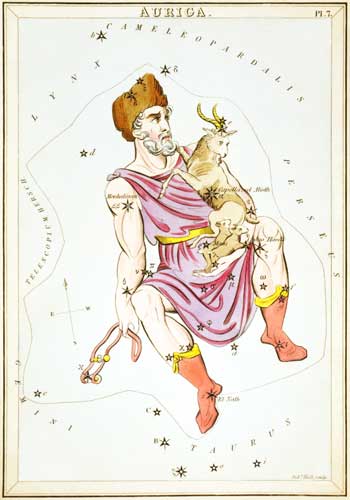
Figure 1: Auriga, as pictured in “Urania’s Mirror,” Sidney Hall, 1825.
(Drawing from Library of Congress and Wikimedia Commons)
This was my own Sapir-Whorf moment. I realized how little I actually knew of each individual star. But for those for which I had a name, for those named stars and constellations—they were like old friends that I would recognize anywhere. It was knowing the word for a star, and especially a constellation—it was knowing its name that allowed me properly to perceive it.
A stellar charioteer
How appropriate that Auriga should emerge first on that warm night, as January is one of the best months to explore this constellation, our stellar destination today. Auriga is one of the oldest named star groupings, appearing in Ptolemy’s second-century catalog of the heavens. The word “auriga” is merely Latin for “charioteer,” though the constellation is sometimes associated with mythical Myrtilus, who found his place in heaven after suffering especially bad luck in love. The charioteer is often shown carrying a goat, as in the 19th-century illustration in Figure 1.
Figure 2 shows Auriga as a modern-day star map, with nearby constellations drawn to help you locate him. He is positioned more or less at one point of an equilateral triangle, with Orion and the V of Taurus at the other points. I visualize the she-goat with her head as Capella, and the body extending out to star Epsilon Aurigae. Her two hind legs dangle below (stars Xi and Eta Aurigae). Not all star maps draw Auriga this way. Often star Delta Aurigae is drawn as the top of the charioteer’s head (dashed lines), and because the star forming the lower left of Auriga is also shared by constellation Taurus (it is technically Beta Tauri), some star charts leave out the lower two stars altogether.

Figure 2: Auriga, shown with neighboring constellations. (Drawing by Marc Vilain)
I will note in passing that the Greek-letter names of these stars are completely unmemorable to me. In the absence of a name, I can never identify these stars in the sky as much more than “twinkling,” which I believe has something to say about Sapir-Whorf.
Beyond the constellation itself, several small star groupings shimmer at the edge of perception in and around Auriga. A binocular view is especially rewarding, as there seems to be no end to these little filigrees of stars. In dark skies, binoculars will also reveal three hidden gems not visible to the naked eye: open star clusters M37, M36, and M38, which lie out of numerical order in a nearly straight line. These look for all the world like someone had smudged the sky with a stellar Q-tip. If you have access to a telescope, such as the library’s StarBlast, the smudges will resolve to open clusters of several dozen stars. The hardest to spot is actually the largest, M38. Because the light from M38 is spread over a larger area, the Q-tip smudge appears noticeably dimmer. I find the line of stars marked with an arrow in Figure 2 helpful for locating the clusters and especially for distinguishing M36 (left of line) and M38 (right of line).
Fellow sky walkers, I wish you not-too-cold nights in the weeks ahead. If it’s cloudy, I urge you to watch “Arrival”; the library owns a copy, or it can be streamed through Amazon Prime. But on clear nights, may you linger long under the stars, learn your way around a new portion of the sky, and find your worldview changed, even just a little, by the language of the stars. To those who listen, the stars speak to us in poetry.
Marc Vilain walks the roads and fields of Harvard at night, with his head in the stars. He is a linguist in his day gig.