The recent bout of subfreezing weather can harm animals as well as humans—both our household pets and our domesticated animals that live mostly outside. And it’s not just the cold; the ice, salt, and lack of visibility for people on the roads are dangerous for cats and dogs. Narrowed roads and ice also pose risks for horses and their riders.
Dr. Pamela Koretsky, owner of Harvard Veterinary Clinic, suggests that we look after our pets as we would an eager, energetic 2-year-old, by setting limits, providing extra layers, and using common sense. She also recommends keeping indoor and outdoor cats alike inside in the frigid weather.
Because even long-coated dogs get cold, Koretsky advises using sweaters, coats, and booties to protect from the cold and road salt. Especially at risk in the cold are short-hairs, older dogs, and even puppies, all of which are likely to have trouble regulating their body temperatures. Also, according to Koretsky, on-leash walks in the severe cold weather should be limited to just after a dog’s business is done. If a dog is shivering in the cold, she says, then the dog is probably chilled. Koretsky cautions that if a dog has been bathed, it should not go outside until it is fully dry, which may take more than 10 hours.
Remember to fill the humidifier
Koretsky explains that a humidifier is even more important for dogs than for humans, because a dog’s natural cooling system is to pant, which leads to moisture loss. Fresh water and humidity will help with hydration and keep a pet’s skin from flaking and itching.
Advice from the American Veterinary Medical Association includes removing snowballs from fur between toes and washing a pet’s paws clean of road salt after a walk; knowing your pets’ limits; using pet-friendly ice melts; cleaning up antifreeze and car coolant immediately after a spill because they are lethal to animals; and avoiding ice to keep animals from slipping or falling through.
Winter help for other animals
Other animals need extra care in cold weather, too, according to websites on stock raising. Horses, sheep, and chickens all need an adequate, unfrozen water supply. Most also need some extra food and a place to shelter from bad weather.
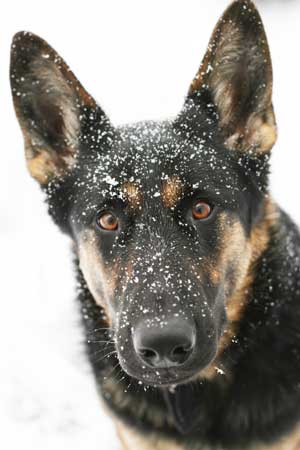
Even large dogs are at risk in cold weather—especially older dogs who may have trouble regulating their temperature.
(Photo by Lisa Aciukewicz)
Ulf Kintzel, a shepherd writing for the Cornell University Small Farms Program, reports that sheep can do fine with snow as a water source if the snow is clean and soft, but not if it is frozen. Still, they prefer an open water source, he says. “While cold temperatures generally do not bother well-fed sheep in full fleece, cold winds do,” he writes (http://smallfarms.cornell.edu/2015/01/12/considerations-for-winter-grazing-your-sheep).
Although chickens do need drinking water, don’t put the water inside the coop, says Kathy Shea Mormino, writing for Community Chickens website (www.comm
nitychickens.com/10-winter-chick en-care-mistakes-to-avoid).
Too much moisture in the air can cause mold and other unhealthy conditions, so leave the water dish in the run. And several writers agree it is a bad idea to heat a chicken coop. “Remember, chicken coops are generally pretty dusty places, and we hear stories every year from people who have lost their coops—and their flock—to chicken coop fires,” says My Pet Chicken Blog (https://blog.mypetchicken.com/2012/11/16/cold-weather-chickens-8-things-not-to-do).
Caring for horses
The University of Minnesota’s agricultural extension says that horses often prefer to remain outdoors, if they are acclimated to the cold and if their needs for warm water, extra feed, and shelter are met.
Winter hay and grain are drier than summer grass, so horses need extra water in winter to ward off colic and to make sure they take in enough feed. Both horses and ponies will drink more water if it is kept between 45 and 65 degrees Fahrenheit, according to research cited by the university extension’s website. Snow or ice does not provide enough water for domestic horses, the website says.
Horses also need extra food to maintain their body temperature in winter. The university notes that small horses and ponies may need a bigger increase above their normal amounts of feed than larger horses, because smaller bodies have more surface area in proportion to weight.
While a horse’s coat provides insulation, the horse still needs shelter in rainy or windy conditions. A little freezing rain or sleet reduces a horse’s ability to maintain its body temperature, according to the website. And horses need blankets if they may become wet, if their winter coat has been clipped, or if they were recently moved from warmer areas. (www.extension.umn.edu/agriculture/horse/care/equine-winter-care)
Even alpacas need a little extra care in the extreme cold. Co-owner Matthew Varrell of Harvard Alpaca Ranch said the “girls and youngsters” were brought into the barn on the very coldest days. “But the boys, well, they had a choice—most stayed outside,” said Varrell.