Harvard’s music booster organization, Fanfare, under the presidency of Bolton Road resident Tim Clark, has launched a capital campaign, the major part of which is to replace the Bromfield music department’s current Steinway piano with a larger, higher quality instrument. The plan had been to restore the town’s 1931 Steinway M baby grand piano, which would provide an upgrade for the school and at the same time preserve an important part of the town’s cultural history. Last week another piano came on the scene, a 1936 Baldwin grand piano that a resident offered to donate to the school. It, too, is in need of restoration. Fanfare wants the music department to choose which piano it would like restored for school use so the boosters can proceed with their fundraising, targeted for a specific piano at a specific price. Fanfare hopes to know the decision by the end of December, in order to complete restoration in time for spring concerts.
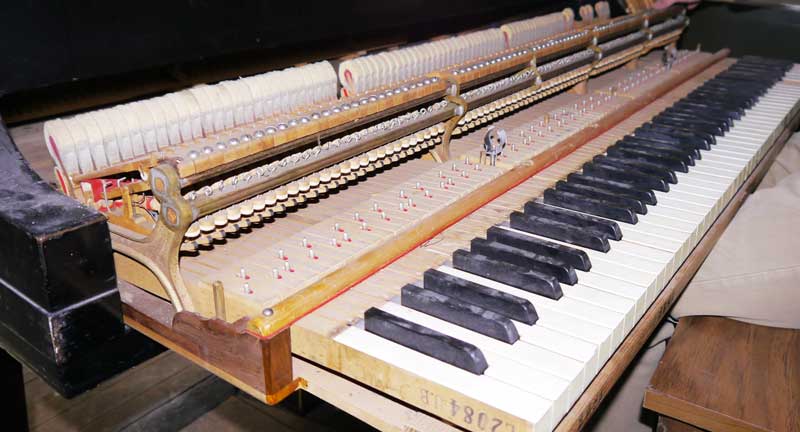
“Keys on the town’s Steinway need repair as seen in this Jan. 2013 picture. (Courtesy photo)
Records show that in February 1931 the town approved $1,000 for the purchase of a piano for upper Town Hall. The annual report shows an expenditure of $999 for the Steinway, with unexpended funds of $1. For about 50 years, the piano had a busy life being played at a variety of events at Town Hall. Ida Harris in her “Harvard History 1894 to 1940” writes about Harvard’s having “the best dancing floor for miles around,” and one can imagine the piano being played for the people who “began flocking to Harvard to dance.” Numerous shows were performed on the stage in upper Town Hall, and the piano must have provided musical accompaniment for everything from Victorian melodramas to vaudeville acts to Broadway musicals.
As time went on, the second floor of Town Hall was increasingly needed for municipal offices, and the number of social events there declined. By 1996 renovations had been made to Town Hall and offices opened on the second floor. The town piano was moved to the side of the room and surrounded by filing cabinets and boxes of town papers. There it gathered layers of dust.
Several years ago Town Hall was out of space again, and serious problems with the building itself needed to be addressed. The 2011 Town Meeting approved a complete restoration of the building. A group of residents campaigned to have the new building design include returning upper Town Hall to a performance space. Keith Turner of Littleton County Road made a video of upper Town Hall, in which people talked about the former cultural and social uses of the space and advocated for its being used again for such purposes.
Saving a historical piano
Clark was a selectman at that time and interested in the fate of the 1931 piano, for which the town had no plan. Turner’s video featured Marianna Quinn, a piano technician trained at the North Bennet Street School, the first of four assessors and conservators whose opinion on the piano Clark has solicited. According to Quinn, restoration is a great alternative to buying new, and she said that despite exterior dings and dents and one brown leg, the result of a break along the way, “there is potential for this piano to be great.” In addition to her professional evaluation, Quinn said, “It would be nice to keep the piano that’s been in town since its birth, since 1931.”

Two piano movers from Bushell Piano & Organ Movers of Framingham work on getting the piano settled into its new space in the Bromfield music room in April 2015. (Courtesy photo)
The Town Hall project moved ahead, and there was to be an auction of furniture and office accessories deemed “surplus.” Clark was alarmed that the piano was going to be in the auction, “treated no differently from a filing cabinet.” He started a fundraiser to pay to move the piano, possibly to the Center on the Common, in the old library at that time. He had collected $450 when the Center on the Common met with difficulties and its future was uncertain. Clark approached the Bromfield music department, suggesting that the town piano could replace the school’s smaller Steinway, also in need of repair. Clark contacted Superintendent Linda Dwight, who responded positively just days before the auction. The money Clark had raised was used to move the piano from Town Hall to the school, where it has sat, tucked into a corner, for more than two years.
Recently, Clark approached Fanfare, founded 25 years ago as an advocacy group for the school music program, to ask for help for the school to deal with the piano situation. Meanwhile, Rebecca Ufema, chairwoman of the unified arts department; Craig Robbins, band director; and Nik Hunt, an aide in the music department and school piano accompanist, conducted an inventory and put together a needs assessment for all the pianos at the Bromfield and Hildreth Elementary schools. Top priority was a reliable piano for Bromfield, one that is portable, to use for concerts. Other items included dollies, a padded cover, piano bench, and an amplified electric piano. In response, Fanfare launched a capital campaign for the first time in the organization’s history. Its goal is $14,000. To date, the piano fund has $7,925: $2,125 from donors responding online and to a Fanfare mailing; $3,500 in matching funds from the Karpel Family Foundation; and $2,300 in Fanfare reserves earmarked for a new piano but that have now been voted for refurbishment. Although only halfway to its overall goal, the campaign has enough now to begin restoring a piano.
Up to the schools
Clark told the Press that he had recently learned of a resident’s offer of a 7-foot Baldwin grand piano to the school. The instrument has been assessed by Tom Rourk of Concord, who has a piano shop in Lowell. Fanfare wants members of the school music department to decide which piano better suits their needs and would be the better choice for an investment, and Clark has given them some points of comparison between the Steinway and the Baldwin (see comparison below). If the Baldwin is chosen, Clark said he will have to notify donors who have already given to the Fanfare campaign to make sure they will apply their gift to a different piano from the one previously described.
Clark admitted that he has an attachment to the town piano. He sees it as “something larger,” a symbol of the town’s commitment back in 1931 to a gathering place and to the importance of music within the community. However, he said, he is trying to not let his nostalgia cloud his judgment, and he wants the school to have the best instrument for the best price.
But if the Baldwin is chosen by the music department, Clark hopes a steward will come forth to give a new life to the town’s 1931 Steinway.
Visit fanfareformusic.org for news on which piano will receive funds for restoration and to contribute to the capital campaign.
Points of comparison between
1936 Baldwin and 1931 Steinway
- Both are similar vintage (1936;1931) and similar quality of construction.
- As new instruments, the Baldwin is $70K; the Steinway M is $65K.
- In restored condition, they have similar market value ($20K).
- Both pianos need upgraded felts, hammers, wippens, and jacks.
- Both pianos will be cleaned and voiced, action regulated.
- The Baldwin needs new ivories; all are cracked and would be replaced with synthetics. The Steinway ivories are in good condition; a few chips need repair.
- The action/feel on the Baldwin should be better, especially the sharps because of slightly longer keys.
- The Baldwin is 7’; Steinway is 5’-7” (current piano is 5’-2”).
- The Baldwin case needs minor polishing at no cost; Steinway case requires repair and refinishing ($2500-3000).
- The Steinway has no cracks in the soundboard; Baldwin has some cracks in slightly flatter board, which may close up and crown if moisture is regulated (by addition of a damp chaser). Neither’s sound is compromised by these defects or age.
- As older instruments, their lifespans are unpredictable but are certainly an incredible value compared to the cost of buying new or similar refurbished pianos.
- The Baldwin is considered a “semi-concert grand”; the Steinway a “studio grand” designed for smaller spaces. The Baldwin should have a bigger voice because of its size, but it will consume more space. Both are approximately the same width.
- The Steinway has local historical significance as it was purchased by the taxpayers for $999 in 1931. despite neglect, it has remained in good condition.
- The cost to restore the Baldwin is $5,700; the Steinway $9,600.
- If the Baldwin is chosen, then there are two pianos to surplus from the school and remove from the music room. They have nominal value in their current condition.
Compiled by Tim Clark