Harvard voters can expect an unusually late 2018 Annual Town Meeting, but the delay will bring no relief to town boards and departments as they prepare budgets for fiscal 2019.
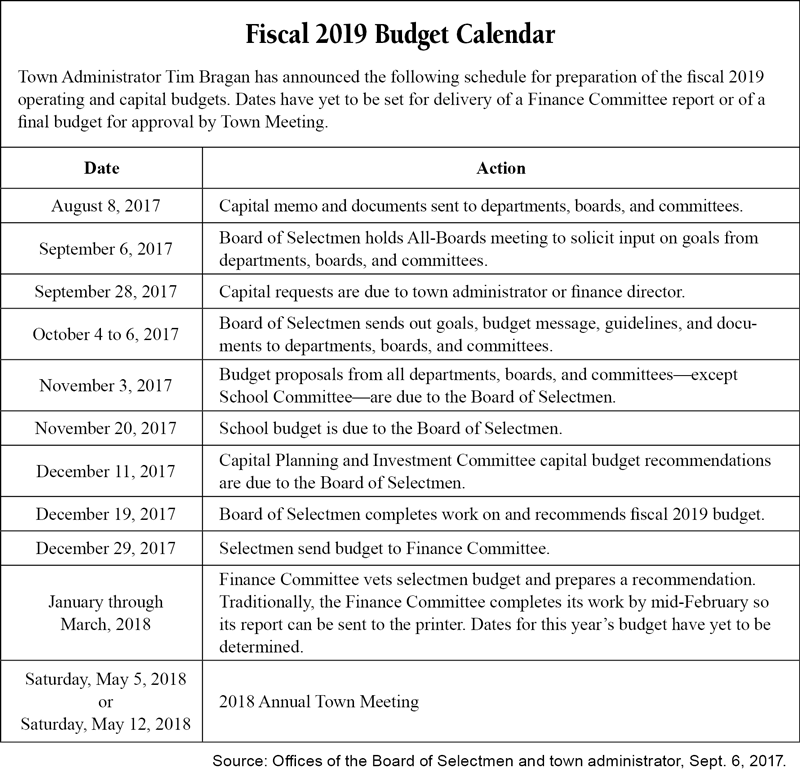
The selectmen and Town Administrator Tim Bragan say that because the state authority that approves spending for school buildings is unlikely to vote on Harvard’s budget for a new elementary school until March 2018, the next Annual Town Meeting will be delayed until early May to allow time for the cost to be reviewed. Nevertheless, the selectmen and the Finance Committee will push to complete their work by their traditional February deadline, even as they test the altered budget process outlined in August’s preliminary report of the Charter Commission (see table below).
Bragan delivered that news Wednesday, Sept. 6, to the more than 60 department heads, committee and board chairs, and other volunteers and officials who gathered that night in upper Town Hall for an all-boards meeting. The meeting typically kicks off the planning for the coming fiscal year, a process that leads to an operating budget and capital plan by February to be debated and voted upon at Annual Town Meeting.
What’s different this year, as explained by Bragan and Charter Commission Chairman Paul Cohen, is the determination to follow the budget process proposed by the draft charter, which calls for spending decisions to be driven by a vision and goals articulated by the selectmen. Under the charter, should it pass next spring in its present form, the selectmen would be responsible for creating the annual budget, a job undertaken in the past by the Finance Committee. As envisioned by the charter, the Finance Committee would vet the work of the selectmen and assure that the operating budget is financially sound. The charter would require the selectmen to complete and deliver their work to the Finance Committee by Dec. 31, leaving the committee barely two months to review the budget and prepare a final report.
The February deadline must be maintained if Harvard is to continue its tradition of a late March or early April Annual Town Meeting, Bragan said. If the charter passes, it would be better to find out now rather than later whether it will require more time and a later Annual Town Meeting date, he added.
Role of FinCom undiminished
Selectwoman Alice von Loesecke emphasized that the new process in no way would diminish the role of the Finance Committee. The role of the selectmen, she said, would be to synthesize the goals of the various town departments, boards, and committees and “to make sure they fit into a budget.” The selectmen “will depend heavily on the Finance Committee, as we always have, to do the detailed vetting and all of the analysis of the financial metrics behind the requests,” she said. “We depend on them to do that work, because that’s what they do.”
Much of the preparatory work will fall to Bragan, Finance Director David Nalchajian, and their staffs, who will collect and collate the individual department, committee, and board requests into a budget book they will present to the selectmen. Town staff will later compile the selectmen’s budget and hand it to the Finance Committee for its consideration.
Before learning the details of the fiscal 2019 budget calendar, attendees heard from commission Chairman Cohen, who explained the rationale for a new budget procedure. “We recognize that money is scarce,” he said. “There are many worthy proposals for funding in a community, [but] unfortunately [they] all … can’t be funded.” A strategic plan and vision are needed, he said, “to articulate why some things are being funded and others are not.” The charter makes that the responsibility of the selectmen. Ultimately, he said, Town Meeting will decide what gets funded.
Next steps
Following Cohen, Board of Selectmen Chairwoman Lucy Wallace directed the attention of attendees to a handout that included the fiscal 2018 goals of the board as well as the 65 action items assigned to various boards by the 2016 Harvard Master Plan. She then invited representatives of the other departments, boards, and committees at the meeting to share their own goals for the coming year. Common to many groups was a desire for better outreach and communication with residents. The goal with the biggest financial impact, however, was the School Committee’s commitment to bringing its plans for a new elementary school to fruition.
It’s now the job of the selectmen to synthesize their own goals and those articulated by other town departments, boards, and committees to produce a single document that can guide budget discussions in the coming weeks. The document and financial guidelines are due from the selectmen between Oct. 4 and 6.
Selectwoman Kara Minar had the last word, thanking the many board and committee members who attended the 90-minute meeting. “As I look around the room, I see a lot of serial volunteers … I want to thank everybody … for coming together to work on behalf of the town.” Suggestions for how the selectmen can better support and recruit volunteers, “to keep that great community spirit alive,” would be welcome, she said.