It took less than a minute last week for small pellets of hail to damage a portion of the apple crop at both Carlson and Westward orchards, as well as some of Westward’s blueberry crop. Damage from the storm on Tuesday, June 25, was largely confined to orchards south of town center.
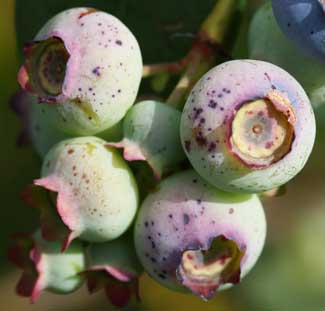
Though not widespread, some blueberries show signs of bruising from hailstones after a brief storm June 25. (Photo by Lisa Aciukewicz)
Frank Carlson said he thinks the apples in his 15 acres of orchards on Bolton Road were decimated, although he is waiting for the final verdict from the insurance adjuster. Carlson said, “We’re fortunate. Whole apple crops were totaled at orchards in Sterling, Bolton, and Northborough.” He added that the dents and cuts in the apples mean they cannot be sold as “fancy fruit” to wholesalers; instead, the apples will be sold for juice or cider. The remaining 75 acres of Carlson’s apple trees on Oak Hill Road were spared, as were the blueberries and peaches. There was some pitting on the nectarines, though, which Carlson said have a thinner skin.
At Westward Orchards, Chris Green said that some of the apples in the orchards behind the stand on Mass. Ave. were damaged, and the blueberry bushes, filled to the brim with blueberries this year, also received some damage from the short storm. The berries that were struck by the hail have small specks on their skin, and while Green said that the berries are still fine to eat, it does weaken them and can cause them to fall before they’re ripe. But the bushes are still packed with fruit, and Westward opened on July 5 for pick-your-own blueberries.
Orchard manager Susan Conant at Community Harvest orchards on Prospect Hill Road said the orchard had very little damage, and the apple crop is in good shape. Pam Lawson of Doe Orchards and Linda Hoffman of Old Frog Pond Farm told the Press they were grateful their orchards were spared, but Lawson cautiously added “so far” to her response. Green said there have already been five hailstorms this summer that caused damage at various orchards in New York and New England. “It’s one of the intricacies of farming,” he said.