Last weekend’s guided walk of war-related sites in Harvard’s town center provided a glimpse of the town during armed conflicts from the American Revolution to World War II. The walk, attended by about 30 people, was presented by the Harvard Historical Society and the War Monument Restoration Committee, and it was part of the Hidden Treasures Program sponsored by the Freedom’s Way National Heritage Association.
In the Town Center Cemetery, Historical Society President Doug Cregar spoke at the Rev. Daniel Johnson’s grave, the first stop on the tour. A Harvard graduate, Johnson became Harvard’s third minister in 1769, and Cregar said that he was known for his “magnetic personality and stirring oratory.” At the age of 30, shortly after he was appointed an Army chaplain during the Revolution, Johnson died of malignant dysentery. The town thought so highly of him that it spent 200 pounds on a monument engraved with phrases of high praise, including that he “shone with a brilliancy and luster surpassing most of his order.”
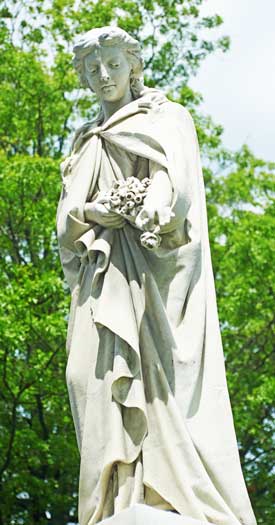
“Memory,” the Civil War monument. (File photo by Kathryn Costello)
At the Civil War memorial, Historical Society member Kari James spoke about the sculpture atop the base, named “Memory.” James explained that most Civil War monuments were erected soon after the war and featured male military figures or weapons. But although Harvard began fundraising for its memorial in 1864, it took 24 years to raise the $1,200 needed. By that time, James said, “the country’s attitude toward war had changed,” and the sculpture reflects that change, conveying sorrow and tribute instead of glorifying war. The names of the 15 Harvard men who were killed in the Civil War are engraved on the sides of the base. The names of the men and women who served are engraved on stone tablets in the Town Hall lobby.
From Powder House to World War I
Pat Jennings, a Historical Society board member, met the group at the Powder House, which sits on a small hill between the fire station and Town Hall. Jennings explained that the town used to keep its ammunition in a loft of the meetinghouse, but in 1811, with the War of 1812 on the horizon, the town passed an article to build a freestanding powder house to hold the ammunition. The cost was $87. In 2013, the Powder House was severely damaged when a truck rolled down the hill from the fire station and hit it. The structure was taken apart brick by brick and rebuilt to its original specifications using most of the original bricks. The cost to rebuild it was $20,000, paid for by the truck owner’s insurance company. Only a handful of powder houses still exist in Massachusetts.

The World War I Flag Pole Memorial is slated for repair.
(Photo by Lisa Aciukewicz)
Jennings also pointed out the “old stone pound,” referenced on the Powder House’s plaque as “Horse High, Bull Strong, and Hog Tight.” The pound, built in 1821, is the rock-walled area across the fire station driveway from the Powder House (behind the town vault building). Jennings explained that in the 1800s, farmers pastured their animals on the Common, and the pound was used to hold animals that were either unclaimed or whose ownership was in dispute, until the rightful owner could be determined.
The next stop on the tour was the World War I memorial (with the flagpole) on the southwest corner of the Common. Jon Schoenberg, chairman of the War Monument Restoration Committee, said that Harvard held a “welcome home day” on July 4, 1919, for Harvard’s World War I veterans. The following year, Annual Town Meeting voted to raise and appropriate $1,500 for a memorial, which was erected in 1921. The names of most Harvard citizens who served in that war are engraved on a plaque on the south side of the memorial, and the name of Edward Enoch Thomas, who was killed in a battle in France, is on a plaque on the north side (see story on page 7). The committee is currently planning to restore the concrete base, the two plaques, and the flagpole by Memorial Day 2018, the 100-year anniversary of the armistice between Allied forces and Germany. An additional plaque with the names of about a dozen Harvard residents who served in World War I, but who are not listed on the current plaque, will be added.
Final stop
The tour’s last stop was the monument across from the General Store honoring Harvard’s men and women who served in World War II, the Korean War, and the Vietnam War. John Lee, a member of the War Monument Restoration Committee, said that a memorial naming the Harvard men and women who served in World War II stood on the Common until the late 1970s. The memorial stand was made of wood, and when the wood deteriorated, it was taken down and replaced with the existing monument. No one knows the whereabouts of that original memorial. Lee said that the committee’s next project will be to determine whether to add names to this monument and how to honor veterans of other wars.