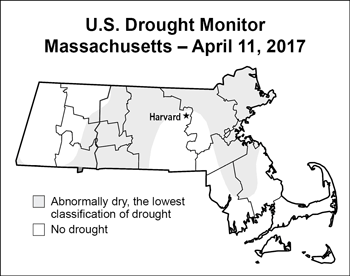
For the first time in almost a year, more than half of Massachusetts, including most of Harvard, is classified by the U.S. Drought Monitor as “no drought.” The area north of Route 2 is classified as “abnormally dry.” (Source: U.S. Drought Monitor)
For the first time in more than 18 months, the U.S. Drought Monitor in its April 6 weekly report classified the section of Harvard south of Route 2 as an area of no drought. The area north of Route 2 remained classified as abnormally dry, the Drought Monitor’s lowest drought level. But the state has yet to follow suit. On April 14, Massachusetts Energy and Environmental Affairs (EEA) Secretary Matthew Beaton announced that a state drought advisory will continue in all of central Massachusetts, including Harvard.
Beaton’s decision was based on the recommendation of the state’s Drought Management Task Force, which has been closely monitoring local conditions throughout the state. Beaton said in a press release that, even with the recent rains, “the state as a whole has not fully rebounded.” He added, “It is difficult for periods of heavy rain to absorb into the ground to impact hydrological systems, and as a result, it is still important to incorporate best water conservation practices into our daily lives to not stress water systems.” The EEA makes the following recommendations for residents who live in a region under a state drought advisory: “Outdoor watering with irrigation systems and sprinklers should be limited to no more than one day per week; and watering with a handheld hose should be limited to after 5pm or before 9 am (to avoid evaporative losses).”
Groundwater levels back to normal
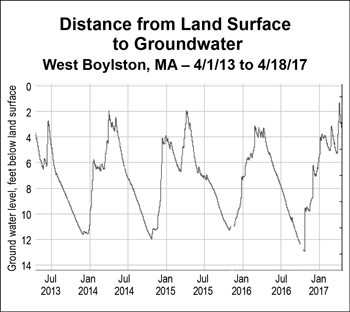
Groundwater levels at the USGS West Boylston test well typically fluctuate about 8 to 10 feet each year, from a high point in early spring to a low point in late fall. This graph shows that although the groundwater level fell slightly lower last fall than in previous years, the level has rebounded. (Source: U.S. Geological Survey, National Water Information System)
According to the U.S. Geological Survey’s National Water Information System, which monitors test wells throughout the country, the groundwater level in a test well in West Boylston has rebounded to its normal springtime level. Harvard resident and geologist Jack Guswa told the Press that groundwater levels are the best indicator of how private wells are doing, and that the water levels in Harvard’s bedrock wells should be back to where they were before the drought. “It’s not like the droughts in the western states,” said Guswa, “where more water is taken out than is ever replaced.”
But while groundwater levels have rebounded in central Massachusetts, it will take time for reservoirs to return to their normal levels. The Quabbin Reservoir is currently only about 83 percent full, according to the Massachusetts Water Resources Authority (MWRA). While that is up from 79 percent in January, levels are still well below where they should be. In the 10 years prior to the 2016 drought, the lowest Quabbin water level recorded by the MWRA was 87 percent. Guswa said that the primary contributor to the Quabbin is surface water runoff, not underground aquifers, and because of the size of the reservoir, it will take a while to replenish it.

A look at the previous five years shows that in the spring of 2016, the Drought Monitor still considered Harvard abnormally dry, setting the stage for the extreme drought of last summer and fall. (Source: U.S. Drought Monitor)
Trees not out of the woods
Another lingering effect of the drought is stressed trees. According to a fact sheet on the University of Massachusetts Amherst Extension School website, drought stresses the metabolism of trees and shrubs, making them less resistant to insects and diseases. Once the diseases or infestations take hold, it can make the plants unhealthy for years after the drought, sometimes eventually killing them.
Location is also key, according to Sean Bilodeau of Acorn Tree and Landscaping. Bilodeau said that trees rooted in difficult spots, such as ledge, are at the most risk. “They may still have some live roots trying to hang on,” he said, “but ultimately many will die, and that can take years.” But Bilodeau said that he sees a lot of trees that are heavy with buds, so he believes a lot of trees made it through the drought and will be fine.
Because the state’s drought advisory remains in effect for central Massachusetts, the Drought Management Task Force will continue to meet and track conditions in this region, and will advise the EEA if any local response is called for. Harvard Board of Health Chairwoman Sharon McCarthy told the Press that her board relies on the EEA for drought guidance, and the Board of Health continues to urge residents to conserve water. The Drought Management Task Force is scheduled to meet again in May.
So far, so good at local orchards
After last year’s loss of the entire peach crop and a smaller than usual apple crop, it looks as if Harvard’s orchards may get a break this year. No major cold snaps this spring, the easing of the drought, and last year’s small-to-nonexistent crop all contribute to what may be a bumper crop of peaches and apples.
“It’s too good to believe, after last year,” said Frank Carlson of Carlson Orchards. His peach trees are heavy with buds, and his apple trees are “very heavy” with buds. Old Frog Pond Farm owner Linda Hoffman said that her farm’s apple trees are filled with buds, the peach buds are opening, and the blueberries look good. Pam Lawson of Doe Orchards said there are “blossoms everywhere,” and although they lost a few of their youngest Christmas trees to the drought, everything else in the orchard “looks good right now.”
Carlson said orchard workers pumped a lot of water onto his trees last summer and fall, and he’s optimistic that the trees won’t suffer any lingering effects from the drought. “If they had been stressed, they wouldn’t be budding this heavy,” he reasoned. “Now we just have to get through bloom. We’ll know on June 1 how good the crop will be.”
—Joan Eliyesil