
Even seasoned New Englanders, inured as we may be to winter’s cold blasts, had the snow melt from our hearts during our unseasonably mild February. Those lucky enough to be home for a late afternoon walk were greeted by warm sunsets more appropriate to April. And best of all, as the skies deepened, there, perched above the Harvard hills was Venus: Venus, the goddess of beauty, the embodiment of love in all its aspects, from flirtatious glances to, well, much more.
How especially appropriate for Venus to have been presiding over this warm spell, I thought one February night, as I heard the first of the spring peepers calling for a mate.
This did not last. All too soon, those warm February days were but a fluke of a meteorological memory. Gone were the hapless peepers that had followed Venus’ call out of their swampy ooze. And gone too was Venus. What happened? Fellow sky walkers, today we consider why Venus has left our evening walks, and further consider her return to our pre-dawn skies.
Venus on the half-shell
According to myth, Venus the goddess was born in her full adult form, emerging from the sea on a shell. Nobody got this image better than Sandro Botticelli. Even her name, Aphrodite in Greek, testifies to her origin, as its etymology signifies “carried by sea foam.”
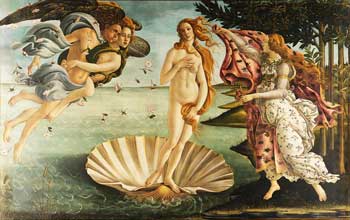
“Birth of Venus” by Sandro Botticelli. (Google Art Project/Wikimedia Commons)
To ancient Greeks, this made perfect astronomical sense. The cult of Aphrodite is historically associated with the islands of Cythera and Cyprus, both laying claim to be her birthplace. Picture Venus the planet as we see her just after sunset or just before sunrise: grazing the horizon. On a Mediterranean island, that horizon is the sea foam.
A smidge of planetary mechanics
Why then do we see Venus only just past sunset or just before sunrise? This has all to do with the respective orbits of the Earth and Venus. The outer planets (Mars, Jupiter, and beyond) have orbits beyond Earth’s, making them often visible all night long. In contrast, Venus’ orbit lies between Earth and the sun, thus limiting the opportunities when she can be seen.
Figure 1 below shows how this comes to pass. The left pane illustrates the planetary arrangement during the mid-February’s warm spell, just after sunset. Harvard is represented by the profile of the Town Hall, perched on a grossly not-to-scale Earth; the dashed line shows the portion of the sky visible above Harvard’s horizon. Back in February, Venus lingered in this visible portion of the sky, until the rotation of Earth swept our horizon line past our sister planet (second pane of Figure 1).
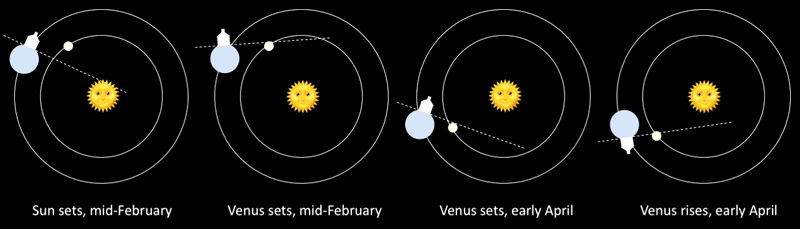
Figure 1: Earth and Venus in their orbits, shown for February and April, 2017. Orbits and planetary positions are approximately to scale; sun and planets are not. (Illustration by Marc Vilain)
The third pane of Figure 1 shows the planets in early April, as Venus sets in the late afternoon. Venus circles her orbit faster than Earth (a Venus year is 224 Earth days), and having overtaken Earth in its orbit, now sets ahead of the still-visible sun. Thus have we come to lose Venus as the evening star. The fourth pane, however, shows what happens the following morning: Since Venus now leads the sun into the sky, we observe Venus rising before dawn. The evening star has morphed into her alter ego, the morning star.
Venus on the croissant roll
The eyepiece sketch in Figure 2 below was drawn at the telescope, back in the February warm spell. This is not the moon, but Venus. Why a crescent Venus? For the same reason as we sometimes see a crescent moon.
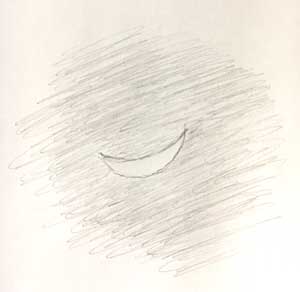
Figure 2: Eyepiece sketch of Venus, late February. (Drawing by Marc Vilain)
The face of Venus that is exposed to the sun is always fully illuminated, but the portion of the planet that we see from Earth usually includes some of her dark night side. When Venus is closest to Earth in her orbit, as she has been recently, we see much more nightside than dayside. A telescope reveals this as a crescent shape. From April on, Venus will be increasingly ahead of Earth in the planets’ race round the sun; the farther along Venus goes, the fuller she will appear in telescopic sights. Eventually, she will cross behind the sun, reemerging as the evening star, and over the months beyond that will wane from full back to crescent.
Charting the rebirth of Venus
First, however, a morning star challenge. Fellow sky walkers, I invite you to head out before dawn on clear mornings and watch Venus rise ahead of the sun. Just look due east from a clear east-facing vantage point; my favorite is the conservation land on Slough Road, between Woodchuck Hill Road and Mass. Ave. (Route 111).
I challenge you to make a project of this and go several times over the next few weeks. Keep track of Venus’ position in the sky when you observe her (hint: take a cellphone picture). If you have access to a telescope (such as the library’s StarBlast lend-a-scope), take it with you and draw an eyepiece sketch. Even a rudimentary scope will do. Do not point it at the sun!
This project starts out painlessly as wake-up times go: observing by 6 a.m. ought to do it for the beginning of April, 5:45 a.m. for mid-April, and then 5:30 a.m. and eventually 5 a.m. in May. If you need the company of others to increase your motivation to rise early, or if you don’t have access to a telescope, you’re welcome to join me. If you want an email or text notice of when I’ll be observing, send me your email address or mobile number; just look me up through Nextdoor Harvard, or find my number the old-fashioned way, in the phone book.
Fellow sky walkers, what could be better than greeting the sunrise in the company of Venus. She is, after all, the goddess of love. Who would turn down such company as we head into springtime’s amorous season?
Marc Vilain looks skyward toward Venus
from the roadways and fields of Harvard.