Communications pro seeks diverse input, civility, ‘middle ground’
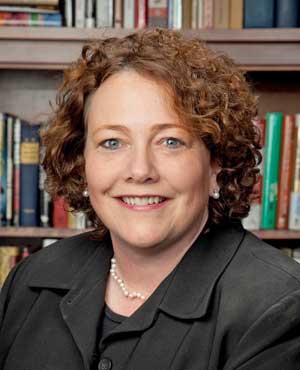
Kara Minar. (Courtesy photo)
Kara Minar, one of three candidates for the Board of Selectmen this year, has been involved in government at the national level for much of her working life. But local government is “where the rubber meets the road,” she said in an interview this week.
Minar is a Massachusetts native, born in Maynard, but before settling in Harvard, she worked in many different places. For several years she was based in Washington, D.C., first for Sen. John Kerry and later as a consultant for international clients. After getting a master’s degree in international affairs, she traveled the world as a presidential advance director for the Clinton administration in the 1990s. Subsequently, she worked for the State Department, New York University Law School, and Harvard University.
Currently Minar is a communication consultant, a job that allows her to telecommute from her home in Still River. She became an associate member of the Planning Board in 2005, just a year after moving to Harvard, and has served on that board with only a two-year break since then. “It’s a place where you can help shape a community and hopefully reflect what the community is looking for,” Minar said.
Q. How would your presence as a selectman contribute to the work of the board?
A. Years of experience on the Planning Board gives you an opportunity to listen to a lot of different concerns that are going on. … You are really in a person-to-person connection on the Planning Board, whether there’s an applicant that comes forward or neighbors that are directly concerned about something. And that experience gives you the information on what people are concerned about … and also gives you the tools to be responsive to them.
Q. What are the three most important issues that the selectmen will face during your three-year term, and what would be your priorities, including spending, for dealing with them?
A.Well, the Devens question, because it has to be decided by 2032, and you can’t make that decision or switch overnight. … And a lot of that has to do with diversifying revenues. … I’m glad the Board of Selectmen is bringing that forward as a ballot question. [A second issue is] again on the revenues, what we do for the commercial district. … Third, our housing diversity. We have a big push for seniors who need to find a way to downsize, but they want to stay in town. … We need [senior housing] options in town and also other options for people who are just starting out, for young families.
Q. What are your thoughts on the changes to town government being considered by the Charter Commission?
A. I want to see the full proposal. My first reaction would be that I understand the need to make town government as efficient as possible, but I’m a little concerned about taking direct votes away from people and investing it solely in the board [of selectmen]. … I think it’s important to stand up and say, OK here’s my vision, and the other person’s vision, and which vision do you [voters] want to support? [And on the idea of electing the whole Board of Selectmen every two years] I’m not sure that lends itself to good long-term planning.
Q. What work needs to be done to decide whether the town should resume jurisdiction for Devens?
A. We ran some of the numbers. For several years there’s a gap where the town has to pay $400,000 or $500,000 to cover the costs of Devens. But as all those tax breaks [that the state granted for business and industrial development] come off, the income rises, and it would be a net gain of a million dollars a year. … Then how much of that is used for fire, DPW, and that sort of thing? And the social and cultural impacts—how do we do a better job of integrating what has developed as two communities? … [She points out that there is no public library or Council on Aging at Devens.] In the interim period, maybe we should have MassDevelopment help defray the costs for our library and our COA, and figure out how to get seniors and others [at Devens] to use some of the resources here.
Q. What steps should be taken to develop the commercial district?
A. The Planning Board has done some work [with design guidelines] trying to create more a sense of a Main Street to slow traffic, bring the buildings closer to the road, and put the parking in back. And [we] also thought about sidewalks … so it becomes more of a community asset where people can walk. The next step might be trying to market it. … to get out to developers and say, “Look, the town would be interested in a small commercial district development that would help diversify our revenues, but in a way that is a benefit to the town.” … We’ve been fortunate that we haven’t done anything that’s catastrophic, no huge mistakes.
Q. The Board of Selectmen has been criticized for being polarized. What would you do to make it a more collaborative committee?
A. In working with the Planning Board, … we’re trying to come around to some consensus of what is best for the town and not getting into the personality aspect of it. Just having basic civility goes a long way and maybe a little bit of humor. I’m proud of the fact that I have a lot of friends coming from different viewpoints, and … I generally try to find a middle ground.
Q. What would you do to make the work of the town administrator and professional staff more transparent and accountable?
A. I’m not sure that’s much of an issue with Town Hall folks, because generally their positions get expressed in meetings. I think there are areas where more transparency is needed, particularly on boards. For instance, not all the FinCom meetings are on cable, and I think that would be helpful, because I think folks need to understand the decisions that are being made. And perhaps the same thing for CPIC [the capital committee], with the big ticket items and infrastructure.
Q. Is there anything else you would like the community to know about you that we forgot to ask?
A. One of the things that makes Harvard unique is that it really does still have a sense of community. A lot of people get engaged, whether they are volunteering at the Transfer Station or putting in new windows at Hildreth House on their own time or coaching soccer or volunteering at Parks and Rec. … I love those things. I love the turkey raffle, I love the volunteer Fire Department. I think that’s what you keep in mind when you’re trying to make decisions.