
So what’s the big deal about Key West? What’s it got that Harvard doesn’t? Recently I was fortunate enough to spend two weeks in the city that flaunts itself as the southernmost point in the continental United States, so I made some observations.
First the most obvious: the “winter” weather. Key West has never had a temperature below 41 degrees. During our two weeks, we had one rainy day. The rest were consistently sunny or partly sunny in the mid-70s. People strolled around in shorts and bathing suits—many of them couldn’t possibly own a full-length mirror. Ubiquitous sunglasses meant little eye contact with strangers, which was often a good thing since many were drunk, lost, or embarrassingly touristy. We were barely back in Harvard when we had a morning of black ice, an afternoon in the high 50s, and then a blizzard.
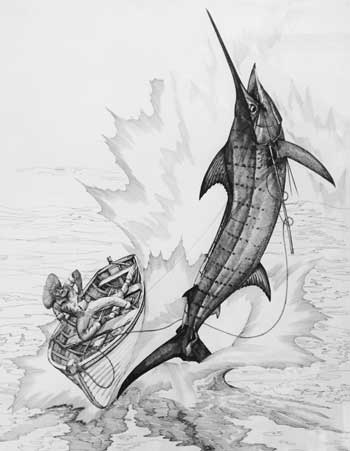
Illustration of Hemingway’s “The Old Man and the Sea” by Guy Harvey at the Customs House Museum in Key West. (Courtesy drawing)
In Key West it’s all about the sunsets. Every afternoon starting around 4:30, people migrate to Mallory Square and the harbor. It’s a circus in many senses. There are performers such as the guy who juggles flaming sticks while balancing on a teeter-totter atop the seawall. He then dons a grungy straitjacket, has volunteers wrap him in heavy chains, and proceeds to roll on the pavement to contort himself out of them all. Farther down is the mad Frenchman and his trained cats. Unbelievably, the cats do jump from place to place on command, and one even jumps through a hoop of fire. At all-too-frequent intervals, the Frenchman sweeps in front of the audience with his insane laugh AAAAAH-HA-HAAAA. Some of the people actually watch the sunset, more than half photograph it, and the rest miss it because their drink is in the way.
Green flash
We had an amazing sunset experience aboard the schooner Appledore 2. Conditions were perfect and all eyes were on the horizon. At the final instant of the sun’s setting, I heard people around me shouting joyfully, “I saw it, I saw it.” Just as I was thinking, “You’d have to be literally blind not to see it,” I heard murmurs of “the green flash.” They’d seen some superhero cross between the Green Hornet and Flash Gordon? Turns out, under optimum conditions, the atmosphere causes the sun’s light to separate into different colors, the last of which is green. One woman was almost in tears, saying she had wanted to see it all her life. I was relieved there were other bewildered people like me who had never even heard of the green flash in all their lives. Harvard has its share of sunset aficionados who view the phenomenon from Prospect Hill. Do they know about the green flash?
Bars line Duval Street, their open fronts attracting customers at any time of day. The nights are insane, as acoustical music pours forth and all manner of people with drinks in hand clog the street. It’s remindful of an outrageous 1950s fraternity party, and, from an older and more sober viewpoint, I found it a bit terrifying. Without the full acoustics, lethal tropical drinks, and totally crazy people, Pub Nights at the General pale in comparison. Sometimes paling is good.
Ernest Hemingway is everywhere in Key West. We visited the house where he lived with his second wife from 1931 to ’39. More than 50 polydactyl cats roam freely on the grounds, descendants of Hemingway’s original cat and judiciously bred to maintain their number. While we saw the studio where he wrote and the typewriter he used, I felt the presence of Hemingway less at the house where he lived and wrote than at Sloppy Joe’s, the bar where he drank during those years. There, in addition to the music, friendly bartender, and drunken camaraderie, are the old wooden skis Hemingway wore, and mounted on a wall is a huge sailfish he caught. The bar was dubbed Sloppy Joe’s at Hemingway’s urging, a vague allusion to melting ice all over the floor. One of our group accidentally knocked over a drink, and the waitress, bringing towels, smiled and said, “Happens all the time. It’s on the house, literally.”
Chickens and daiquiris
We experienced more of the author Hemingway in a special exhibit at the Customs House Museum, a Romanesque building reminding us a bit of our old library and Old Bromfield. A well-known (to none of us) artist, Guy Harvey, did 59 pen-and-ink drawings, each of which illustrates a passage from “The Old Man and the Sea.” Text and poster-size drawings lined the stairways to the third floor. The drawings were even more amazing when we learned Harvey had done them in a single year at the age of 17.
We did a group read of the only novel Hemingway set in Key West, “To Have and Have Not,” published in 1937. Over Hemingway daiquiris in a quiet resort bar, we discussed meanings of the title, the social criticism of the wealthy, the way Hemingway wove in the history of Cuba and Key West, the violence, the attitude toward women, and the flaws in the narrative structure. We were brilliant.
Chickens, brought to Key West by Cubans in the mid-1800s for food and fighting, are now protected and allowed to roam freely into bars, restaurants, and private yards. They are, of course, the subject of many a tour guide’s patter. Puns about their “cockiness” and jokes about why they cross the street never fail to get a groan from tourists. Either they always make it to the other side or chicken bodies in the street are removed immediately; Key West prides itself on cleanliness. I was unfazed by the random crowing because I hear that in my neighborhood, but their presence underfoot—or overhead—in a restaurant was a bit disconcerting.
Key lime pie was yummy, tropical plants interesting, Margaritaville mellow, cruise ships 20 stories high, outrageous. The sand at the beaches was no finer than that at Bare Hill Pond, but of course the latter doesn’t have a gulf or an ocean. So Key West has a lot of great things, but it doesn’t have one thing Harvard has—home.