
According to the old playground song, first comes love, then comes marriage. Not so for Littleton County Road residents Esa Salahuddin and his wife, Sidra. For this Pakistani-American couple, their romance was kindled right after their engagement.
As distant relatives, Sidra and Esa had met as children at a family function, though neither can now recollect the experience. The first time they remember meeting was at a mutual cousin’s wedding in 2001 when Esa’s mother pointed her out to him, saying, “Look, this is Sidra. She has grown up so much!” The two chatted politely for five minutes, neither imagining they would one day end up together.
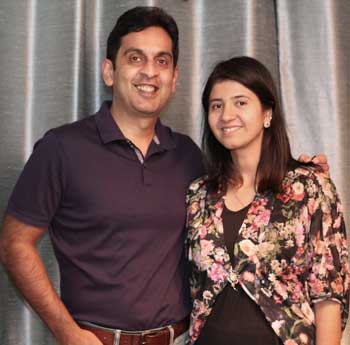
Esa Salahuddin (left) and Sidra Esa. (Courtesy photo)
A year later, Esa’s parents suggested it was time for him to settle down and get married. He recalls his mother saying, “You are living in the U.S. so far away from the family; you need company.” Esa didn’t disagree, and it was his expectation his parents would play a major role in choosing a spouse for him when the time came. “Parents have gone through this, and they will make a better choice, will find something that works,” he explained.
Esa’s family facilitated a face-to-face meeting with Sidra and her parents on the last day before he headed back to Boston, where he was working and going to school. Though it may have been one of Sidra’s most important interviews of her life, Esa’s parents did not reveal that they were considering her as a potential spouse for their son, so as to avoid insulting her if they decided the match was not a good one. “There’s a subtlety to it,” said Esa, smiling. The meeting itself was “very casual, lots of chit chat,” he said, though he admitted, “I was obviously checking her out.”
“And I had no clue,” Sidra said with a laugh. “I don’t know what I was doing, but I was not paying attention.”
After the meeting, Esa’s mother asked him what he thought. “I told her, I’m not sure,” recalled Esa. “They seemed like nice people, but I needed to think about it.” Then he boarded a plane and returned to Boston.
Two days later, exhausted with jet lag, Esa groggily answered a phone call. “Congratulations,” he heard his mother say. “You’re engaged.”
“With who?”
“With Sidra!” she answered. “You said you liked her.”
Esa balked. “I said I liked her. I did not say I wanted to marry her!”
A surprise, surreal
The new arrangement was a surprise to Sidra as well. “It was surreal,” she recalled. “My mom asked, is it OK for us to say yes to them? She told me that morning and that same day, [Esa] was already on the phone. But it fit my expectation that my parents would choose who I was to marry and decide for me.”
“For the record,” quipped Esa, “she was asked before becoming engaged with me. I was not really asked. They told me. I always thought I would have a chance to think about it and officially say yes. I’ve seen the movies; I wanted the chance to think about it. But it would have been very dishonorable to back off at that point.”
After adjusting to the news of his own engagement, Esa called Sidra to talk it over, starting what would become their habit of twice-daily phone calls, a routine that lasted for the duration of their nearly three-year engagement. The two got to know each other over the phone, and after just a few weeks, Sidra and Esa felt comfortable enough to announce their engagement to the world.
“My mother-in-law put the ring on me,” said Sidra, because Esa was still in Boston and couldn’t travel back for the official engagement ceremony.
For the next few years, the two talked on the phone regularly, exchanged letters and gifts, and managed a few in-person visits during the summers. “Many times, we paid phone bills of three, four hundred dollars,” recalled Esa. “It was 83 cents a minute and we’d talk for half an hour.” They both remembered being “lovey dovey” over the phone, though interpreting each other’s tone was more challenging over email. Sometimes they argued, sometimes they dreamed about the future. The calls helped them manage the distance between Massachusetts and Pakistan.
“The time difference was difficult,” said Sidra, because when Esa was free to call at night, her day was just starting.
“And I wanted time out of her life, and she was very busy, so that would frustrate me sometimes,” said Esa. “But over more than two years, we hardly missed a day.”
“You called me every day,” said Sidra, with emphasis, nudging Esa affectionately with her toe. “There was a lot of love there.”
Ready for a life together
When Sidra finally arrived in the U.S. to join Esa, she felt a lot of their stress melt away. The long distance had been difficult, and both were ready to start their life together in the same place. “Life was busy. We were happy with each other. It was beautiful,” Esa recalled.
Now the two have been married for 13 years and have two children. They moved to Harvard more than six years ago and have found the town to be a warm and welcoming place to raise their family, a place that shares two of their most cherished family values: respect and privacy. “Respect is how you talk to people, how you take care of them,” explained Sidra. “And knowing when to speak up for yourself. If my kids can manage privacy and respect, they will be good to go.”
Faith is another very important value for the family. “All the good we have, our faith has so much to do with that, it’s hard to separate them,” said Sidra. The couple dreams about increasing their volunteering and community contributions, and they look forward to the days when they have more time to spend with adult friends.
When asked what they enjoy most about each other, Sidra laughed as she answered, “Everything. Even the things I don’t enjoy, I enjoy, you know? I can talk to him about anything and everything, which I don’t have with anyone else. The comfort and trust that you don’t have to hide anything. There are no barriers there.”
“And we support each other, whatever it is,” added Esa. “We talk about it. We reach an agreement that everyone is happy in. Even when we disagree, we can support each other and move on. We don’t hang onto negativity. We appreciate what we do for each other.”