Sky walkers who frequent Cambridge’s Christmas Revels will recognize the following rhyme:
“Stand on head! Stand on feet! I want meat for to eat!”
With these words, the dragon of the Revels’ mummers play announces itself as it stomps onto the stage. And just to make sure audience members haven’t somehow misconstrued the significance of its reptilian snout and dragon-sized wings, the dragon goes on to assure the audience:
“I am the dragon, here are my jaws (Roar)! I am the dragon, here are my claws (Grrr)!”
Fellow sky walkers, our astronomical ramblings today bring us to a celestial dragon endowed with a fearsome head of jaws and some perhaps not so fearsome claws.
A stellar dragon
Draco, as it is named on star charts, winds its way between the Big and Little Dippers (see Figure 1). To locate Draco, find a spot with unobstructed views of the north. Once you’ve located the Dippers, search for the dragon’s head, a blocky shape to the west (left) of the Little Dipper, about as far from the bowl of the Little Dipper as the Little Dipper is from the bowl of its larger counterpart. The dragon’s body coils up from there, then back down around the Little Dipper, and it trails off in the gap between the two Dippers. Our chart shows the version of Draco as drawn by H.A. Rey (of “Curious George” fame), and features what has to be either itty-bitty claws or a pair of puny wings.
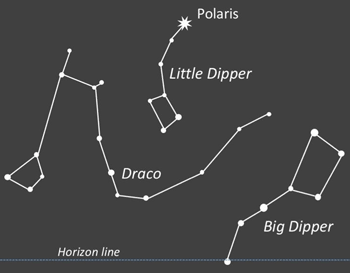
Figure 1: Draco winds its way around the Big and Little Dippers. Drawn as around 8 p.m. in late December. (Illustrations by Marc Vilain)
This is an especially good time of year to look for Draco, as the seasonal procession of the constellations places Draco roughly parallel to the horizon in the early evening hours. From this vantage point, Draco appears very much like an iconic curvy Chinese dragon, to my eyes looking like it might have just slithered off a Ming vase.
A mythological dragon
Draco the constellation belongs to Western mythology, however, and was in fact recognized in Ptolemy’s catalog of the stars. Ptolemy drew up this catalog in the second century, and dragons ever since have belonged in our mythology as emblems of what is terrifying or unknown—or both. Cartographers in the Middle Ages and beyond would mark unexplored waters or lands of the world with monstrous serpents and designate such terra incognita with the phrase “Here be dragons.”

Figure 2: Chinese constellations in the same region as Draco.
Ancient Chinese culture viewed dragons very differently: as beings of great power and omens of good fortune. It is perhaps surprising then that ancient Chinese astronomers did not recognize their own iconic dragons in this set of stars. Instead, various chunks of what we see as Draco make up parts of two celestial Great Walls, bulwarks protecting the area around the celestial north pole (see Figure 2).
A dragon for Saint George
As to the dragon that started this column, it makes its appearance in mummers plays, a British folk tradition in the same spirit as wassailing. Performing thoughout much of English-speaking Great Britain and Ireland, roving bands of mummers would set off at this time of year to perform these plays in their neighbors’ homes or, preferably, their neighborhood pubs.
When dragons appeared in these traditional plays, it was usually to be foils to Saint George, who would dispatch them in ways befitting their fearsomeness, a bow to their mythological status as emblems of what is unknown and terrifying. These were winter solstice plays, with the dragon perhaps symbolizing both the year past, hence its death, and the new year lying ahead, full of the unknown and perhaps terror.
A dragon for
Harvard mummers
My personal mythology of dragons casts them in not so terrifying a role. For the past dozen years, I have been writing topical mummers plays performed at solstice time by the adolescent parishioners of the Unitarian Universalist Church. These plays would be incomplete without the Harvard town dragon. Our dragon is a mischief maker to be sure. One year, the dragon stole the illuminated star from the town Christmas pageant. Another year, the dragon took over all the private homes of Harvard.

In this year’s mummers celebration at the Harvard Unitarian Universalist Church, Julia Clark (left) watches as Bodhi Chadran (right) tries to pump life back into the dragon (Kai Oldham) after he has been slain. (Photo by Lisa Aciukewicz)
There is method to this dragon, though, beyond just mischief. The dragon does not act in these mummers plays for caprice, but in response to what he or she (we’ve had both) perceives as an injustice of the human condition. The star was taken in protest of the profligate use of electricity that is the engine of much global warming. The homes were taken to underscore the devastation suffered by so many of our fellow citizens who lost their homes and savings in the financial crisis of 2007 and 2008.
To this extent, Harvard’s town dragon in these mummers plays isn’t the fearsome beast of myth, but a mirror reflecting back the fearsomeness of what we humans choose to do to one another, or to the world around us. The dragon therefore invites us to reflect on where we have come short in our commitments to generosity and the public good, either as a nation, as citizens, or as individuals. This year, and this should come as no surprise, the dragon turns his steely eye and scaly claws on the hate speech and bigotry that have besmirched our town.
The significance of dragon as the new year approaches
That the dragon reflects on our human condition at the turn of the new year makes him an unexpectedly Judaic figure. Reflecting on one’s failings and forgiving the failings of others is central to the high holiday of Yom Kippur, appropriately crowning the Jewish celebrations of the new year. And in these troubled days, perhaps we need a bit more of this reflective approach to the new year than simply renewing our yearly resolution to get more exercise and lose more weight.
Fellow sky walkers, as you seek out Draco in the night sky this holiday season, may I suggest you invite Harvard’s town dragon into your thoughts and into your heart. May your year ahead be not so much fearsome and unknown, as it be burning with the flame of commitment to what matters in this world.
Marc Vilain looks for peace in the stars from the roadways and fields of Harvard.