Planning Board meetings rarely draw a crowd, but word that the board might be considering a zoning change to encourage clustered housing on the Littleton Road Poor Farm land brought nearly two dozen neighbors to its Monday night meeting.
The request for the change came in a letter last week from the Municipal Affordable Housing Trust asking for special zoning that would apply uniquely to the 28 acres of land at 166 Littleton Road currently owned by the trust. The request, however, dovetails with a study begun by the Planning Board earlier this fall to substantially update the town’s existing “cluster housing” bylaw approved by Town Meeting in 2003. With next year’s Annual Town Meeting approaching rapidly, the board must now decide whether to continue its work on a bylaw change that would apply to any available agricultural or residential land in town or to focus instead on the specific needs of the Poor Farm parcel.
The affordable housing trust’s letter asks the board to create “appropriate zoning” that would allow up to 19 housing units to be built there, though it does not specify how many of those units could be part of a single building. The letter states that repeated efforts to attract a buyer for the land have failed and surmises that the only way a developer could profitably construct a mix of housing on the site at present is through use of the state’s Chapter 40B affordable housing statute. While the letter did not specify a date, trust member Ron Ricci, who attended Monday’s meeting, said the organization hoped a proposal could be brought to the 2017 town meeting.
CLICK IMAGE TO ENLARGE
The work already being done began late this summer when the Planning Board engaged the Montachusett Regional Planning Commission to review Harvard’s cluster bylaw. Commission planners have reviewed the bylaws of eight towns that have successfully completed housing projects that both increased housing diversity and preserved open space. In September, principal author Shubee Kalra delivered a first draft report, which contained a number of recommendations, including a formula for calculating how many units could be built and reducing the number of engineering studies required of a developer for such a project from two to one. Subsequent meetings between the board and Kalra have led to a draft bylaw that board members hoped would be ready for the next Annual Town Meeting’s consideration.
How many units?
Of its many provisions, however, the draft bylaw’s proposed formula for determining the maximum number of residential units that can be built has drawn the most scrutiny. Even before receiving last week’s letter from the housing trust, the board had asked the Montachusett planners to test the formula using what was known of the Poor Farm land, one of the most studied parcels in town. A number of such formulas are in use by Massachusetts towns and typically take into account such factors as the amount of developable land available after subtracting wetlands, ponds, and other nonbuildable areas and dividing that result by the smallest permitted lot size for a residential dwelling.
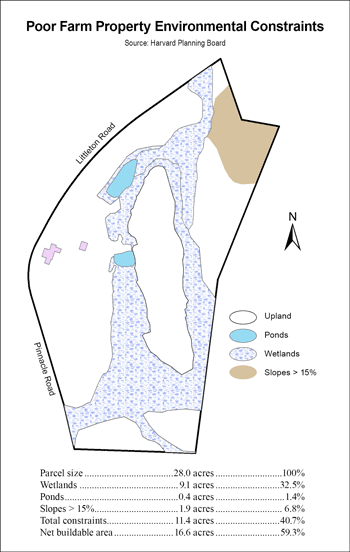
Similarly, Harvard’s draft bylaw proposes arriving at the maximum allowable units by dividing the developable area of a parcel by the minimum lot size allowed, a formula recommended by the state. Though only a portion of the Poor Farm’s 28 acres has been perked, only 16.6 acres appear to be developable (see the map above), according to data provided by Harvard planner Bill Scanlan. The draft bylaw specifies the minimum lot size for a dwelling as 1.25 acres, which means the number of units at the Poor Farm could not exceed 13 units. That’s fewer than the housing trust would like to see, but more than neighbors seem inclined to accept. Formulas used by other towns would produce different results: A formula used by Rowley would allow 16 units on the Poor Farm land, whereas the Brewster formula would allow only three.
Bylaw or overlay district?
The trust purchased the Poor Farm parcel for $1.2 million in August 2013, and working with the MetroWest Collaborative, a nonprofit community development group, proposed building 36 units in 10 to 14 buildings in a neighborhood dominated by single-family homes. Stiff opposition from Park Lane and Pinnacle Road homeowners concerned about traffic, housing density, the presence of wetlands, and potential effects on nearby wells and property values led to the project’s abandonment. The trust voted to put the property up for sale on Dec. 22, 2014, but it continues to pay a $3,300 monthly mortgage.
The Planning Board must now decide whether to continue work on a revised bylaw that could be used for clustered housing on any Harvard residentially zoned parcel, or to prepare legislation for an overlay district tailored specifically to the needs of the Poor Farm land. Planning Board Chairwoman Kara Minar said Monday that she favored the latter. Completing work on a replacement bylaw in time for Annual Town Meeting and getting buy-in from the town would be a challenge, she said. If it failed to pass, she noted, state law would require that the board wait two years before trying again. An overlay district applied to a specific parcel would be an easier sell, she said, and could serve as a test case.
But Park Lane resident Sue Hanson disagreed, saying that it would set a bad precedent. The monthly mortgage payments of $3,300 were peanuts compared to what a dense development would do to home values in her neighborhood, she said. “Consider the fact that lawsuits may follow based on any action that is irresponsible, which I feel has already happened in purchasing that property without any due diligence,” she warned.
Adam Horowitz of Woodchuck Hill Road also warned of the precedent an overlay district for a single site would set. If an overlay district were to be approved by the town, he said, he would challenge it, asking why the overlay couldn’t be applied to his own land. “The same principles must be considered for the whole town,” he said. A bylaw is a reflection of what the whole town wants, he said, “but spot zones help one organization out.”