On Sunday, July 4, 1948, the Harvard Historical Society dedicated a millstone at the top of the Common as a “Town Marker,” a monument to the founders of Harvard. It seems to have been a common practice for towns to choose a millstone as a commemorative marker of their founding, since such stones were relics from a town’s earliest days. The society’s Town Marker committee had spent several years raising funds for the project, having a bronze plaque made, and securing a location. The society had hoped to hold the dedication on its 50th anniversary, but circumstances had held up the process by a year. Even more unfortunate was the death of Walt Harris, the man who had spearheaded the project but did not live to see its culmination.
A June 29, 1948 newspaper article about the upcoming dedication of the millstone reports, “Every reason exists to believe that it is one of the original stones with which John Prescott equipped the mill he built in 1668 on the Nonacoicus Brook in what is now known as the Old Mill District, Harvard.” The article states, “It is expected Mrs. Harris, widow of the discoverer, will unveil it” directly following the ceremony in the Unitarian Church.
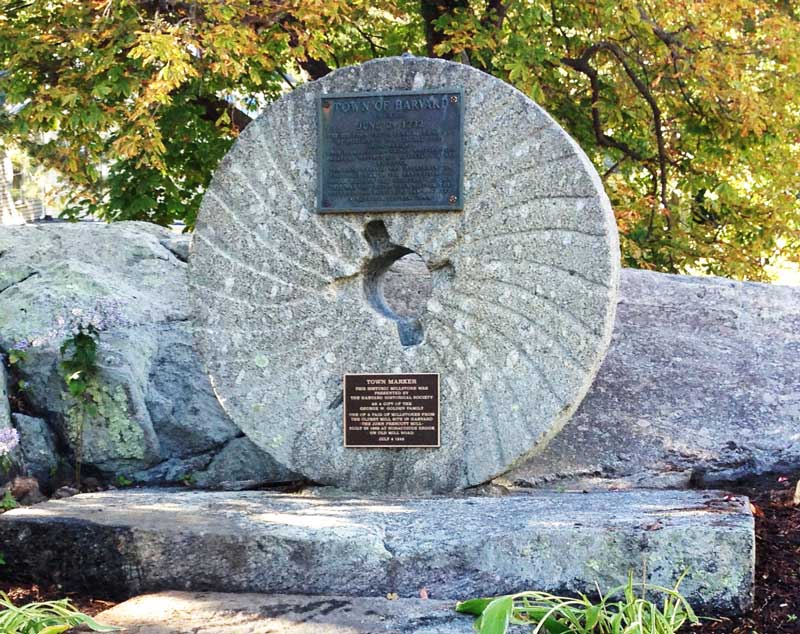
The millstone—Harvard’s Town Marker at the top of the Common—is visible once again, having been obscured for several years by an overgrown shrub, weeds, and briars. Kathy Jackson and Maryann Piasecki, co-chairwomen of the civic beautification committee of the Garden Club of Harvard, dug out the offending vegetation a few weeks ago. They debated pruning the shrub as opposed to removing it but decided to take it out and avoid the annual chore of keeping it cut back. Jackson said that historically the club has taken care of the area around the millstone, but that it had been a while since any work had been done there. Now that the stone and steps approaching it are free of overgrowth, the monument looks as it did at its dedication in 1948. Come spring, daffodils and a few perennials will enhance the site. (Courtesy photo)
According to the same news article, “In 1938 the late Walt Harris found the stone in two sections in the deserted millpond.” It goes on to say that it remained on the farm of George Golden Jr. But, in a different, undated news article Harris wrote, “An especially excellent and historically desirable millstone has been located by Ole Gabrielson.’’ Three other men went to examine it along with Harris and discussed the matter with the owner, Golden, who said generously, “You may have the millstone whenever you are ready to use it. I was going to put it in my lawn and erect a flagpole with the hole for a socket.”
Perhaps it was the same stone Harris is reputed to have found earlier, and he had pointed it out to fellow committee member Gabrielson, who presumably was some authority on millstones. Or perhaps there was another one on the same property. Harris says later that Golden also gave a “half millstone completing the approach” in memory of his mother, and perhaps that was the one Harris had found. Whichever (and such discrepancies are the joys of historical research!), Harris had known about millstones on the Golden farm and had negotiated with the owner to donate one—or one and a half—to the Historical Society for the Town Marker.
Living in wartime
With a millstone available, Harris documented the next step. The committee seems to have hesitated about moving forward because of the war and people’s responses to it, but “a vote of reassurance was passed” and the project was continued. Perhaps the group was persuaded by Harris, who wrote, “Live as naturally as possible in wartimes. Thus, in this spirit we proceed with our bronze tablet as a symbol of New England persistence and grit in all good matters, small and great!”
No organized attempt was made to raise funds “under the conditions,” but records show a list of 19 donors contributing amounts of mostly one and two dollars, with the society authorized to make up the necessary funds. Learning from the Bronze-Craft Foundry that after January 1, 1942, government restrictions would prohibit the manufacture of a bronze plaque such as they wanted, members voted to proceed immediately with a simple tablet such as they could then afford. The cost was $50.40.

Dedication of Town Marker in 1948 with these words on a commemorative tablet on front of the millstone.

Town Marker rededicated in 1997 with addition of a plaque about origin and donors of the millstone. This was placed on the front of the stone, rather than on the back as the original committee had planned, most likely for greater visibility.
It was still necessary to raise funds for the rest of the project: $50 to move and settle the millstone in an appropriate place, $15 to affix the tablet to the stone, and $25 to plant some greenery.
Harris concludes the report, “Gratitude is one of the noblest attributes of man, who by being grateful ennobles himself and all those who are enriched by his appreciation. Thus, this Society has a bronze memorial tablet to the beginnings of Harvard and while serious times may delay its public placing, yet that much is done, the record cast in bronze awaits its ultimate position, we hope before long, as opportunity affords.”
Opportunity did not “afford” for several more years, the project delayed most likely by the war years. Finally the remaining steps were taken, but without Harris’ documentation of them.
Though the millstone was dedicated in 1948, it would take another 49 years for the Town Marker to actually be complete. For years George Golden (who died in 1994) had been telling his son Norman that something was missing from the millstone. At the younger Golden’s urging, Joe Theriault, former president and member of the Historical Society, looked into the matter and found that the initial plans for the millstone had called for a plaque on the back of the stone explaining the origin of the monument. In Harris’ words, “There is to be a small plate affixed to the back of the monument when in place indicating the donors of these stones, the Historical Society date, etc., in a graceful statement.”
As part of its 100th anniversary celebration, the Historical Society chose to complete Harris’ original plan. On Memorial Day 1997, the society rededicated the Town Marker, having installed a bronze tablet on the back side of the millstone. The $315.60 cost, was, of course, much higher than Harris’ original estimate of $10 for such a tablet. In his address at the rededication ceremony, Theriault thanked the late Mario Barba and John and Janet Zimmer, who now live in Littleton, for their work on the project. He remarked, “Each generation owes a debt of responsibility to preceding generations in preserving our history and our culture. With this action today, we continue to discharge that responsibility.”
Based on material from the archives of the Harvard Historical Society.