
One of the most emotionally wrenching moments in all of musical theater occurs in the third act of Monteverdi’s opera “l’Orfeo.” Orfeo, on his quest to bring his beloved Euridice back from the dead, has been hitherto accompanied to the gates of the underworld by Hope. She points to the words written above the entrance, “Relinquish all hope, ye who enter here,” then turns away. The happy-go-lucky violins and recorders of the previous acts give way to trombones and especially to cornetti—early brass woodwinds that elicit both the sadness of loss and the muted joy of hope at the very same time from the very same note.
Now alone, all that Orfeo has to accomplish his quest is his legendary voice, and to accompany himself, his lyre. It is this lyre that is the subject of our astronomical quest today, fellow sky walkers.
Summer’s triangle

Figure 1: The southwest region of the sky around 8 p.m. in early November. (Illustration by Marc Vilain)
Lyra, as a constellation, provides one of the three stars that form the Summer Triangle, the subject of a recent column (see “Flights of Fancy, Oct. 14). Having spent most of the summer months near the zenith, Lyra is now at a less neck-craning position in the sky, making this a fine month to explore its rich star field. The chart in Figure 1 lays out the whole sky region involved. To find Lyra, locate the Summer Triangle, then focus on Vega, the right-hand star on the short side of the Triangle. From there you will easily make out Lyra. For a sense of scale, the short side of the Triangle is about the width of your spread-open hand at arm’s length, and the long sides are two hand widths. Lyra is about halfway up from the horizon to the zenith and is about the size of your closed fist.
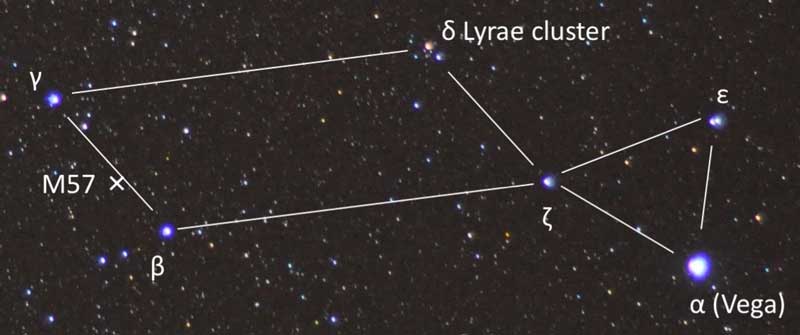
Figure 2: Astrograph of Lyra. (Photo by Scott Roy Atwood)
The photograph in Figure 2 labels the individual stars in Lyra according to current scientific convention, where the brightest stars in a constellation are given Greek letter names in decreasing order of brightness. Vega, being Lyra’s brightest star, is α Lyrae; next comes β Lyrae, and so forth. All of Lyra’s Greek-letter stars are surrounded by numerous lesser stars, and the whole effect is magical in binoculars. Make sure to linger especially on the region around δ Lyrae, which contains a loose open cluster of related stars.
The Ring Nebula
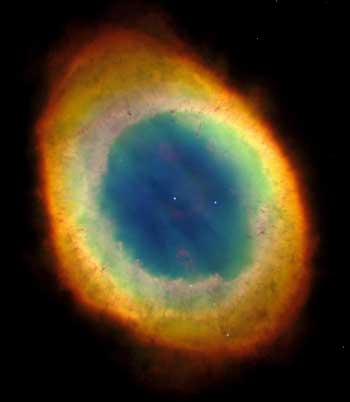
The Ring Nebula, as imaged by the Hubble Space Telescope. All that remains of the original star is the faint dot in the center. (Photo courtesy of Hubble Heritage Team – AURA/STScI/NASA)
The real treasure in Lyra, however, is M57, the Ring Nebula. You will need a telescope to observe the Ring, but the sight is not to be missed. The library’s StarBlast lend-a-scope will show M57, as will other scopes of that caliber (Newtonians with 4-inch mirrors and larger). M57 lies about halfway between β and γ Lyrae. If your telescope has a secondary finder scope, point it so that it holds both β and γ in its field of view; if you have a gunsight finder, as on the library’s StarBlast, point the finder halfway between the two stars. Then look through the eyepiece and scan for the nebula. You will first see a gray puff that becomes clearly ringlike at higher magnification. Most people picture it as a smoke ring.
M57 is a planetary nebula, a structure typically formed when a star nears its end of life. As it exhausts its nuclear fuel, the star swells, and in cases such as M57’s, blows off its outer shell of gases. What remains of the star is a white dwarf. Meanwhile, the shell expands outward and often appears in the sky as a faint glowing sphere. M57 is unusual in being cylindrical in shape; we happen to be observing the cylinder end-on, hence the ringlike appearance.
I often get a chill when I observe the Ring Nebula. It’s hard not to think of the violent end of the star that gave rise to M57, and to the end of the planetary system it may have harbored. At times like this, Orpheus’ lyre seems especially emblematic of his trip to the underworld. In my mind’s ear, I hear cornetti and their sound of hope and sorrow.
How Lyra got there
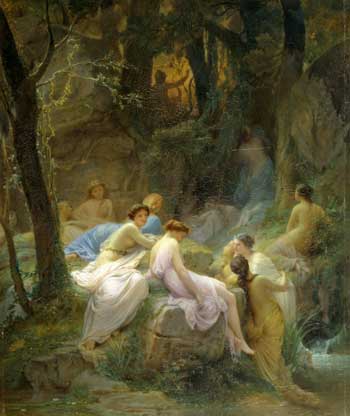
“Nymphs Listening to the Songs of Orpheus” by François Jalabert. All we see of the singer is a shadow on the wall of his hermit cave. (Courtesy Wikimedia Commons)
Mythology tells us what happens to Orfeo after he enters the underworld: Moved by Orfeo’s singing, Proserpina convinces her husband, Plutone, to release Euridice back to the land of the living, so long as Orfeo does not look upon her until they’ve left the underworld. When Euridice trips on the way out, Orfeo instinctively looks back and loses her forever. What happens next, in Monteverdi’s retelling, is a literal case of a deus ex machina. Orfeo’s father Apollo (the deus), whose chariot carries the sun across the sky, descends from the stage machinery (the machina) to gather his son. The two then rise together off the stage in glorious song. I imagine Orfeo gently depositing his lyre in the sky on the way out.
Traditional mythology does not provide quite such a Hollywood ending. Distraught over losing Euridice, Orfeo forswears the love of women, a decision as bemusing to us today as it was to 19th-century painter François Jalabert: Consider the disbelieving look of rejection on the nymphs he painted (see painting above). Angered by his wholesale rejection of their gender, a group of harpies descends upon Orfeo and they mete him out a rather unpleasant end. The lyre keeps playing on its own, so I picture a harpy drop-kicking it into the sky in good riddance. Orfeo should have stuck with the nymphs.
Fellow sky walkers, however you picture Lyra ending up in the Summer Triangle, I wish you a thoughtful and rewarding exploration of this region of the sky. And perhaps a musical one: Keep listening for those cornetti.
Marc Vilain walks the night sky from the roadways and fields of Harvard.