
Fellow sky walkers, welcome back from your warm-season travels near and far. Those who have regularly walked the night sky through these columns will recall the planetary alignment we visited last January, our midwinter music of the spheres. This month, we return to the same congregation of planets from a new vantage point.
Back in midwinter, sky walkers braving the predawn hours were presented with the five planets visible to the naked eye arrayed in a gently curved arc. They ranged from Jupiter in the southwestern sky to Venus and Mercury in the predawn east, with Mars and Saturn tagging along between them. It was an alignment breathtaking for its elegant geometry.
Six months later, these five planets still inhabit the same quadrant of sky, but their appearance is much less tidy. We now have two clumps, with Venus, Jupiter, and elusive Mercury in the western sky, while Mars and Saturn are off pouting in the south in constellation Scorpius. At least that’s where you will find them shortly after sunset this week, as the congregation of planets is now observable in the evening, a boon to the nonmatutinal.
A trip to Fruitlands
To see this in Harvard, head to the lookout area above Fruitlands on Prospect Hill Road, in particular to the Still River end of the lookout, next to a large tree and a garbage can. Sunset is shortly after 7 p.m. this week. After you’ve enjoyed that romantic moment with your companion of choice, look toward Mount Wachusett in the west: One or two hand-widths above the mountain, you will spot Venus as a faint, white twinkle in the sky. You may see her in binoculars before you can see her with the naked eye. Start looking from the windmills to the left of the summit, and scan upward from there, but expect the Goddess of Love to play a coy game of hide-and-seek. Throughout this week, Venus’ nightly appearance will be somewhat to the left of her previous day’s position. Furthermore, her setting twinkle will drift toward the right over the course of the evening.

Figure 1: Venus (circle) and Jupiter (x) as seen over Mount Wachusett around 8 p.m. (Figure by Marc Vilain)
Figure 1 shows the skyline above Mount Wachusett, with Venus’ position at 8 p.m. charted for the last few days of August. Expect Venus to be to the left of those locations if you look for her this weekend. A convenient night to do so will be Friday, Sept. 2, as the moon’s thin crescent will be right alongside Venus. The figure also shows where to locate Jupiter, but unlike his bold mid-winter presence (when his soundtrack was all brass and tympani), you will need keen eyes to spot Jupiter this week, low on the horizon amid the last embers of sunset.
As Figure 1 suggests, Venus and Jupiter were briefly in almost perfect conjunction on Aug. 27, a chance convergence caused by the two planets aligning just so in their orbits. That night, to observers with telescopes on the Fruitlands lookout, they appeared in danger of imminent collision, or at least imminent embrace, but were in fact separated by 725 million miles.
Two more planets, maybe a third
That same January column gave the world’s simplest directions for finding Jupiter: Stick your left arm out and you will be pointing right at it (stick it out to the side, as I was reminded to say). The same applies today for finding our two next planets. After the sky darkens around 8 p.m., face Mount Wachusett and stick out your left arm to the side, naturally. You will be pointing toward Scorpius. On the Still River end of the Fruitlands lookout, this will be the area just above the trees on the right side of the roadway.
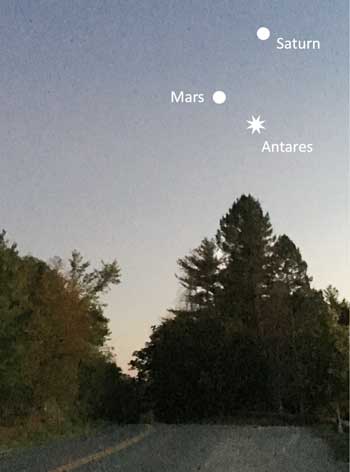
Figure 2: Expected positions of Antares, Mars, and Saturn, as seen in early September looking south from the Fruitlands overlook. (Figure by Marc Vilain)
What you will see are three orange “stars” arranged like an elbow, as in Figure 2. The only actual star in this grouping is Antares, the bottommost of the threesome. The crook of the elbow is Mars, and Saturn is at the top. Binoculars will show Mars as almost a deep red, and a telescope will reveal the glory of Saturn’s rings. We will say more about Saturn next month, but here’s a sneak preview: If you do not own a telescope, sign up now for the library’s StarBlast lend-a-scope.
As for Mercury, star charts locate it below Jupiter, and somewhat to the left. Several trips to the Fruitlands lookout have yet to show me the winged messenger, however, as he has so far been lost in the last glow of sunset or been hidden behind mountains and low-hanging clouds.
One final note: Don’t wait. Jupiter, and hypothetically Mercury, will be visible only for the next few weeks and will become increasingly hard to spot in the light of sunset.
Back in January, I mentioned how aptly Gustav Holst’s orchestral suite, “The Planets,” meshed with the personalities of the planets, at least as they reveal themselves to my sky-walking eyes. Holst has Jupiter as the bringer of jollity and Venus as the bringer of peace, and while both are now fading into the distance and the sunset, a diminuendo coda to their glory of lastwinter, we know they will be back again in their full symphonic splendor just a few months from now.
Marc Vilain walks the night sky from the roadways and fields of Harvard.