Labor Day weekend’s brush with Hurricane Hermine and the spurts of strong wind and rain this past Sunday were unwelcome reminders that we are in the eye of hurricane season, and New England is not immune. There have been some destructive hurricanes here over the past decades but none to compare to the one 78 years ago—the Great Hurricane of 1938. A newspaper clipping quotes Walter Haskell, chairman of the Board of Selectmen at the time, as putting the damage to Harvard at $500,000, including the loss by owners of apple orchards.
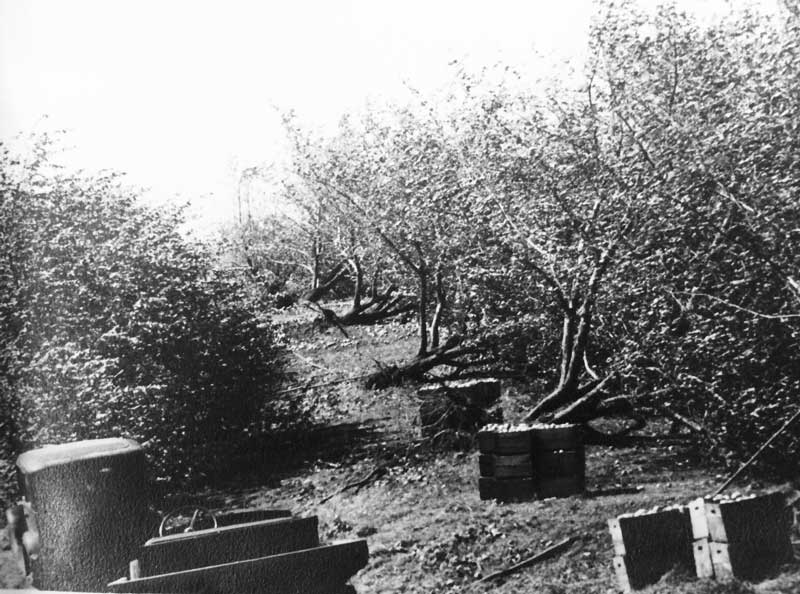
The storm devastated Harvard’s orchards.(Photos courtesy of Harvard Historical Society)
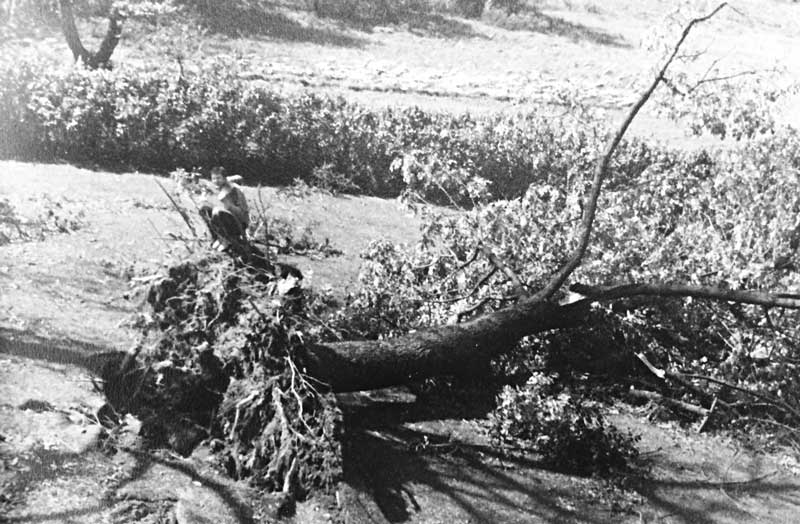
A man sits atop a fallen tree brought down by the storm.
Frank Carlson shared with the Press a letter his grandfather Hjalmar Carlson wrote a short time after that storm. (Mrs. Watson owned what is now Whitney Lane Farms; Walter and his wife lived at 115 Oak Hill; the orchard was on Old Littleton Road.)
Our experience during the hurricane, of September 21, 1938 was rather a wild, and, an exciting afternoon. About four o’clock in the afternoon, it turned very dark, and windy. And at five o’clock, the wind was blowing so hard, that it broke some of the trees, and, others came up with the roots. As I work for Mrs. Watson, and, live in the cottage, and, seeing what the wind was doing down here, I had to go up and see what was happening up on the hill, at my own place. Which was occupied by my son Walter and wife. Which in earlier years, was known as the Cushman cottage. It was all I could do to get up the hill. The first thing I saw was the shingles flying off the barn. One went flying threw one of the bedroom windows. I helped my son put the board in front of the window. Of course by that time, there were no lights or telephone. The pines were down behind the hen houses, and some leaning over on the hen houses. After that I came home again, to see if everything was all right down at Mrs. Watson’s. Finding things in the same condition there to. Trees everywhere. After that I had to go back to Walters with a lamp, and, the wind was so strong, I had to crawl up the hill on my hands and knees. I thought I would never get home that night, because there were trees, and, apples all over the roads.
The next morning we walked up to our orchard, which was known as the Crosby place, and, later owned by Alfred Anderson now owned by me. What a time we had to get there, trees all over the roads, we had to crawl under and over the trees, and, telephone wires. Finally we did get there. We found our shed standing, which is the only building I have there. And, Oh! What a sight. Out of 300 trees there were only 60 standing up. The trees were all leaning on there sides with the roots showing above the ground. As we only had our crop half picked. The rest was on the ground, and, the ground was all covered. After walking up there, and, looking around we were so tired, we decided to ride home on the tractor. But, what a time we had to get home, going through gate ways, into the open fields, and, on to the roads again, crossing from one side to another, until we got home. On our way home, we meet one truck load of men opening up the roads, so, they would be passable. At the end of nineteen days we had lights, and, were we glad. Lets hope we never have to see a thing like this again.
—H. W. Carlson
A compilation of testimonials
In the Historical Society archives is a scrapbook entitled “Story of the Hurricane September 21, 1938,” painstakingly typed in 1939 by Emila Estelle Hersey, who was secretary of the Historical Society. She includes handwritten testimonials from three other residents and lists 11 people besides herself who contributed photographs. Miss Hersey recounts, often with vivid imagery, the devastation of the storm, but she also shows resiliency and a sense of humor in the face of loss. She knows the names of all her neighbors and reveals a deep sense of pride in them and in her small town of Harvard.
The hurricane struck us Wednesday, September 21st 1938, at about four thirty P.M. and for hours it raged in unabated fury, doing untold damage to buildings and trees, wrecking nearly everything that came in its path.
The foliage had been unusually heavy and the ground was soft and cozy from long heavy rains, even the moon and the tide united their strength in setting the stage for that awful tragedy.
All we could do was to hold our breath and watch our beloved trees writhe and twist in agony and then slowly sink to earth with huge balls of earth upraised in air, or see them broken off like pipe stems and go hurtling through the air. No sound of falling trees could be heard above the roar of the wind except when they crashed onto a building.
We prayed that our windows and doors would hold and most of them did, thanks to our old New England custom of building houses to withstand high winds and heavy snows. Chimneys fell and roofs crashed but our good foundations held.
No human hands, however skillful, could have felled so many trees falling in all directions and done so little harm to buildings, however hardly a building in town escaped some damage and many had hair breadth escapes.
Of all the many people who had to abandon cars and were walking home by highways, rail road tracks, and across country, no one was injured, but some did arrive home clad in rags and tatters.
All that night every able bodied man and boy sawed and chopped, by the aid of a flash light or an occasional head light of a venturesome or stranded auto, to clear main roads of fallen trees.
Fortunately the electricity went off early so no fires added to the horror of that night.
(It would be two weeks before electricity was restored.)
We in the houses sat with dripping candles, or no light at all, awaiting the next crash and asking what next?
Few slept that night and the next morning we came to in a world without chimneys, light, telephones, radio, mail, buses and all the other modern conveniences that go to make our lives so easy and pleasant.
No one did any work that day for everybody was out taking stock of their own damage and viewing the awful devastation all about town. Trees and wires were down in such a twisted mass that it looked hopeless.
No one was weeping or wailing or complaining, just a spirit of thankfulness that things were no worse, and a cheerful desire to help the other fellow who had been hit harder.

The elms on Harvard’s Little Common.

A Harvard youngster atop an uprooted tree sees things from a new perspective.
Miss Hersey then gives a house-by-house account of the damage around the town center. Unfortunately, Miss Hersey does what historians did before houses had street numbers—she identifies property only by the people who lived there at the time, making it difficult for modern readers to orient themselves. Of herself (16 Still River Road), she says the following:
Miss E.E. Hersey lost one chimney, had a badly battered roof, windows and gutters broken and trees all trimmed. The tops of trees from afar added to the confusion in her garden.
It is easier to picture the damage to well-known structures, although the Unitarian Church Miss Hersey describes here burned down in 1964:
Part of the large stained glass window in the front of the Unitarian Church was blown in and broken. The Town Hall lost a chimney, and numerous slates from the roof and the weather vane was folded up like a book. The Fire House lost its big door. Maybe Powder House Park needed to have some trees removed but no one quite approved of the way the wind did the job. One tree landed flat on the roof of the powder house but that sturdy little structure of 1812 stood its ground amid the debris. The Hildreth estate lost a wind mill and many beautiful pines, spruces and hemlock to say nothing of fruit trees, for that storm seemed intent upon putting New England out of the apple business.
A sky light is always the delight of a high wind so the one on the library building was carried away and broken and a lot of damage done to the light in the room below. The Kerley, Reed and Bryant store lost all of its top railing and the large nearly 100% perfect blue spruce between the store and the Congregational Church was blown over. The church lost two chimneys, innumerable large lights of glass and slates were blown with such force that they were half buried in the ground and stood up in rows like miniature grave stones.
The houses on Little Common were not badly harmed. But those large old elms that were the pride and delight of everyone, most of them set out more than two hundred years ago, and only a few mere sticks left standing. That little part and the small square at Still River Village were about the saddest looking spots in the state. No shell shot area could have looked much worse.
Without doubt there is always a ludicrous side to every tragedy, but at the time its not so awfully funny to have your best hat whisked off for parts unknown. A full line of the family wash may present a grotesque appearance sailing away for an unknown port but its serious at stock taking time. It may look like a joke to have a sizable tree astride a roof but its no joke to get it down. Neither is it a joke to see a hen house, hens and all, soar away and be able to salvage only a bit of kindling wood.
Now we may just as well look for the silver lining, and enjoy new vistas opened up before us and be glad of new views that we never supposed existed. And above all be thankful that there is so much of beauty left for us to enjoy and that our homes are safe and sound and no one killed or injured.