Duane Slick, who is Native American, and Martin Smick, of Anglo-American descent, have collaborated on a special exhibit at the Fruitlands Museum art gallery that is running through Nov. 6. Called “Finding Metacom,” the exhibit is a collection of art objects that reflect the two men’s journey to understand more about the Wampanoag leader Metacom, or Metacomet, who is also known as King Philip.
Slick said that last fall, Mike Volmar, former curator of Fruitlands, asked him to do an exhibit using the Native American collection compiled by museum founder Clara Endicott Sears. Volmar also suggested that it be a collaborative effort. Slick asked Martin Smick, a fellow teacher at Rhode Island School of Design, to join him in the project. As the two men explored the collection, it became clear that the most compelling object was the war club of Metacom. Slick said the central questions then became, “What is the American identity? Do we acknowledge the conflict between the white men and the natives?”
They also took into account the intentions of Sears. It seems clear from her writings and the artifacts she purchased that her intention was to honor the Native American people, which led her to romanticize them. But in 1930 Sears also went to great lengths to purchase the war club, acknowledged to be King Philip’s, an artifact that was undeniably a symbol of the war he led against the settlers. (Subsequently, the war club was stolen from the museum in 1970 and returned in 1995 by a collector of Native American artifacts who bought it at a Worcester yard sale and suspected it had been stolen.)

King Philip’s war club is part of the “Finding Metacom” exhibit at Fruitlands Museum. (Courtesy photo)
King Philip’s war club
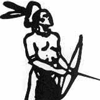
The focal point of the exhibit captures these conflicting attitudes toward the Native Americans. On a white stand in the center of the room is King Philip’s beautiful, but lethal, war club. Framing the club on the north and south sides are two large mesh screens, hung from the ceiling, with the same image imprinted on both in stencil and acrylic, one in green and the other maroon. In the foreground is the bronze statue of Pumunangwet that stands outside the Fruitlands Native American museum. His taut bow is extended upward as he “shoots for the stars.” Smick said he used Photoshop to put the Shaker office building, actually located across the driveway from the statue, in the background behind Pumunangwet to represent a colonial structure and “hint at the presence of the early settlers.” His intention was to show the stark war club caught between the iconic images of the romanticized view of the Native American.
Literacy: A tool of subjugation?
Filling most of the west wall are rows of what the artists call text paintings, blocks approximately 9 by 12 inches, each of which captures in words and color something that came up in the artists’ research to better understand the Native American experience in New England. Smick said the text panels reflect the idea that literacy was a tool the colonists used to undermine the Native American culture and to convert them. It is English words that tell the story of the conflict.
Some of the blocks relate directly to Metacom. In #31 the words “Metacom Fell” appear on a background of wampum purple and vivid red. A marker at Mount Hope in Bristol, Rhode Island, commemorates the death of the Wampanoag leader in 1676 with the words “King Philip Fell.” Smick has changed the words to the Wampanoag name and used red to show the violent manner of Metacom’s death. He did not simply “fall,” but was, in fact, murdered then drawn and quartered and his head severed and placed on a post. “People of the First Light” refers to the Wampanoag tribe. Other blocks directly reflect prejudices against the Native Americans. Slick’s #1 “Kill the Indian Save the Man” is a reference to government policy beginning in 1887 to “Americanize” the Native Americans, stripping them of their culture, largely under the guise of education.
Who gets to tell the story?
On the east wall, “The Sum of All Knowledge” echoes the theme that it is the white man who has told the story of the Native American. Slick took a picture of a tower of books about King Philip’s War that he created from the collection at the library of the University of Northern Iowa, a place he knows well from his undergraduate days. He wrote, “The titles and authors reveal the biases and agendas that have shaped how we learn about Metacom.” Ninety-five percent are Anglo writers.
On the south wall is a large painting of a sun, called “All the Sunrises in the World.” The Wampanoag tribe—and many others—buried their dead facing east so at first light their spirit could be released. Slick said this painting is his gift to Metacom, who wasn’t buried. Other paintings by Slick call on images from native culture—the coyote, elders’ storytelling—to honor traditions but also to raise the question of a merging identity.
An artists’ statement by Slick and Smick reads, “Our work will raise important questions about the responsibility of the museum to teach the history and reality of Native peoples and will confront inherent conflicts between Native and European-American identities. Our hope is that this exhibition inspires a spirit of reconciliation and greater understanding.”
The artists will be at Fruitlands Saturday, Sept. 17, for a reception and gallery talk starting at 1 p.m.
King Philip’s War: A Brief History
Metacom, or Metacomet, was the second son of the Wampanoag leader Massasoit, who had established friendly relations with the original Mayflower Pilgrims. Metacom adopted the English name King Philip in honor of that relationship. But in 1675, 13 years after he succeeded his father, that legacy of peace ended. In light of what happened, the title King Philip now seems ironic.

Reacting to the continued European encroachment onto Wampanoag lands and to what he felt was humiliation at the hands of the colonists, Metacom declared war. Slick said that he and Smick found evidence that Metacom’s older brother, Alexander, had been murdered by settlers. Perhaps this was further motivation to break the peace. In what, according to Wikipedia, has been called “the single greatest calamity to occur in the 17th century,” battles were fought in Massachusetts, Connecticut, Rhode Island, and Maine. By August 1676, the Wampanoags and their alliance were almost completely destroyed. More than half of New England’s towns had been attacked by warriors, and 12 of the region’s towns had been wiped out. The colonists’ economy was all but ruined, and the population was decimated.
Seeing the end in sight, Metacom went to his birthplace near Mount Hope in Bristol, Rhode Island, where he was killed while walking in the forest. Ironically, the man who killed him was a Native American, hired to fight with the colonists. Metacom’s head was severed and put on a post at Plymouth as a warning to others.
One of the settlements destroyed in the war was the isolated village of Lancaster in February 1676. Metacom led a dawn raid with a force of 1,500 Wampanoag, Nipmuc, and Narragansett warriors, who burned houses and slaughtered more than 30 people. Reverend Joseph Rowlandson’s wife, Mary, was taken prisoner, along with three of her children, including a 6-year-old child who had been wounded and died nine days later. Mary later wrote, “Now away we must go with those barbarous creatures with our bodies wounded and bleeding and our hearts no less than our bodies.” Mary was ransomed after a time and reunited with her husband in Boston. In 1682 she published an account of her experience.
The Lancaster site may well have been in view of Clara Sears’ home at the top of Prospect Hill, and, avid historian that she was, she would certainly have known about Metacom’s raid. One wonders what thoughts she had as she pursued the purchase of King Philip’s war club.
— Carlene Phillips
Sources: Wikipedia, “Metacomet” and “Directions of a Town: A History of Harvard, Massachusetts” by Robert C. Anderson (The Harvard Common Press, 1976)