This summer the farm hosted its usual set of nesting birds. I enjoy watching the barn swallows most. They are a continual presence skimming over the water, eating mosquitoes and other insects when I am doing my morning tai chi down by the pond. When I start mowing the field, the barn swallows stream out of the barn and follow the tractor around, grabbing insects the mower disturbs.
We had two broods of swallows this year, which means we have around 40 to 50 of these wonderful birds ridding our place of mosquitoes—no need to spray, not that I would. I had just one pair of tree swallows nesting, which is worrying.
I know swallows, as well as other species, are in decline. There are several theories about the decline. The first suggests it is driven by a related decline in insect abundance or a mismatch in the timing of when insect abundance is highest and swallows are breeding (climate change?).
A second theory is connected to the fact that the greatest declines have been in birds that migrate long distances to Central and South America. This theory suggests that conditions at wintering locations or during migration could be affecting these species, as well as a loss of habitat in their breeding areas. As I have noted before, the demolition of barns in breeding areas has a tremendous impact on the loss of barn swallow nesting habitat.
On a recent evening visit to the Parker River National Wildlife Refuge, it was hard to believe that tree swallows are in decline. We witnessed probably hundreds of thousands of these birds gathering in “clouds” over the marshes and eventually settling down into the tall grasses around the Bill Forward Pool to roost for the night. For anyone interested in this spectacle, it is worth the trip to Plum Island. They may be there until the end of August, at which time they continue their journey south. One could call Mass Audubon’s Joppa Flats Education Center to ask if the swallows are still there. If you miss the tree swallows, there are usually many sea and water birds feeding on the refuge on their migration south. The refuge offers one of the most beautiful landscapes close to home and is worth a visit any time of year—especially at sunset.
Other nesters we had on the farm were bluebirds, red-winged blackbirds, song sparrows, chickadees, catbirds, phoebes, goldfinches, common yellowthroat, and great-crested flycatcher. Red-tailed and red-shouldered hawks nested nearby. The other morning on my walk, I witnessed a red-tailed running around the field chasing what was probably a vole or a mouse.
Yesterday I noticed only two or three barn swallows and today there are none, so they must have left on their long trip to their wintering grounds in Central and South America. This week we have had three green herons and a kingfisher around the pond joining the great blue heron that drops by most days for a few frog snacks. They are finding easy picking now that the pond is at an all-time low, exposing more frogs for their delight. We have also had a spotted sandpiper feeding on the exposed mud at the side of the pond, another sign that the birds are moving south for the winter.
Off to the Tibetan highlands
This summer we had several wonderful weeks in the Tibetan highlands of Sichuan and Yunnan in China. The first part of the trip was with a group from New England Wild Flower Society. The hope was to see wildflowers in the high (12,000 to 15,000 feet) mountain meadows of Sichuan. Wildflowers are one of Pam’s passions, and she was not disappointed. The quantity and variety was incredible and included the blue and yellow poppy as well as several corydalis species, gentians, rheums, saxifrage.
-in-Shichuan_800w.jpg)
Minya Konka (Gongga Shan) is the easternmost peak in Sichuan Province, China. (Photos by David Durrant)
The second part of our trip was on our own to western Yunnan. We visited villages of the Shaxi, Nuodeng, Dali, and Litang. Pam continued her quest for wildflowers, and we both enjoyed being absorbed by the Bai, Naxi, and Yi cultures and landscape.
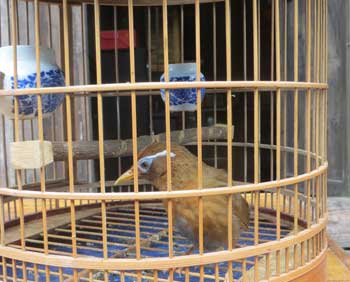
A caged hwamei laughingthrush.
As for birds, I was disappointed. There were not many birds at the time of year we went (July). I suspect there is more variety and quantity during the months of migration. One spectacular bird I did see was the Himalayan griffon, a huge vulture and one of the largest and heaviest birds found in the area. I probably saw as many caged birds as I did wild. The Chinese have a tradition of caging the hwamei laughing-thrush and enjoying its wonderful song. One morning while doing tai chi on a riverbank, I too enjoyed these songs as the locals brought their caged birds with them while they were doing their morning exercises.
The trip was one of the best I have had the good fortune to take. Not only were the landscapes some of the most beautiful I have seen, but being immersed in the Tibetan culture, meeting friendly and generous people, and having wonderful food (all of it fresh, of course) gave me a real appreciation of the wonderful way of life in this corner of the world.
Pamela and David Durrant live on East Bare Hill Road at Micheldever Farm, where they watch birds and enjoy their chickens and their guard donkey, Rascal, and their old ewe, Miss Piggy, both of whom love it when the neighborhood kids bring them carrots.