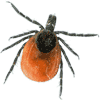
The next time you find a tick crawling down your back, don’t flush it down the toilet; send it to college. At the May 10 Board of Health meeting, member Tom Philippou reported on a new university study that is examining the nationwide distribution of ticks and tick-borne diseases. The study is being conducted by Dr. Nathan Nieto, assistant professor of microbiology at Northern Arizona University. To help provide input for that study, the Bay Area Lyme Foundation (BALF) is offering free tick testing. The Board of Health recommends that residents submit ticks to Nieto’s study, and it will work with BALF to obtain results for Harvard.
Ticks will be tested for pathogens that cause Lyme disease, anaplasmosis, babesiosis, ehrlichiosis, Rocky Mountain spotted fever, and tick-borne relapsing fever. Results, reported via email, are generally available in about three weeks and will include the species of tick as well as a list of positive and negative results for the six pathogens.
Not a diagnostic tool
BALF recommends that if you have been in a tick habitat, you should watch for symptoms of tick-borne illnesses and not rely on tick testing for a diagnosis. If a tick tests positive for a disease, it does not mean that it transmitted the disease; likewise, if a tick tests negative, it does not mean that the sender did not get a disease from another tick, possibly unnoticed.
Ticks may be submitted, dead or alive, in a small plastic baggie with a moist cotton ball or piece of wet paper towel. Ideally, the tick should have been collected no more than 72 hours before mailing. The baggie should be put into a small padded envelope, along with a form (available on the foundation’s website) identifying when and where the tick was found, as well as whether the tick had bitten anyone. The study is looking for ticks of all types, not just deer ticks, and it doesn’t matter whether the tick was found on a person, a pet, or a blade of grass.
The tick submittal form and the address are available on the foundation’s website.