A few weeks ago, as a warm spring night was falling, the moon came in close proximity to Jupiter. A short distance separated the two, and from that vantage point, Miss Luna appeared to be flirting with the giant planet. Just a few days from being full, she looked as if she had let a lock of hair trail down the right side of her face, and gazing upwards, seemed to be giving Jupiter come-hither eyes. Jupiter, being as obtuse as males are wont to be, ignored her and allowed her to sail along and settle unrequited into a neighboring constellation.
This image of celestial courtship stayed with me as April stretched into May, bringing us into the full bloom of springtime, with its promise of a reborn natural world, fertility, and the onset of the planting season. As it happens, the constellation that Miss Luna settled into was Virgo, the young maiden, herself an inherent symbol of fertility.
Locating Virgo
As a constellation, Virgo stretches prominently across the entire southeastern sky at this planting time of year. She appears to be reclining on her back, her arms open wide, sharing her symbolism of fertility with the fields below. In ancient iconography, Virgo is shown holding a stalk or sheaf of wheat, rounding out yet another circle of fertility. This wheat is associated with Spica, or Alpha Virginis (meaning the brightest star in the region of Virgo); you can also picture Spica as our maiden’s left hand. Either way, it is one of the bounding stars that will help you locate Virgo in the night sky.
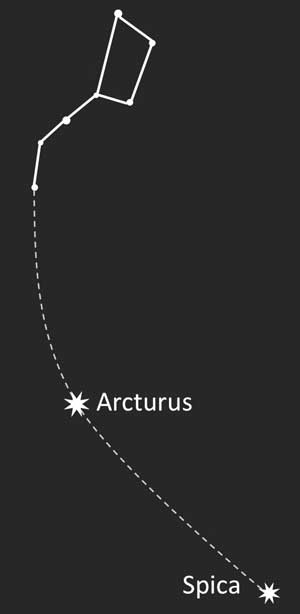
Chart 1 – Arc to Arcturus and speed on to Spica. (Charts by Marc Vilain)
To do so, start with the Big Dipper. The curve of the Dipper’s handle arcs roughly toward Arcturus, the alpha star in Boötes. If you continue in roughly the same arcing trajectory from there, your next comparably bright star is Spica. The stargazing saying for this relationship, “arc to Arcturus, and speed on to Spica,” is demonstrated in our first star chart. As the second star chart shows, Spica bounds Virgo from below; Arcturus bounds the constellation above her legs; and for the present season, Jupiter appears positioned just about right to give Virgo a pillow on which to rest her head.
Using Spica, Arcturus, and Jupiter as guides, you should have little trouble locating Virgo in the sky. The entire constellation becomes visible shortly after nightfall, at which time she appears to be propping herself up on her forearm. The chart shows her at 9 p.m. in the first two weeks of May. As the night wears on, she seems to relax, or perhaps to tire, and lies increasingly at a horizontal. Bear in mind that this is a truly large constellation that ranges across the sky from nearly due south to nearly due east. The chart, incidentally, shows the traditional and somewhat demure stellar arrangement for Virgo’s legs using solid lines. To my eye, however, a more visually obvious arrangement consists of her official right leg coupled with an unofficial one (the dashed line) that borrows a star from Boötes, producing a much less modest version of our young maiden, who might then seem disinclined to remain especially virginal for much longer, at least not during this season of fertility.

Chart 2. Virgo in the night sky. Dashed line is unofficial (and less demure) right leg. Click image to enlarge.
Note also that, Spica aside, Virgo has few bright stars. You will want to go looking for her from a relatively dark location; recent nighttime strolls have given me fine views across Westward Orchards’ apple fields on Oak Hill Road, kitty-corner from Carlson Orchards when heading into town. You will also want a night with no moonlight, especially as Miss Luna traverses right through Virgo on her orbit, washing out those not-so-bright stars in moon glow. Lastly, be careful not to confuse Virgo with nearby Corvus, a trapezoid constellation easily mistaken for Virgo’s similarly shaped head. “Corvus” is Latin for “crow”; I imagine this mischievous crow to be waiting for Virgo to fall asleep so he can help himself to that wheat she’s holding.
Measuring the seasons
The astronomical association of the stars with the agricultural calendar is ancient, and even more so is the association of the moon and the sun. I am not aware of Virgo herself being used to measure the calendar in ways other than metaphorical, but our forebears went to great efforts to mark key astronomical moments of the year, the solstices and equinoxes in particular.
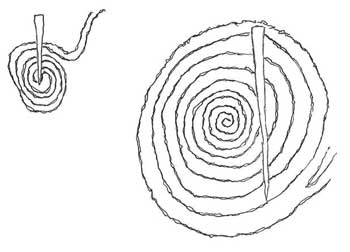
Petroglyphs at Fajada Butte. Slits between nearby boulders cast light daggers on the spirals at sunrise, shown here at the equinox.(Drawing by Marc Vilain)
One culture that critically relied on astronomical observation to time the spring planting season was the ancient pueblo people of the American Southwest. Though the landscape was lusher at the height of pueblo culture (850 to 1150), the environment was no less arid, and the rainy season no less short. The architecture of these ancient pueblos incorporates numerous north-south walls and corridors, with windows placed in such a way as to illuminate inner rooms precisely at the time of the winter solstice. Chaco Canyon hosts a particularly striking solar observatory, the sun dagger petroglyphs on Fajada Butte. The figure below shows twin spiral-shaped rock carvings at Fajada; they are positioned behind a trio of leaning boulders in such a way that the spaces between the rock slabs cast daggers of light through the centers of the spirals: through the large spiral at the solstice, and through the smaller one at the equinox.
Fellow sky walkers, just as with our ancient forebears, the warming days of spring invite us to re-engage with the natural world around us and with the night skies. It is a rite of spring as ancient as human history, and as ancient as humanity’s first attempts to name the stars and constellations above us.
Marc Vilain lives in the center of town and can often be found strolling our country roads at night with his eyes to the stars.