Anyone who’s traveled past the corner of Bolton and East Bare Hill roads in recent months is probably wondering what’s going on there. The answer is, a lot. Erik Skulte and Nicole Schmidt bought the 3.75-acre property last summer with the idea that it would make a perfect spot for a small, family-run farm. They named the property Currier Farm after Nicky’s family, most of whom were farmers. This spring, they began their farming journey by having nearly all of the trees on the property cut down. Stumps are scheduled to be removed this week, followed by grading, and grass will soon be planted on most of the property. Next spring, Skulte, Schmidt, and their two children, Alex, age 8, and Isabella, age 7, will plant grapes, apples, and sugar maples. The fruits of their labors will be homemade wine, hard apple cider, and maple syrup.
Last spring, the Skultes left their home in Milford, Connecticut, for an RV trip across the country, looking for a place to settle down and start a farm. Erik, who grew up in Sudbury, had heard of Harvard, and when the Skultes made their way from the West back to New England, they fell in love with Harvard as a farming community. “When we saw this property, we knew this was it; it had a slope for grapes and lots of sun,” said Nicole. The Skultes worked with Tree Warden Christian Bilodeau, who identified which trees could or could not be taken down, and with Department of Public Works Director Rich Nota, who explained the process for creating a temporary opening in their stone wall for heavy equipment to use. Nota took photographs of the wall so that it could be put back as it was when clearing and grading on the property is complete.

Nicole Schmidt holds a young chicken in the recently finished insulated hen house.
The Skultes said that every scrap of wood from the trees taken down will be used. The pine was sold for boards, and the Skultes will use the cedar trees for poles in the vineyard and the oak trees for boards or firewood. Some of the chips will be used for mulching, and the tree-cutting company sold the rest to an electric company to be used for fuel in one of the new, ecologically friendly woodchip-burning boilers, which some power stations are using to replace their coal-burning boilers.
Short- and long-term plans
Planting in this year’s vegetable garden is already underway, and the Skultes hope to have a farm stand up and running on their property this summer. Erik touted the heirloom tomato plants and thornless raspberry bushes that will come from Nicky’s mother’s 150-acre farm in Connecticut. Eggs from the 18 chicks living in the newly constructed “hen house hotel” will also be available by the roadside this summer.
But the grapes, apples, and sugar maples are longer-term projects. After the property is cleared and graded, the next step is soil testing and preparation, which the Skultes hope to finish this year. In the spring, they will plant a small number of grapevines and see how they do during the cold New England winter. They’re going to experiment with hybrids that have been bred for colder climates, but they will also try some of their favorites, such as merlot and cabernet franc. Nicky said that it will take four years for the grapes to be ready to harvest for wine. Both the grapes and the apples will be “as organic as possible,” she added.
Wine MBA
Nicky has a solid educational background for this grape-growing venture. She studied to be a sommelier and passed the first-level exam through the Court of Master Sommeliers in New York City. She went on to receive a wine MBA from the University of Bordeaux in France and a culinary degree from the French Culinary Institute in New York City. She enjoys opening people’s palates, and she even gave this reporter a lesson in wine tasting (see “Beginner’s lesson” below) with a chocolate raspberry port made from a “wine kit.” (see “Making wine” below)

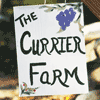
A sign on the mailbox greets visitors.
While Erik has no farming experience, his friend Shannon Edgar of Stormalong Cider, a handcrafted hard-cider producer in Sherborn, is providing advice on which apple varieties to grow for hard cider. The trees that the Skultes have chosen will be mainly heirloom varieties, such as Ashmead’s Kernel, an old English apple from the early 1700s, and Ananas Reinette, first grown in France in the 1500s, with a pineapple flavor.
The Skultes say that their kids will also play a big part in the farm and will reap profits based on the amount of work they put in. The grapevines will be “Alex’s Vineyard,” and the apple trees will be “Isabella’s Orchard.”
“We want the kids to be grounded,” said Nicky. “When kids help on a farm, they see that some things take time. Not everything provides instant gratification.” Even wine and cider making will include Alex and Isabella, who already have experience with the wine fermentation process, as well as bottling and corking.
Balancing farm, family, and life
Both Erik and Nicky have full-time jobs: Erik works in finance at a company in Boston; Nicky is a middle-school teacher, and she also works for Beyond Booksmart, an educational coaching company. This summer she plans to run a farm camp at Currier Farm for children in grades 2 to 5, teaching them the value of growing their own food. In their spare time, the couple participates in ultra-distance trail runs, which range from 50 to 100 kilometers, although so far they have been content with the 50K distance. Nicky said that the trails in Harvard are “phenomenal,” and she is able to stay almost exclusively on conservation land during her 20-mile training runs.

Nicole Schmidt points out rhubarb in one of the farm’s raised beds. The lot behind is mainly cleared in preparation for vineyards and an orchard.
For Erik, the decision to move to Harvard has provided him with balance in his personal life. He worked for years on Wall Street and recalled, “I never saw my family. I got up early to catch the 4:15 train to the city and got home late.” He said he knew Harvard was the right town for the family when he saw a T-shirt for sale at the General Store emblazoned with “What happens in Harvard, stays in Harvard … but nothing ever happens here.”
“I wanted to be able to come home to a place like that,” said Skulte.
The quest for a new lifestyle for the Skultes was also driven by the emotional trauma they endured during their son’s battle with serious health issues. Alex suffered two strokes soon after he was born 14 weeks prematurely, weighing just under two pounds. Alex has already undergone six brain surgeries, and although he has epilepsy and cerebral palsy on his left side, he plays lacrosse and joins in family trail runs. His presence during this interview revealed a precocious, self-assured 8-year-old, eager to tell his story and grow his grapes. When Nicky revealed the planned yearlong trial for the vineyard, Alex protested, saying, “That’s a little too much. Maybe one winter.”
“I think we’re happier because we respect every day now,” said Nicky. “We no longer view our lives in terms of competition because we’ve been through so much pain.” Erik agreed, and said that “working the land and seeing the gifts that the earth gives” will be therapeutic for the whole family.
In 2008, the couple created the Baby Alex Foundation to raise money for pediatric brain injury research. So far, they have given more than $250,000 in grants to research institutions such as Boston Children’s Hospital and Harvard Medical School. For more information on the Baby Alex Foundation, go to www.babyalexfoundation.com.
A beginner’s wine-tasting lesson
I was embarrassed to admit I had never “tasted” wine before, but wine expert Nicky Schmidt walked me through the process. It was eye-opening. These were Nicky’s instructions (yes, you will have to spit):
- Swirl the glass for a short while to release any odors that may have built up in the wine while it’s been sitting in the bottle. It helps to keep the glass on a flat surface while swirling.
- Once those unwanted odors are gone, it’s time to smell the “true essence” of the wine. Take a series of quick short sniffs, then stop and let your brain process the information.
- Sip a small amount into the front of your mouth, breathing at the same time, and swish the wine around the front of the mouth and teeth.
- Spit the wine out. When you swallow wine, you feel the alcohol burning as it goes down your throat, and that overshadows the taste of the wine.
- Don’t taste wine just after brushing your teeth or chewing gum.
- To truly taste the wine, don’t pair it with food. If you do pair it, make sure the food complements the wine, for example a creamy brie with an acidic white wine.
—Joan Eliyesil
Making wine from a kit
The Skultes have been making wine from kits for about four years. The kits are available online from sites like Amazon, homebrewing.org, and northernbrewer.com. Kits contain either pure grape juice, concentrated grape juice, or a combination of the two. The advantage of kits goes beyond not having to crush grapes; kits provide access to grapes from around the world, and they contain all of the ingredients needed, already measured.
If you are a beginner, the first thing you will need is winemaking equipment. Equipment kits are available that contain all of the basic tools you’ll need to make and bottle wine. After that, you’re ready to buy a winemaking ingredient kit to make whatever variety of wine you’d like, everything from pinot noir to gewürztraminer. Kits make about 28 bottles, and kit prices are generally in the $50 to $80 range.
The Skultes also suggest going to a winemaking supply store when you’re starting out. These stores tend to be customer-friendly, and many offer classes and workshops in both brewing beer and making wine. Stores in our area include Strange Brew in Marlborough, NFG Home Brew Supplies in Leominster, and Homebrew Emporium in West Boylston and Cambridge.
—Joan Eliyesil