The two art exhibits opening the season at Fruitlands Museum couldn’t be more different—or more complementary, both to each other and to the Fruitlands landscape. In the hallway and the large gallery room are 80 works chosen for the second student art competition for middle and high school students. Sixteen schools are represented, with subjects ranging from self-portraits, to country landscapes, to fruit, to seascapes. The variety of medium is even broader—oil, watercolor, tissue collage, acrylic, photography, and even cardboard. For many of the students, this is the first time their work has been on public display.

An owl carving by William Schnute. (Courtesy photos)
In one of the smaller galleries, by contrast, is master carver William J. Schnute’s exhibit, “The Natural World in High Relief,” featuring realistic and dynamic animals carved from single blocks of wood. Schnute’s freestanding and wall-mounted carvings have been used as architectural features nationwide.
Diversity a challenge
The student art was hung by outgoing Fruitlands Director Wyona Lynch-McWhite and Harvard resident Tom Keaney, who describes himself as a freelance museum specialist exhibition installer and who has done many installations at Fruitlands. He said a show like this presents challenges because of the large number of works, all of different sizes. He described how he and Lynch-McWhite laid all the pieces on the floor against the walls and then moved them around—and around and around—creating small groupings of the same size, subject, or color tones and using a large piece or a pair as anchors.
The Americans with Disabilities Act stipulates that paintings be hung at eye level for someone in a wheelchair, and Keaney said there is a lot of measuring involved. This invisible line around the room also gives “subliminal consistency,” he added. Keaney described labels as the “bane of an installer’s work.” They arrive hand printed and have to be copyedited and then transferred to identically sized cards with the same fonts. And, of course, the right label has to accompany its work, which is sometimes no small feat.

“The Sea,” an acrylic by Meenu Ramakrishnan.

“Spring Deer,” a pen-and-marker drawing by Felicia Deng.

“Boston Harbor” by Aaryan Bhatt.
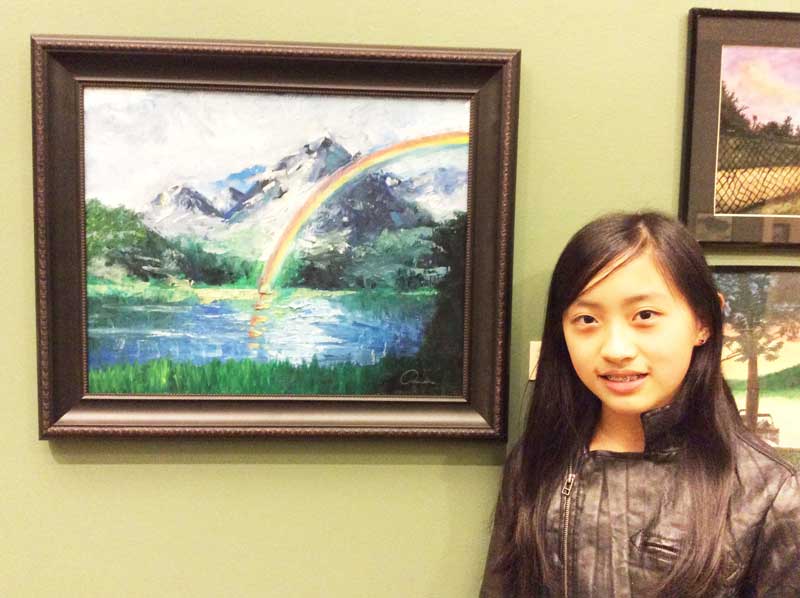
“Rainbow Reflection” by Lin Lin Yu.
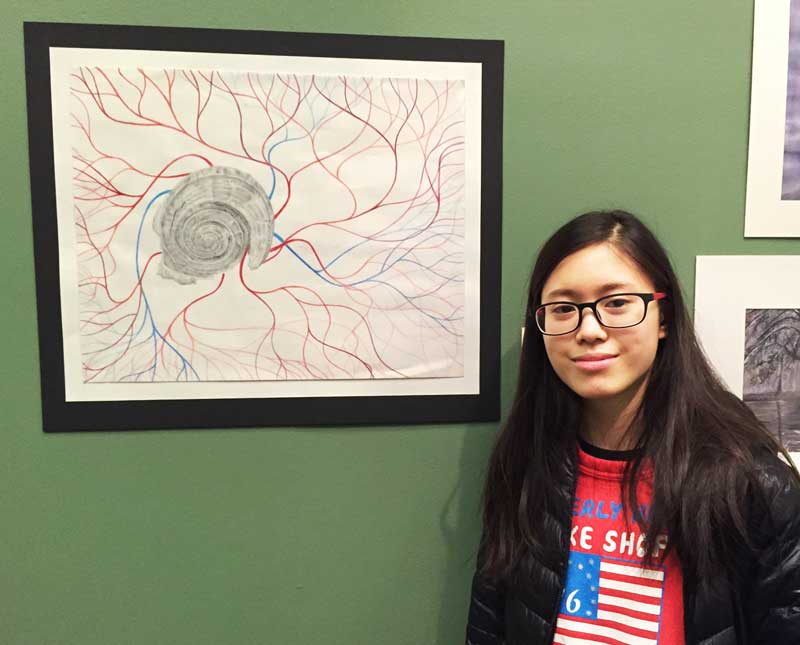
“Life Veins of the Sea,” by Grace Young.
Acrylics and oils
At the opening reception the evening of April 15, Bromfield art teacher Cindy Harris introduced me to the work of four of her middle school students, and I talked with two of the artists. Seventh-grader Aaryan Bhatt was clearly delighted to have his acrylic “Boston Harbor” on a gallery wall. Apparently as much an art critic as an artist, he told me that the skyline did not come out quite as he had thought it would. He had drawn the buildings and then added the acrylic around the sketched lines. “As you can see,” he told me, “they are a bit tilted.” He went on, “But the sky and the water are cool.” I agreed, especially the water. He told me he had layered blues and turquoise, going over and over them to get the effect of waves.
In a really nice gesture, he called my attention to the painting next to his, saying his friend had done it. A bit later I met Lin Lin Yu, who talked about her oil painting “Rainbow Reflection,” a vividly colored and highly textured view of mountains, trees, and water. “It expresses my emotions at times,” Yu said of the piece. She added, “The brightness of the colors describes my personality.” She said she hopes to be a graphic designer or an artist who teaches people.
Bromfield senior Grace Young told me she does mostly observational graphite drawings, such as the intricate patterns of a seashell in “Life Veins of the Sea.” For this piece, she wanted to add an element of design, to go beyond the observation and make it special. To do this she used colored pencil for swirling lines surrounding the shell, red for blood in the veins and blue for the veins themselves.
Unlike the Bromfield entries, some of the paintings are the results of a specific assignment.
Self portraits
Seventh-grader Francheska Austin, whose small work is in the hall gallery, described the self-portrait assignment for students at McKay Arts Academy of Fitchburg. Students were to take a picture of themselves, show mood through a color that reflects them, and use paint and cut or ripped paper to do shading. Austin said she chose pink because it has always been her favorite color. A large example of this same assignment hangs on the north wall of the gallery and was also chosen to be on the banner advertising the exhibit. “Untitled” is by Nevin Arsenault, and it shows the shoulders and face of a young man, topped by straight black hair. Large black eyes gaze sideways, a bit warily, perhaps. Touches of yellow, amid the shades of pink and lavender, seem like rays of light on the face and over one shoulder.
Sandra Robillard, an art teacher at Longsjo Middle School in Fitchburg, told me that her assignment to the students was to use fruit for a still life that could hang in the school cafeteria (coincidentally a perfect subject for Fruitlands). One example in acrylic is a clump of tomatoes on the vine, looking ripe and tempting, by Dariana Suarez-Jackson.
A junior at Leominster High School, Hannah Normile said she fulfilled a watercolor assignment with “Autumn Stroll,” for which she looked high up into the huge trees at the edge of the baseball field across the street from her house.
“I can’t believe that’s not clay,” said a viewer looking at “Commonwealth Ave.” by Madline Konz of Shrewsbury High School. I agreed. The brownstones do indeed look sculpted, and they are—but in cardboard. “Erosion,” wherein cutout green reeds reveal a dead bird at their center, with an open wound showing bits of paper and shiny metal entangled in it, seems a powerful comment on environmental abuse by Wachusett Regional High School’s Dillian McGaley. The double meaning of “Fall Apple” by Lillian Moynihan, also of Wachusett, suggests another social criticism.
Almost in the middle of the south wall I found one of my favorites of the show. It’s quite small and somewhat dark, and one might pass right by it, but on close inspection I found it truly amazing. This delicate watercolor, titled “Barrett Park” by Emma Cucchiara of Leominster, shows green shrubs surrounding a pond, the muted greens with touches of red and yellow reflected in the water. Each leaf in the foreground is distinct, and yet overall the effect is intricate and lacelike, order imposed on the wild.
Rich hues of wood
Almost out of time, I entered the smaller gallery, which, in contrast, has only about 15 major pieces by Schnute and is without color except for the rich hues of different kinds of wood. Each is incredibly beautiful and powerful. In the center of the room is “Things That Go Bump in the Night,” an owl swooping down, carved in white oak, each feather and talon distinct. “How does he get back in there?” asked a fellow viewer about a mahogany tree trunk in which two squirrels are moving down the middle section, while behind them are intricate patterns. A stash of nuts looks real enough for a viewer to reach out and take one. A circular “Chase” of honeylocust, a freestanding raven of cherry, and a bald eagle with its head carved of sperm whale tooth are all powerful and unique. The storyboard describes the process of Schnute’s work and concludes, “The form and structure of the final carving achieves a balance between the wood grain and the artist’s hand to capture the beauty of the natural world.”
The two exhibits, each expressing the beauty and wonder of nature, are perfectly attuned to the beautiful setting at Fruitlands.