It’s out with the old, in with the new this month at Community Harvest Project’s apple orchard on Prospect Hill Road. The hunger-relief organization recently received funding to begin a high-density planting project, and in the past few weeks, orchard staff and volunteers have removed about 200 old apple trees and planted nearly 1,700 dwarf apple trees in their place.
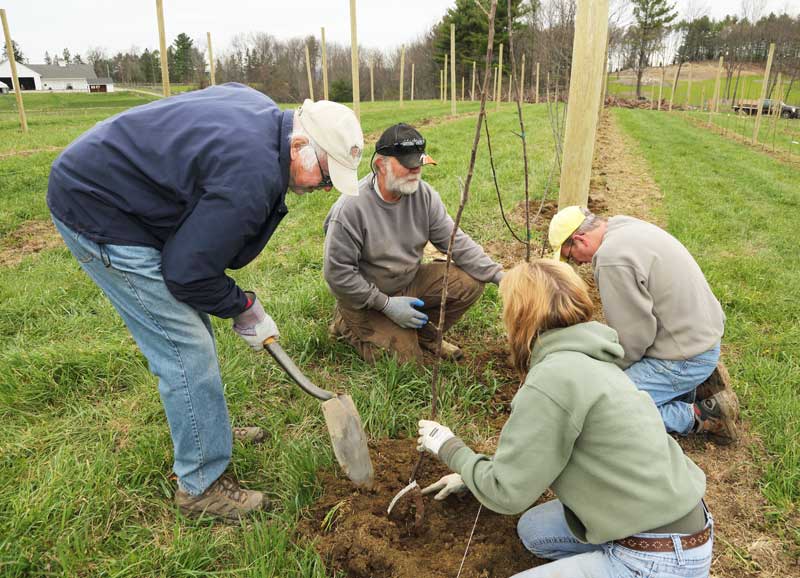
Volunteers plant dwarf trees to replace standard apple trees at Community Harvest’s orchard on Prospect Hill Road, April 25. It is switching to dwarf trees that not only grow more fruit per acre, but allow for harvesting the apples without ladders. From left: Ziggy Waraszkiewicz, Peter Dorward, Linda McPherson, and Jim Sicard. (Photo by Lisa Aciukewicz)
Orchard manager Ken Dion said the new trees will produce about a bushel of apples per tree when they are mature, three years from now. The old trees produced about 400 to 500 bushels per acre, and the dwarfs are expected to produce about 850 bushels per acre. The trees grow to a height of 10 feet, but Dion said that orchard staff will keep them pruned down to 8 feet so volunteers can pick the apples without using ladders.
Each dwarf tree is wired to a wooden pole for support. Dion explained that the roots of dwarf trees are not as big as those of a regular tree, so they need the support of the pole. The trees are planted closer together than regular apple trees, about 25 feet apart. Dion said that will make spraying easier, and pruning will also be easier because of the dwarf tree’s smaller size. The trees that were taken out were Cortland and McIntosh trees, and the dwarf trees are Honeycrisp, Fuji, Empire, and Ginger Gold.
Orchard workers are installing the 1,700 wooden poles using a “post pounder” attached to a tractor. The pounder digs the pilot hole for the post, the post is manually placed in the hole, and the pounder’s 500-pound weight drives the post into the ground. Volunteers from Grafton, where Community Harvest is based, and volunteers from Harvard are planting the trees. Dion said this is just the first wave of replacement trees at the orchard, and they are planning to install more dwarf trees in each of the next two years.
“This will over time increase our ability to provide more fruit into the hunger-relief system,” said Executive Director Jodi Koeman. “We are one of the only nonprofit farms in the country doing this.” Community Harvest Project is a nonprofit organization that uses volunteer labor to bring fruits and vegetables to hunger-relief organizations in the Worcester County Food Bank network. For more information, go to http://www.community-harvest.org.