By Jove! Jupiter has returned to the night sky!
This is a particularly auspicious month to observe Jupiter. Earth and Jupiter are both traversing the same slice of the solar system, bringing the two planets as near to each other as they get. This makes Jupiter appear that much larger, resulting in better views of what is already a must-see. And as bonus for the sleep-deprived, Jupiter rises shortly after sunset, allowing for plenty of quality observing by mid-evening.
Observing Jupiter
Once Orion is in full stride in the night sky, face him straight on and stick your left arm out to the side. You will be pointing right at Jupiter. It is the brightest object in the eastern sky. The star chart below shows Jupiter lying in its present location, just below Leo, but in truth it may be easier for you to find Leo by first locating Jupiter than the other way around.

Jupiter’s position below Leo. (Drawing by Marc Vilain)
To the naked eye, Jupiter appears noticeably larger than any nearby point-like stars. I see the light from Jupiter as creamy yellow. If your eye does not quite discern astronomical entities as having colors beyond “twinkling,” try contrasting Jupiter with bluish Sirius, the brightest actual star in the sky.
A menagerie of moons
One of Jupiter’s most striking features is its moon system, readily observed with 10×50 binoculars. You may need to stabilize your binoculars with a tripod mount or by bracing your elbows, but if you can keep a steady hand, Jupiter’s moons will jump out of the eyepiece at you. What you will see is the disk of the planet along with Jupiter’s four principal moons, typically aligned on one or the other side of the disk.
These are the Galilean moons, discovered by Galileo Galilei in 1610, though their names come to us from Galileo’s contemporary, Simon Marius. Marius named them after the four mortals who came to be Zeus’ love companions: the priestess Io, the noblewoman Europa, the hero Ganymede (showing that Zeus swung the bat from both sides of the plate), and the nymph Callisto.
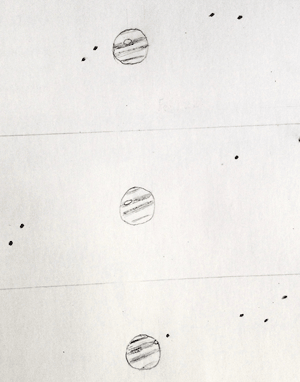
Eyepiece sketches of Jupiter from Feb. 22 (9:45 p.m.), Feb. 27 (2 a.m.), and Feb. 28 (11:45 p.m.). Drawn as seen in the eyepiece (south is up). Great Red Spot visible on Feb. 22 and 27; questionable on Feb. 28. (Drawing by Marc Vilain)
Jupiter’s moons are roughly comparable in size to our own moon, with orbits ranging in diameter from approximately one lunar orbit (Io) to five (Callisto). These moons burn rubber as they traverse their orbits: Io completes a revolution around Jupiter in less than two days, and even outermost Callisto gets the job done in just over two weeks. As a result, the relative alignment of the moons is constantly shifting. The eyepiece sketches at the right show how they appeared to me during a few recent cloudless nights.
Galileo observed similar rearrangements in the configuration of these moons, and he rightly inferred that this could only be explained by their orbiting Jupiter. This discovery had momentous consequences. If these moons orbit Jupiter, this pulls the rug from under the ancient Ptolemaic model that all celestial bodies orbit Earth. Challenging this model with observable scientific facts put Galileo at odds with powerful members of the Church; the tale is told well in Bertolt Brecht’s “Life of Galileo,” performed a few years ago at the Bromfield School.
Get out your telescope
If you own a telescope or can borrow the library’s StarBlast lend-a-scope, take a good look at Jupiter this month. A telescope’s increased magnification will give you a much better feel for the relative positions of the Galilean moons. Try sketching the moons over a few nights, as I did above.
A telescope will also show you details of the gas clouds forming Jupiter’s atmosphere. The most readily visible characteristics are the dark-colored bands; these appear reddish or orange in photographs, but are largely colorless in the eyepiece. It is possible, during nights of good seeing and at high magnification, to discern significant detail: the swirls that edge the bands, or the Great Red Spot that travels along the Southern Equatorial Band. You can improve your chances to see these features by adding a color filter to the back of your eyepiece (the StarBlast can’t do this). Blue, cyan, or even skylight filters will darken the red-orange tints of the bands, thereby increasing visual contrast and bringing out details.
Of fruits and planets
So just how big is Jupiter? If we take Earth to be the size of a cherry tomato, then Jupiter at that scale would be as large as a watermelon. Mercury turns into a black peppercorn, and poor ex-planet Pluto, forever seeming unable to get any respect, would be about the size of a sesame seed.

The relative size of planets, visualized as foods.
(Drawing by Marc Vilain, based on a NASA idea and a design by BBC Learning)
You could fit a lot of Earth-sized cherry tomatoes in the same volume as that Jovian watermelon, more than 1,300 as it turns out. All that volume translates to a lot of mass, and while Jupiter’s composition (mostly hydrogen and helium) is much less dense than that of Earth (with its rocky mantle and iron core), Jupiter is still 300 times as massive as our home planet. In fact, Jupiter is more than twice as massive as all other planets in the solar system combined.
Gravity
All that mass exerts a lot of gravity. Mathematical models of Jupiter’s gravitational pull suggest that it plays interference with the myriad asteroids between Mars and Jupiter, keeping them from coalescing into what would be another rocky planet.
Space probes going to the outer solar system have used Jupiter’s gravitational pull as a planetary slingshot: As the probe flies by the giant planet, Jupiter’s pull accelerates the spacecraft before flinging it out faster on an outward-bound trajectory. New Horizons did just this on its mission to Pluto, gaining 9,000 mph from its flyby of Jupiter and shortening the mission by three years.
By the same mechanism, Jupiter’s pull serves to guard the outer periphery of the solar system, sometimes slinging wayward comets into deep space. Occasionally, one such comet gets captured by Jupiter wholesale, as happened to Comet Shoemaker-Levy 9. The comet fell under the sway of Jupiter’s gravitational pull, eventually shattering into fragments that fell into the gas giant in July 1994. The Hubble Space Telescope documented this final outcome, disquietingly showing those comet fragments as they slashed through Jupiter’s atmosphere.
Fellow sky walkers, the sad fate of Comet Shoemaker-Levy 9 notwithstanding, Jupiter is ready to fill your astronomical evenings with observational joy. Do not resist the beckoning call of our great gas giant: This is the month to observe Jupiter in its fullest. I hope to see you under the starry skies.
Marc Vilain lives in the center of town, where he can occasionally be found pointing his telescope toward Jupiter from the vantage point of his front yard.