Never mind the Oscars—the best show in town this weekend was the Bromfield student science fair. Nearly 200 middle and high school students flooded the cafeteria and hallways of the Bromfield School with poster presentations, engineering prototypes, and much verve and enthusiasm. It all looked very much like the annual meeting of any scientific society, except for so many of the presenters barely reaching adult shoulder height.
“We had 114 projects,” said Bromfield Science Department Chairwoman Deb Pierce, many of them collaborative team efforts. The projects covered the traditional scientific disciplines of physics, biology, and chemistry, along with psychology, environmental science, and a number of entries in computer programming and other disciplines. Pierce noted that the range of projects in environmental science had especially blossomed this year.
In fact, this year’s coveted Blue Rosette awards were given both to environmental and environmental-leaning projects. Seventh-grader Michelle Mazu received the middle school rosette for CO2 greenhouse effects on environment, temperature, and crop plants, while the high school rosette went to juniors Isaac Abouaf and Eric Xing for their biochemistry project, Comparing biodiesels derived from different organic sources.
Budding scientists
Who participates in the science fair? “We have everyone from sixth through 12th grade,” said ninth-grade science teacher Jackie Travers. “Most of them are self-selected and choose to participate out of interest.”
In addition, a number of 11th- and 12th-graders fulfill advanced placement course requirements by presenting at the science fair. This provides students with opportunities to communicate scientific work—opportunities that they may not otherwise have in high school. “We try to impress upon them that this is how science is done in college and beyond,” said Pierce.
Science spoken here
While some projects reflected research efforts focused on extensive literature reviews, most were experimental in nature. The scientific method was everywhere to be seen in these students’ projects, with each poster listing hypotheses, data collection, experimental analysis, and verification of the starting hypothesis.
Seventh-grader Ethan Taylor found what he expected. Standing next to a disquietingly cannon-like ball launcher, he described how he verified that the pressure of compressed air used to lob mini tennis balls through the air had a linear relationship with the distance the balls traveled, sometimes going hundreds of feet. How did he get a long enough measuring tape? “I used a hand-held GPS instead,” said Taylor.
But the essence of science is that empirical results do not always substantiate the starting hypothesis. Just ask sixth-grader Aiden Long. In his survey study of video game players, he had expected that males would prefer games where they played male characters, regardless of whether these games matched their stated preference for level of violence. Females, he hypothesized, would prefer less violent games, regardless of what gender character they played. Not so. “I found the exact opposite of what I expected,” said Long, a research result made the more valid for being so unanticipated.
A small but growing number of projects was cast explicitly as engineering efforts. Among them was junior Will Day’s The turbojet—and how it works, complete with a model of a turbojet that looked like it truly meant business. Day’s project was awarded a community judging award by the PTO, with PTO presenter Mark Thompson describing it as the “Don’t-Call-in-the-Harvard-Fire-Department-Quite-Yet Award.”
Other engineering or engineering-oriented projects considered optimal design of sails, effectiveness of insulation, water piping sensors, or the dirtiest place in Bromfield (cringe-inducingly, it’s the PIN pads that every student touches when paying for lunch). Regarding engineering in future science fairs, Pierce said, “We hope to take it further, because that’s where the creativity comes from.”
Judges, judges, everywhere
Projects were adjudicated by panels of academic or “faculty” judges. While the name suggests otherwise, no teachers were involved: More than 60 volunteer judges were raised from the Harvard community. Most have backgrounds in science or engineering, according to Travers. There were enough judges, added Pierce, that students received detailed reviews from at least three adjudicators, even those who did not go on to win prizes.
In addition, various community organizations awarded prizes in areas related to their concerns: pond life, for example, in the case of the Bare Hill Pond Watershed Management Committee. New this year among community judges was the Cable Committee. “They were looking for kids who do something really unique with technology,” said Pierce.
While not all projects went on to win prizes, a reflection of the realities of scientific work, all the students were recognized in ways otherwise valuable. In a room packed with presenters and attendees, not one poster failed to draw the appreciative interest of community members, teachers, parents, and, especially, student peers. The science fair has grown in numbers over the years, and this year’s presenters, and the excitement of their work, will bear much of the credit for drawing new budding scientists to participate in science fairs to come.
Our reporter regrets only having been able to cover a few of the many worthwhile posters at this year’s Bromfield science fair, and wishes he could have said something about all of them.
Charlie Carbonell (grade 8)
Pinhole cameras

Charlie Carbonell (second from left) discusses his project with Lions Club judges (from left) Rick Veltri, Alice von Loesecke, Hank Fitek, and Bruce Doulimont. (Photos by Lisa Aciukewicz)
“Artists in the old times had a huge camera obscura,” said Carbonell, a room they could walk into with a pinhole or lens on one wall that projected their subjects onto a canvas. “They then painted what they saw,” essentially tracing the projected image. Carbonell built a model camera obscura that projected the image onto tracing paper instead. Alternatively, he could replace the tracing paper with light-sensitive photographic paper, exposing it much as one would in a film camera. For the experimental part of his project, he determined the appropriate exposure times for still life images and portraits. Carbonell’s project was awarded a Lions Club prize.
Sylvia Ren (grade 11)
A possible natural solution to plastic litter
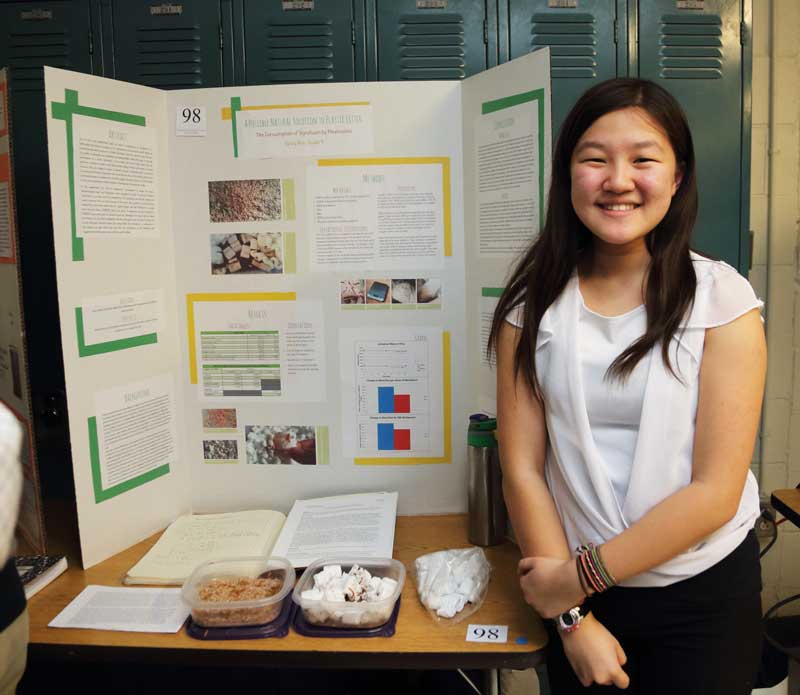
Sylvia Ren.

A meal worm chews its way through a piece of Styrofoam.
We are told that Styrofoam is a terrible pollutant that is almost impossible to break down, reported Ren. What to do about it then? Feed it to mealworms, of course. Ren followed up on a Stanford University article reporting that mealworms could digest Styrofoam, leaving fully nontoxic droppings. She wanted to see how efficiently they did so, compared to worms fed a preferred diet of wheat bran. She put worms to the task of digesting Styrofoam or bran—many worms, 5,000 of them. Ren found that “the wheat-fed worms ate 20 percent more mass than the Styrofoam-fed worms. The experiment is on a small scale, however, so this may not be statistically significant.” Like many of her 11th-grade peers, Ren made use of statistical measures to put her results into perspective.