On Wednesday, Feb. 10, nine members of the Bromfield Model United Nations team boarded a plane bound for eight days in Greece, accompanied by BMUN adviser and 10th-grade global studies teacher Bryce Mattie and sixth-grade ancient civilizations teacher Sharlene Tuttle. Student travelers were Clara Alexander, Katie Erdos, Brian Johnson, Deirdre Kennedy, Bolek Myczkowski, Connor Reitler, Ailsa Saverse, Eva Xue, and me. Composed of seniors and juniors, the group included best friends and friendly acquaintances who would soon be squished together on a seven-hour Lufthansa flight and, upon arrival, three cozy Greek hotel rooms.
Thessaloniki: Reinventing history
We arrived in Thessaloniki on Thursday afternoon, Greek time. Because our Model United Nations conference at Anatolia College would not start until the next day, we spent the afternoon strolling up and down the plaza in 60-degree weather, balmy compared to the subzero temperatures that were freezing our friends back home.
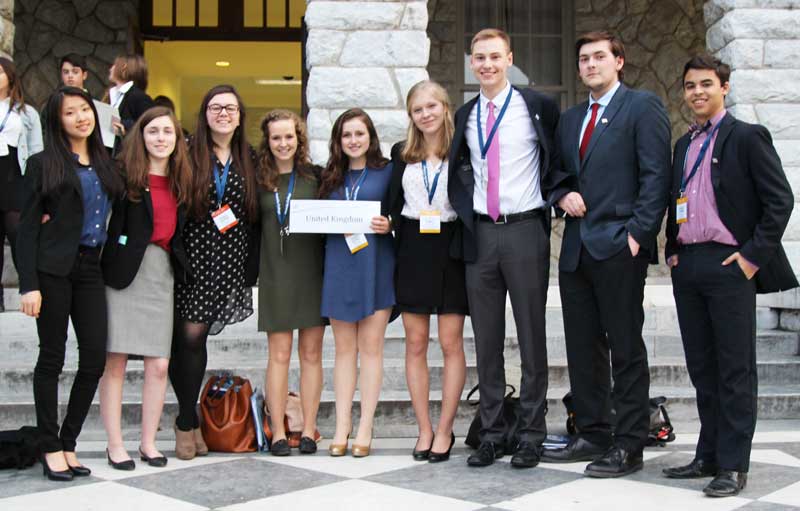
From left: Eva Xue, Clara Alexander, Ailsa Saverse, Deirdre Kennedy, Katie Erdos, Lily Moore-Eissenberg, Brian Johnson, Bolek Myczkowski, and Connor Reitler after closing ceremonies at Anatolia College.(Courtesy photos)
That evening, we went to see the White Tower, a forbidding remnant of Ottoman occupation. The tall, circular structure loomed overhead, dwarfing the comparatively young trees surrounding it. With tiny scattered windows, some of which spanned barely the width of a hand, this 15th-century building clearly served a sinister purpose once upon a time. Indeed, the Ottomans used it for imprisoning, torturing, and executing enemies. One can still detect a red tint to some sections of the white exterior, which was scrubbed and whitewashed when the Hellenic State annexed the city in 1912.
After enjoying a delicious breakfast at our hotel the next morning, we set off for Anatolia College. Each member of the Bromfield delegation served on a different committee, such as the General Assembly, the Economic and Financial Committee, and the International Court of Justice. We followed United Nations procedure and debated important global topics like the use of torture, the stock market crash, territorial disputes, and human rights violations. Senior Deirdre Kennedy represented the United Kingdom in the European Council of Ministers, which tackled the immigration crisis as one of its two topics. Kennedy described their approach as multifaceted, with one clear action being “establishing the European Union (EU) Committee on Immigration Research and Policies, whose goals are to gain insight on how many refugees each country can take in while maintaining economic and social stability and recommend appropriate policies to countries and to the EU.”
Divvying up Ottoman lands
The Historical Committee, of which I was a member, was charged with dissolving or partitioning the Ottoman Empire after its loss in World War I. I played the role of Italian Prime Minister Vittorio Emanuele Orlando, clashing with Greek Prime Minister Eleftherios Kyriakou Venizelos in my efforts to claim coastline territories. Other representatives included Kurdish, Armenian, and Arab leaders, all vying for a stake in the Ottoman Empire’s former territory. Most notably, we ended up creating a United Arab Kingdom, an independent Kurdistan, and an independent Armenia, and Italy gained more land than it did in the real Treaty of Sevres. Reinventing history turned out to be pretty fun.
Closing ceremonies arrived in no time at all. In those three days, we had debated global issues for at least eight hours each day, accidently shown up at a formal dinner dance in T-shirts and shorts, and exchanged contact information with new friends from around the world. If it weren’t for the anticipation of the days of touring ahead, I would have felt positively forlorn.
Meteora: Ankle-length skirts
Surprisingly, I don’t think any of us minded the eight-hour drive to the monasteries at Meteora. The rolling hills of rural Greece stood in sharp contrast to the city of Thessaloniki, and the small towns we passed along the way punctuated the endless expanse of scrubland. We stopped at a Greek Orthodox icon shop, where licensed artisans craft and sell high-quality replicas of traditional icons. A woman at the store outlined the steps that go into making an icon. Highly procedural, the process struck me as a religious ritual in itself, complementing its practical goal of producing authentic iconography in the Greek Orthodox tradition.
At the monasteries, the girls had to don makeshift ankle-length skirts to respect the values of the Greek Orthodox monks living there. Perched at the highest points of clifflike mountains, the monasteries were built to offer a place of solitude for devout worshipers. Luckily for us, today some of the monasteries are open to the public on a rotation. We marveled at the artwork inside the church, finding it difficult to spot any empty wall or ceiling space. With an awe-inspiring view over the surrounding scenery, it was clear why 14th-century monks chose this as a place in which to worship their God.
Delphi: Ruins and omens
Only 800 people live in the town of Delphi; the night of our arrival, we roamed empty streets with stray dogs and peered into shop windows. The next day, we headed to the Temple of Apollo and the ruins at the former site of the town. Walking in, we were confronted by the granite skeletons of ancient treasury buildings belonging to specific city-states. The treasury of Athens stood over the others at a slightly higher elevation, a proclamation of its superiority in war and art. Our tour guide was animated and knowledgeable; we were all surprised to learn that the Greeks painted their statues in vibrant colors, simulating real people and real clothes. The standards of beauty developed in the Renaissance and the normal wear-and-tear to the statues’ exteriors led to the widespread image of pure white Grecian sculpture.
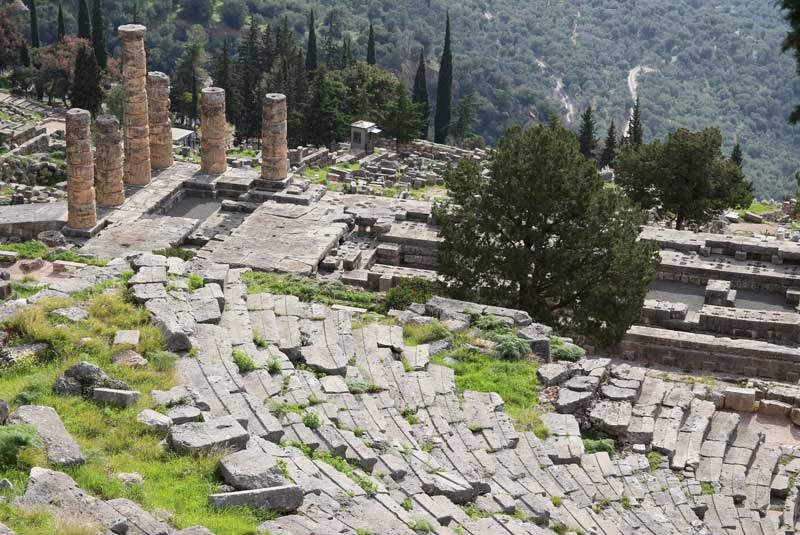
The ruins at Delphi.
On our walk up to the ancient stadium located at the path’s highest point, someone noticed a wiggly line about half a centimeter thick on the rocky wall to the left of the path. Upon closer inspection, we realized that the line was composed of nine furry caterpillars climbing the wall head-to-tail. Nine caterpillars for the nine of us, I thought. Nine caterpillars for the nine muses, Brian added. Collectively, we concluded that the undulating formation represented a welcome from the spirits of Delphi.
However, as we advanced farther up the slope, we encountered longer lines of caterpillars; the higher we climbed, the more often we found ourselves dodging squirming mounds of the bugs. By that point, the insects had begun to seem slightly less magical. Still, as the stadium came into view, the grandeur of the place stole our breath once again. The white bleachers, crumbling at the edges due to age, looked like the original version of what one might see at a college sports stadium today. Here, local authorities hosted the Pythian Games in honor of Apollo. Ghosts of long-dead spectators appeared in my mind’s eye, cheering from their seats on the elevated benches.
Athens: Marble and graffiti
Two things stuck out to us as we toured Athens on our last day: the Acropolis and the graffiti. Slabs of marble decorated a stretch of grass in the middle of the city beside heavily vandalized tunnels through which multicolored, bubble-lettered trains trundled. We took the steps up to the Parthenon, which happened to be under construction, and marveled at the preservation of those pillars that have stretched into the sky since construction began in 447 B.C. That afternoon, we came upon a forested oasis in the center of the city, where we watched turtles bathe in little ponds beside crisscrossing pathways. I knew that pollution had caused the globs floating on the surface, but I liked to imagine that I had discovered the secret to Greek olive oil—that instead of wells of water, Greece’s terrain was dotted with wells of olive oil that fed turtles and humans alike.
We departed for the airport at around 4 o’clock the next morning. Homeward bound, we wished for the five-hour layover we had cursed on our way to Greece. Eight days after we boarded our first plane, no one wanted the magic to end.
Lily Moore-Eissenberg is a senior at the Bromfield School.