Two roads in a wood. Perhaps that’s an apt image for the choice voters must make this spring on whether and how to create a charter for the town of Harvard, first at Annual Town Meeting and then at Town Election.
The choice comes in the form of two citizen petitions, both initiated by Worth Robbins of Mass. Ave. (a co-owner of the Press). Each draws on options made available through Massachusetts law. Each offers varying opportunities for citizen involvement. And for each, the destination is the same—a town charter—even if the vehicle is different.
The first petition, signed by 692 registered Harvard voters, asks townspeople to decide at Town Election whether to elect a nine-member charter commission. The elected commission would have up to 18 months to draft a home-rule charter that, following review by the state’s attorney general, would appear on the ballot of a future Town Election for an up or down vote, bypassing Town Meeting. Though they could have postponed the ballot question until 2017, the selectmen voted 4–1 at their Feb. 2 meeting to call for a decision this year.
The second petition, signed by 11 voters, proposes a different path: a warrant article that would create a nine-member town moderator–appointed committee to draft a special-act charter. The committee’s work would be subject to Town Meeting approval and due in time for the 2017 Town Meeting. The selectmen had no choice but to add the article to the warrant; state law requires them to do so in response to a petition signed by 10 registered voters. The selectmen can decide where to place the article on the warrant, but they can’t deny it. A feature of the article is language that nullifies it if the ballot question passes and a charter commission is elected.
Two paths, shared destination
Passage of either measure leads to a similar outcome: a commission or committee tasked to create a charter acceptable to Harvard’s voters. Either group could decide that a charter is unnecessary. What distinguishes the two panels is the product each delivers. A charter commission delivers its draft charter to the Attorney General, who comments on any inconsistencies and returns the document to the commission. After responding to the AG’s comments, the commission publishes the charter, hold hearings, and schedules it for a vote at the next Town Election.
A charter committee delivers its draft charter in the form of a special act, which must be approved by Town Meeting and then by the Legislature, a process than can take from six months to more than a year. Once the Legislature has approved the charter and the governor has signed it, the document may or may not be returned for a Town Election vote. These process distinctions are spelled out in the flow chart that accompanies this article (see “Options for getting to a town charter” below).

Why two options?
But why are voters being asked to consider two options rather than one? In an email this week, Robbins said the warrant article had been submitted as an insurance policy, though he and the petitioners prefer the election of a charter commission, which they feel is a more deliberative process.
“We drafted the warrant article when we didn’t know for sure if [the selectmen] would vote to put forward the ballot question in 2016 or 2017,” he wrote. “We felt that an appointed committee with the same mandate as a charter commission … would be preferable to a charter commission elected a year later.”
But Robbins said that as he was drafting the article to create a charter committee, he realized that an additional advantage of the warrant article is the opportunity to discuss the charter question at Town Meeting. Unlike a commission-drafted charter, a charter created by following the steps outlined in the special-act article must ultimately come before Town Meeting for approval.
Still, Robbins says he prefers the path offered by a charter commission. “I hope and expect that the warrant article will pass easily at Town Meeting and the ballot question will pass at Town Election, and we will elect a charter commission with a clear mandate to do the work,” he wrote. Passage of the ballot question, as previously noted, would nullify the article (see the flowchart above).
No path less traveled
It’s possible that as the need for a town charter is debated and the two paths compared, support for a special act will emerge. Massachusetts towns have used both methods. A 2010 article written by members of the Edward J. Collins Center for Public Management at the University of Massachusetts reported that 88 Massachusetts towns as of that year had adopted a home-rule charter (i.e., one created by a charter commission) while 63 had used a special act to create theirs (i.e., via an appointed committee). In an email, Michael Ward, current director of municipal services at the Collins Center, said this week he was sure both numbers had increased since then but that a more up-to-date count does not exist.
As Town Meeting and Town Election approach, voters must prepare to choose one of the two available paths or to decide the journey is unnecessary. Although the outcome cannot be known in advance whether the ballot question will prevail, voters must nevertheless decide whom they want to serve on Harvard’s charter commission, should the question pass.
Voting your preferences
With three possible outcomes, voters will need to choose a voting strategy that leads to the choice they prefer. The flowchart above suggests how that might work, but here’s a quick guide:
- If you favor an appointed charter committee, vote for the warrant article at Town Meeting and vote against the ballot question at Town Election.
- If you favor an elected charter commission, vote for the ballot question at Town Election, which would negate the Town Meeting warrant article.
- If you oppose any effort to create a charter, vote no on both questions.
- If you want to guarantee a town charter, vote yes on both questions.
To fully execute your preferences, you must both attend Town Meeting and participate in the Town Election. And regardless of your position, you will want to choose nine commissioners from the list of candidates in case the ballot question passes. That way, even if you disagree with its creation, you’ll have a say in its membership.
Robbins says that for the next few weeks, his focus will be on getting as many people as possible to submit nomination papers with the required signatures, “so voters can choose a strong commission with a good mix of young and old, newcomers and old-timers, experienced and inexperienced.”
Twenty-seven certified signatures are required to place a name on the ballot. Nomination papers are due to Town Clerk Janet Vellante no later than 5 p.m. Tuesday, March 8. As of Tuesday this week, she reported, one citizen had come to her office to request the proper forms.
Meantime, the selectmen have voted not to wait for a charter before making changes that would increase the authority of the town administrator and change the positions of town clerk and town constable from elected to appointed (see article). Asked by Chairman of the Selectmen Ron Ricci at their meeting last week whether the charter initiatives were incompatible with the selectmen’s proposals, petition-organizer Robbins said they were not, but he cautioned that the home-rule petition that is needed to adjust the town administrator’s responsibilities could end up taking as much or more time than a commission-created charter because of the requirement that the former be approved by the Legislature.
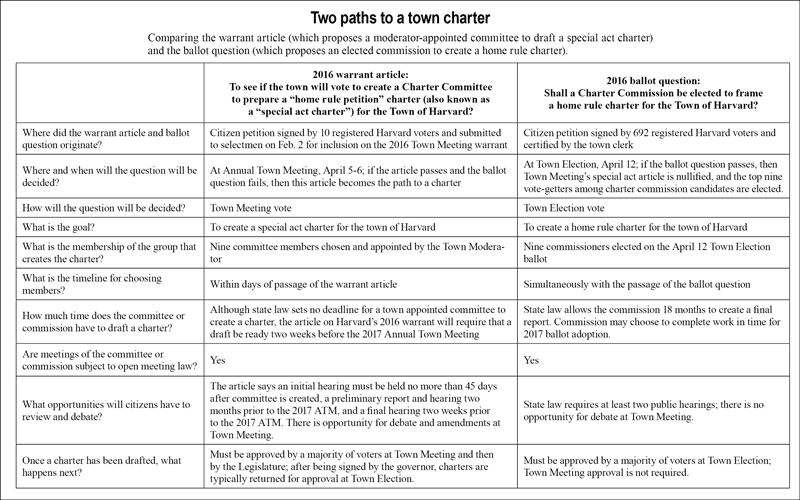
CLICK CHART TO ENLARGE