
There is something about this time of year that draws us to intimate sources of light. We bring trees into our homes and string them with lighted garlands. We light candles on the menorah for the eight days of Hanukkah. And then there’s our town center, its windows aglow with electrified candles, joined by the real thing on the Common after the ecumenical pageant.
In this headlong rush into the holidays and the new year, many of us find comfort in keeping the company of soft lights like these. Perhaps it’s because they remind us during these short days and long nights of the warmer and brighter days to come, or in the words of author and poet Susan Cooper, they “drive the dark away.”
Or perhaps we seek such lights because they remind us of the stars.
Fellow sky walkers, a walk under the starlit skies at this time of year has dual benefits. It brings a moment of peace into a season that so often lacks it. And it brings us closer, if just for a while, to our human forebears’ experience of a time before candles, a time when only starlight brought comfort to the night.
A sky full of color
At this time of year, the sky over Harvard is home to some of the night’s most colorful stars. As the star chart shows, looking east around 9 p.m. reveals five constellations, each with a bright star that shines orange or deep yellow. In the center, the familiar figure of Orion marches into the sky with orange Betelgeuse at his shoulder. I picture Orion holding a bow in his south-pointing arm, while reaching around to pluck an arrow from his quiver with the arm anchored at Betelgeuse.
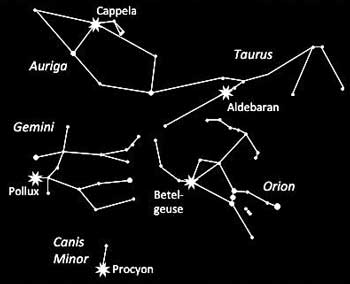
Colorful stars in the evening sky. (Charts by Mark Vilain)
When it comes to stars, many names that have come down through the years were originally given by Arab astronomers of the golden Islamic age. We have received these names with varying degrees of orthographic distortion. In the case of Betelgeuse, a pronunciation along the lines “beht-ehl-jooze” is often translated in popular writing as the shoulder, or perhaps armpit, of the giant. Another more academically accepted reading has Betelgeuse as a particularly wayward version of Bait al-jauza, the home of the giant. Other readings have it as the home of the twins, these being the nearby constellation Gemini.
Gemini itself has a deep yellow or near-orange star, Pollux, traditionally taken as the head of one twin (the other’s head being Castor). As the chart shows, you will find Gemini somewhat below Orion on his “quiver” side.
Meanwhile, hovering higher in the sky on Orion’s “bow” side is the characteristic V of Taurus’ horns. Aldebaran, the deep orange star partway up the lower branch of the V, is sometimes referred to as Taurus’ angry eye, an anatomically questionable arrangement, out there on his horn.
Our fourth orange star is Capella. If I’m talking with singers, I’ll refer to Capella as the patron star of unaccompanied vocal music. In fact the name refers to a small she-goat, carried in this instance by Auriga the charioteer. It takes some imagination to picture a charioteer emerging from the blocky alignment of stars in Auriga; the goat is a little easier to see, with Capella as its head and a pair of dangling legs below.
Imagination will not do much to turn our final constellation, Canis Minor, into anything like a small dog. It is, however, home to Procyon, the last of our orange-ish stars for tonight.
What’s in common among all these stars? Astronomers classify stars according to a two-dimensional chart, with luminosity (brightness) running on the y-axis, and with surface temperature of the star on the x-axis. The higher the surface temperature, the bluer the light of the star; conversely, the lower the temperature, the closer the star is to red (or more accurately, orange). In the case of Aldebaran, Betelgeuse, and the rest, these orange stars are known as red giants. These are stars that have burned through all their hydrogen, or more properly, fused all their hydrogen into helium. When they reach this stage, red giants now start fusing their helium into higher elements, carbon in particular, and at this point they expand to many times their original size. Betelgeuse, in particular, is such a monstrous giant among giants that if it were to replace our sun, it would swallow the solar system all the way out to Jupiter or thereabouts. Good thing this disquieting notion is just a thought experiment.

How the Yolngu people picture Orion.
Finding meaning among the stars
Fellow sky walker, I hope the next few weeks allow you the time to look to the night sky and find comfort in the stars. While you look up at the constellations in our chart, consider for a moment that they come to us in many cases from the ancient Greeks, who enshrined in the stars their own culture’s myths. As ancient as Greek myths may be, they are no more ancient than those of the aboriginal people of Australia, who see these same stars differently. Down under, constellations appear upended relative to the Northern Hemisphere; our second chart shows Orion as he would slouch into the southern sky during the Australian winter. The chart shows how the Yolngu people conceive of these stars: as a canoe carrying three brothers (the three stars of Orion’s belt). Orion’s sword is understood as a forbidden fish, and it’s the fact of one brother having eaten the forbidden fish that led to the brothers being banished in their canoe to the night sky.
I leave you, sky walkers, with this one thought: We share the night sky with people near and far, and are bound in our mutual humanity by the way we may seek the same comfort in the intimate light of distant stars.
Marc Vilain lives in the center of town. As an amateur stargazer, he has been walking the night sky for more than 20 years.