Students in Harvard did well on last spring’s MCAS tests. But it may be the last one they have to take, at least under that name. A little later this month, state education officials will decide whether Massachusetts will continue to require the MCAS (Massachusetts Comprehensive Assessment System) or will switch to a different statewide test.
Massachusetts has relied on the MCAS to evaluate student achievement for the past 18 years. But a number of state officials, including Secretary of Education Jim Peyser and Commissioner of Education Mitchell Chester, have stated publicly that MCAS is outdated and it is time for a change, or at least an update.
The final decision on what testing program to use statewide is in the hands of the state Board of Elementary and Secondary Education. Its announcement is expected in the next two weeks.
PARCC vs. MCAS
Initially, the leading candidate to replace MCAS was the PARCC testing program. (PARCC stands for Partnership for Assessment of Readiness for College and Careers.) According to its website, PARCC is a group of states committed to a unified replacement for the various standardized tests used in individual states. PARCC’s governing board is made up of state superintendents and commissioners, with Massachusetts Commissioner Chester as its chairman.
Two years ago, Harvard had the option to pilot the PARCC test. In the spring of 2014, a randomly selected group of third- and fifth-graders at Hildreth Elementary School took the PARCC math test in place of the MCAS. The Bromfield School piloted the PARCC for math at seventh grade and for English at eighth grade.
Harvard Superintendent of Schools Linda Dwight said in a recent email that the state did not release the scores from that PARCC pilot program. As a result, it is not possible to compare Harvard’s results from the two tests.
PARCC’s supporters assert it does a better job testing critical thinking than MCAS. In an editorial, The Boston Globe said a survey of Massachusetts teachers showed 72 percent regarded PARCC as “a higher quality test.” The Globe also argued that PARCC’s open-ended questions put less pressure on schools to “teach to the test.”
Another issue is the amount of time that schools must devote to required, high-stakes tests like MCAS and PARCC. Initially, Dwight said, PARCC took more testing days than it does now. “There was a lot of push-back,” she said, “and so [PARCC] changed that design.”
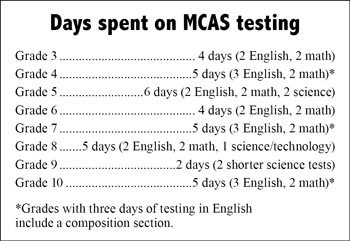
MCAS takes a different number of days depending on grade level (see table). Bromfield Associate Principal Scott Hoffman said that based on the 2014 pilot tests, PARCC seemed to take about the same amount of time as MCAS, although technical glitches with the pilot tests made it hard to compare.
Last spring, more than half the schools in Massachusetts chose to use the PARCC tests. Harvard, however, opted to stick with MCAS. Although the MCAS results are in, PARCC results have not been released yet.
Waning support for PARCC in other states
A central feature of the PARCC tests is that they are aligned with the Common Core, an initiative begun in 2009 by a group of governors and state school officials to create consistent educational standards among their states. Most states—42 out of 50—quickly adopted the Common Core. But when the Common Core became politically controversial, states began to back out almost as fast. Massachusetts still adheres to the Common Core, and local schools have aligned their curricula to those standards.
In the 2014–15 school year, results on the first widespread PARCC tests in many states showed lower scores than districts had achieved in the past under their own state tests. In the wake of those declines, states began to back away from PARCC as well as Common Core.
In 2010, 23 states and the District of Columbia belonged to PARCC. But as of this fall, membership fell to just 12, according to an article in U.S. News & World Report. Even fewer have signed up to use the test in 2016.
In Massachusetts, a leading opponent of PARCC and Common Core has been the Pioneer Institute, a Boston-based think tank that describes itself as a nonpartisan supporter of free-market principles, individual liberty, and limited government. Jim Stergios, Pioneer’s executive director, called many states remaining in the PARCC program “low performers” whose students “cannot pass tests at the level of their Massachusetts counterparts.” That situation, Stergios charges, will create “built-in pressure to reduce PARCC’s rigor.”
MCAS 2.0?
In a recent interview on WBUR’s Radio Boston, Secretary Peyser said he likes the idea of an improved version of MCAS, one that would adopt some of the best features of the PARCC test but keep control of standards within Massachusetts. That option is often labeled “MCAS 2.0.”
Even Commissioner Chester, with his position on the PARCC governing board, expressed support on Radio Boston for creating a Massachusetts version of the test. Chester, who will be making a recommendation to the state board on the choice of tests, pointed out that Massachusetts teachers played a large part in developing the PARCC tests.
Asked how Harvard teachers and administrators felt about possible changes to the testing program, Dwight replied by email, “We are happy to stay with MCAS, which has given us useful information about our curriculum alignment and individual strengths and needs of students to guide our instruction.”