
Welcome, sky walkers, to a Star Wars-themed round of celestial rambling. I promise you a much more meaningful experience than having to suffer through the ubiquitous movie tie-ins involving Star Wars-themed anything (coming soon: the 2016 Star Wars elections).
Our destination today is a long time ago, in a galaxy far, far away.
The Andromeda galaxy (M31 to astronomers) is one of the greatest sights of the fall and winter night skies. It is a bit more challenging to find than the Double Cluster from our last sky walk, but once you learn how to find M31, you will return again and again.
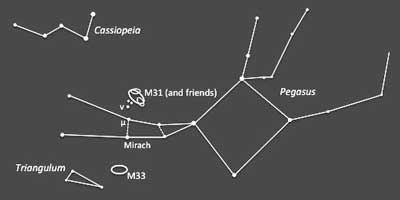
M31 in relation to Pegasus, with hind legs borrowed from Andromeda. (Drawing by Marc Vilain) CLICK IMAGE TO ENLARGE
First, just how far, far away is Andromeda? Current astronomical measurements place Andromeda at a distance of 2.5 million light-years. As a light-year itself is about 6 trillion miles, this is a mind-boggling number that gives meaning to the notion that “astronomical” signifies “big.” As a point of comparison, Pluto is only 5.5 light-hours away from the sun.
Galaxies tend to occur in clusters, and Andromeda is a member of the Local Cluster, a grouping of not quite 50 known galaxies that also includes our own Milky Way. With a diameter of 220,000 light-years, Andromeda is the largest member of the cluster. It also claims the greatest population of stars: 1 trillion stars, compared to the Milky Way’s estimated 200 to 400 billion stars. Numbers this large defy day-to-day experience, but to give some kind of perspective, if all the stars in Andromeda were parceled out to the 7 billion humans on planet Earth, we would each end up with more than 100 stars. Try fitting that into your attic or storage shed.
How to find it
Here then is how to find Andromeda in the night sky. While M31 is visible to the naked eye, you are best off with binoculars; either way, you will want a moonless night, as lunar illumination washes out deep-sky objects like Andromeda. Start by locating Pegasus, which at this time of year is almost directly overhead. The chief feature you are looking for is an almost perfect square of stars, about the size of your fist held at arm’s length. Those stars form the body of Pegasus. His neck and head emerge out of the more southern corner of the square, his front legs come out of the eastern corner, and what I have drawn as a pair of hind legs are tied to the northern corner, as shown in the star diagram above. To help situate the northern corner, it is the one closest to Cassiopeia from last month’s star walk; I picture the upper middle stars in Cassiopeia as pointing the way.
That pair of hind legs is not technically part of Pegasus, but is in fact borrowed from the Andromeda constellation, which gives its name to the galaxy. In the sky, those borrowed stars also look to me like a horn of plenty, with two prominent pairs of stars defining ridges of the horn. The easternmost and larger of those pairs points your way to Andromeda (μ and Mirach in the diagram). Locate the pointer pair in your binoculars and follow along that line until you locate a bright star (v in the chart), about the same distance away from μ as μ is from Mirach. Just past that star are two fainter stars with which this new star forms a triangle, and just past that is Andromeda, M31. It will appear at first as a fuzzy ball, the core of the galaxy.
Steady hand required
It takes good viewing conditions, a steady hand, or a telescope to detect the spiral arms. This is a good reason to borrow the library’s StarBlast lend-a-scope. The telescope will also reveal two companion galaxies near to or overlapping M31: M32 and M110. Oblong blobs are exactly what they look like in a small telescope like the StarBlast. You will need access to a really big telescope to see detail, but it is still a thrill to find Andromeda in the sky with amateur equipment.
Having located M31 with binoculars, try finding it with the naked eye. On a dark night, it appears as a faint smudge. You may need to use averted vision: Look just slightly off center and try to pick it up in your peripheral vision, which can be more sensitive to faint light. While the trillion stars in M31 pack a big stellar punch, this light is spread over the huge expanse of those 220,000 light-years, making the galaxy as a whole appear quite faint.
If you want an additional challenge, the diagram notes the position of another member of the Local Group, the Triangulum galaxy (M33), located one constellation away from M31. Try finding it on your own (it is much dimmer than Andromeda).
We end this Star Wars-themed sky walk by considering that bit about a long time ago. Somewhat confusingly, the term light-year is a unit not of time, but of distance, a light-year being the distance that light travels over the course of one year. There is, however, a time component: The fact that Andromeda is 2.5 million light-years away means that the light reaching our eyes today was cast into space 2.5 million years ago. When we observe M31, we are effectively looking backward in time. At that time, ancestral members of genus Homo had only recently started to walk and make recognizable tools. What did these ancient forebears see or think when they looked up at the night sky?
With that vertiginous thought, I wish you all happy sky walking.
Marc Vilain lives in the center of town. As an amateur stargazer, he has been walking the night sky for more than 20 years.