The month of October culminates with images of pumpkins, witches, and goblins. Halloween, or All Hallows’ Eve, is the beginning of the Christian religious observance of Allhallowtide—a celebration of the dead, using humor to defy death. Biologists kept this in mind when giving common names to various plants and animals that for one reason or another are reminiscent of this observance. Bright colors and strange growing patterns seem to be associated with the Halloween-related names of some of these species.

Witches’ broom on willow. (Photos by Mary Holland)

Halloween lady beetle.
Witches’ broom is a deformity, or disease, in a shrub or tree that causes the abnormal growth of shoots from a single point, creating a mass of branches. Brooms were once fashioned together from bundles of twigs, and since witches were presumed to be responsible for anything unusual, these abnormalities became known as witches’ brooms.
This abnormal growth pattern can be caused by a number of different agents, including mites, viruses, fungi, insects, dwarf mistletoe, bacteria, genetic mutations, or adverse environmental conditions that kill the terminal bud of shoots. Generally, the type of tree or shrub that a witches’ broom is on is a good indicator of its causal agent.
Some common trees that develop witches’ brooms include oak (caused by powdery mildew), incense cedar (caused by a rust), hackberry (caused by powdery mildew and a mite), and rose rosette (caused by a virus). A type of bacteria, phytoplasma, causes witches’ brooms on pecan, hickory, lilac, walnut, willow, dogwood, ash, honey locust, peach, and elm trees. Juniper, firs, hemlocks, and pines can develop witches’ brooms in reaction to an infestation of dwarf mistletoe.
Witches’ brooms: Mostly harmless, sometimes not
Typically, the presence of witches’ brooms on a woody plant does not pose any threat to the tree or shrub. However, one fungus, Moniliophthora perniciosa, is responsible for producing many witches’ brooms on a single cocoa tree. This fungus is ravaging chocolate tree plantations in many countries, threatening the cacao industry by causing yield reductions of 50 to 90 percent.
These broom-like or bird-nest-like structures are inhabited by and provide shelter for many organisms, among them nesting flying squirrels. The inhabitants of witches’ brooms are not necessarily random. Certain species of moths, for instance, are found only in certain types of witches’ brooms.
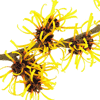
Although the name of the fall-blooming shrub witch hazel (Hamamelis virginiana) sounds as though it, too, has Halloween connotations, it may not. The word “witch” in this case has its origins in Middle English “wiche,” from the Old English “wice,” meaning pliant or bendable. However, it is possible that the fact that the twigs of witch hazel were used as divining rods may have led to its common name, given that witches had special powers.

Witch’s butter.
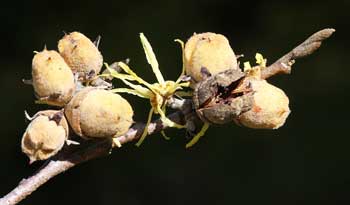
Witch hazel.
Halloween lady beetles (Harmonia axyridis) are also called “harlequin ladybird beetles” (they come in many colors) as well as “multicolored Asian lady beetles” (they originated in Asia). Because they typically enter homes in October, where they overwinter, they obtained the word Halloween in one of their common names. This ladybug was introduced to North America and Europe to control aphids and scale insects, which it has done very effectively. However, due to its voracious appetite and resistance to disease, it is considered one of the world’s most invasive species, in some cases outcompeting and replacing native species of ladybug beetles. (You can identify this species by the black “M” design in its pronotum, the first segment of its thorax.)
An eerie fungus
The jack-o’-lantern fungus (Omphalotus olearius) often produces its fruiting bodies in large clusters on the old rotting stumps of hardwood trees at this time of year. In addition to the timing of its appearance in October, it has at least two other Halloween-related characteristics. It is bright orange like pumpkins that are used to make jack-o’-lanterns, and the gills on its underside emit an eerie greenish glow at night. (This mushroom is appealing to the eye, but poisonous if eaten.)
Witch’s butter (Tremella mesenterica) is a bright yellow or orange jelly fungus that is parasitic on other fungi and usually appears on dead branches in the late fall. As it dries, it becomes hard and often a rusty orange in color. Part of its name comes from its resemblance to butter, being yellow with a greasy surface when young. There are many theories as to its connection to witches, one of which is that it came from Eastern Europe, where it is said that it shows up on the gate or entrance of a house of those who have been cursed by a witch.
Take advantage of this time of year by looking for the weird and wonderful fungi, plants, and animals that conjure up Halloween.
Former Harvard resident Mary Holland is a naturalist, wildlife expert, and writer. Her natural history blog can be found at https://naturallycuriouswithmaryholland.wordpress.com/.