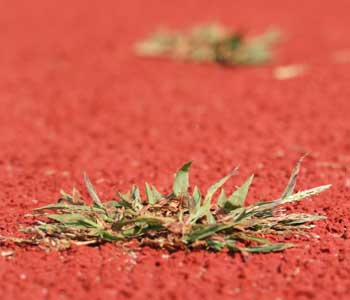
Patches of grass poke through the recently resurfaced McCurdy Track. (Photos by Lisa Aciukewicz)
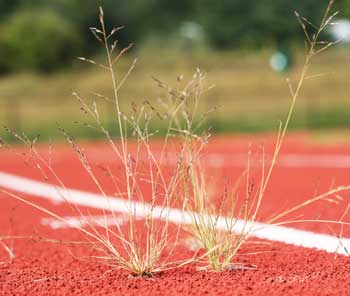
The town’s McCurdy Track is sprouting a crop of weeds that threatens the new $145,000 surface that was installed less than a year ago. While the weeds look small and sparse at first glance, anyone with a lawn or garden knows how quickly small weeds become big ones. And even a small weed is a potential footing problem for a runner going at top speed. Moreover, each weed is the beginning of a break in the track’s surface.
But while everyone involved—the Parks and Recreation Commission, the Harvard Park Trust, the Department of Public Works—seems to agree on the problem, there is less agreement on the cause or the cure.
Town and donors funded resurfacing
The track’s original surface lasted about a decade, and the new surface was expected to last about the same length of time, according to John Lee Jr. of the Harvard Park Trust, the volunteer organization that oversaw both the construction and the resurfacing of the track.
Most of the money for the resurfacing project came from the Community Preservation Fund. The 2014 Annual Town Meeting approved using $120,000 from that fund, under the supervision of Parks and Rec. In turn, Parks and Rec delegated the project to the Harvard Park Trust. When bids on the job came in, the low bid was just under $145,000, but the trust successfully raised the additional $25,000 through donations.
A maintenance problem?
“What upsets me the most,” Lee said in a telephone interview, “is that nobody did anything to fix it [the weed problem] when it began.”
Lee described the problem as a maintenance issue. He said the DPW needed to mow the area around the track more often, before grass and weeds grew enough to set seed. After mowing, he said, all the clippings should be blown off the track to prevent any seeds from settling into the surface. Lee later told the Parks and Recreation Commission that sprinkler heads at the field had become mis-aimed over time and were watering the track as much as the grass, actually helping weed seeds germinate in the track.
Lee said he first noticed weeds growing in the track in early July. At that time he called both DPW Director Rich Nota and the Parks and Recreation Commission, and he also told a couple of selectmen, he said.
When more than a month passed with no action, Lee said, he and his brother Jim went to the track and sprayed the weeds with vinegar, killing about 90 percent of them by his estimate. “It took us a couple of hours and a couple of gallons of vinegar,” he said, but by then the weeds were “huge plugs with big roots.”
A problem with the new surface?
Town Administrator Tim Bragan said he had discussed the track’s condition with Nota, and their diagnosis differed from Lee’s. According to Bragan, the problem began with moisture that was trapped between the new surface and the old one underneath it, allowing seeds to sprout and spread roots between the two layers. He likened the effect to a Chia Pet, where moisture makes seeds sprout into green “fur” on a terra-cotta figure.
“It’s an unfortunate situation,” Bragan said, in which “good people made a good-faith effort” to improve the track but chose the wrong solution. He said the track should have been rebuilt from scratch rather than resurfaced, but that approach would have been much more expensive.
Parks and Rec wants all parties to meet
When the Parks and Rec Commission met Tuesday night, its members and other interested residents discussed the situation for well over an hour.
Marissa Steele, coach for the Bromfield boys cross-country team, suggested that parent volunteers could help with weed eradication, just as the Lee brothers had done. But Parks and Rec Chairwoman Wyona Lynch-McWhite pushed back, saying she did not want to put more burden on volunteers. As a town volunteer who also works full time herself, she noted that most volunteers can’t come over in the middle of a weekday to see that mowing is being done as asked.
Harbormaster Bob O’Shea reminded the group that Parks and Rec had given up part of its own maintenance budget when mowing and other tasks were turned over to the DPW. “Put it back in the hands of the people who care,” he urged, saying that good problem solving always moved solutions closer to the people directly involved.
Lynch-McWhite said a first step should be a meeting in which all the involved groups are present and communicate directly with one another. “There’s too much ‘telephone’ going on here,” she said.