“The Looney Experiment” by Bromfield seventh-grade teacher Luke Reynolds is a delightfully funny, sad, heartwarming, and inspiring book about a lot of different things.
It’s about how Atticus Hobart finds the strength within himself to cope with the difficult things in his life. It’s about how one person can have an indelible effect on another and about what it means to be a teacher, a writer, and a reader.
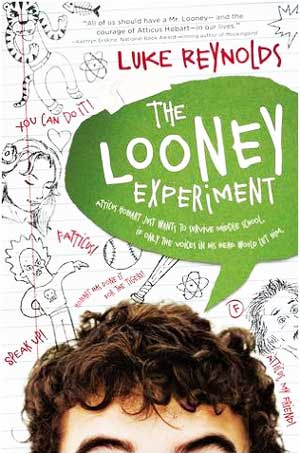
We first see Atticus sitting in his eighth-grade classroom dreading his turn to get up and give his oral presentation on Robert Frost’s poem “The Road Not Taken.” Hearing the teacher call his name, he escapes into his imagination. The poet himself walks into the room; he and Atticus banter; and then Atticus gives a delivery that impresses even the love of his life, classmate Audrey Higgins. In reality, his mouth feels “full of wet sand,” and the teacher looks at him “with eyes like the points of nails” and moves on to the next student.
Added to Atticus’ problems in communication—“When I try to get what’s in my head to come out for other people to hear, it doesn’t work” —is the fact that his father has left the family to figure some things out, and Atticus thinks it’s probably his fault; he’s a disappointment to his dad, especially in baseball. Since fourth grade, the class bully, Danny, has been menacing Atticus, calling him “Fatticus,” and even beating him up on occasion. Audrey doesn’t seem to know Atticus exists, his younger brother is an annoyance, he hates seeing his mom unhappy, and on top of it all, he’s got “no guts” and the “worst name in the world.”
Enter Mr. Looney, a 77-year-old retired teacher filling in while the regular eighth-grade teacher has her baby. It is through Mr. Looney’s lessons, in the classroom and outside of it, that Atticus realizes he is not alone with his fears and insecurities, and he starts to understand the inner resources that can help him be a stronger person. The class reads “To Kill a Mockingbird,” and Atticus sees what a courageous man his namesake is. He realizes he doesn’t have to win something to be respected. He doesn’t have to hit a home run for his team, the Tough Tigers, to prove his worth; there are other ways of being tough.
The book is also about what makes a good teacher, or a good human being for that matter. As demonstrated by Mr. Looney, a good teacher listens first, getting to know each student before giving any judgment or advice, and encourages students to do the same with their peers. A good teacher shakes up expectations so that students look at things in different ways and think more deeply.
The book talks about the process of writing and why an author writes a book. When Mr. Looney tells the class about Harper Lee’s newly published book “Go Set a Watchman” and that it was written before her “Mockingbird,” he talks about the process of revising one’s writing. The idea that you end something doesn’t mean it’s over, he says.
Through Mr. Looney, the book talks about active reading. A book is a dynamic thing that becomes something different for different people. Mr. Looney wants the students to think about who the people in the book are, and, more importantly, “Who are you in their company?”
The word “experiment” in the title seems an interesting choice. It makes me think about the nature of Mr. Looney’s experiment with his students. It seems he wanted to prove that valuing individuality, listening, respecting others’ ideas, and being compassionate would help his students feel less alone and better able to cope with challenges. Perhaps Mr. Looney’s experiment is one we could all conduct in our everyday relationships.