“HES Huskies are ‘paws’itively awesome,” announces a blue-and-white bulletin board in the hallway of Hildreth Elementary School. The slogan revives the husky as the school mascot and connects it to a revitalized positive-behavior plan to which the whole school will be committed. Respect, responsibility, and safety are the watchwords.
The ideas are not really new, says Principal Sue Frederick, but they are now expressed in clearly positive terms and described in kid-friendly ways. What is new, she points out, is the idea of intermittent rewards for students who meet behavioral expectations. And, she adds, there will be schoolwide commitment to being consistent in when and how to recognize good behavior.
Responding to an indicated need
The new program was created in response to a survey last fall that indicated teachers saw a need to reinvigorate the existing way in which positive behavior was being recognized.
CLICK IMAGE TO ENLARGE
Frederick formed the Voluntary Behavioral Committee, composed of a cross section of teachers and assistants, to study the issue.
The committee reaffirmed a commitment to Positive Behavior Support Intervention (PBSI), a proactive approach to establishing the behavioral supports and social culture needed for all students to succeed. PBSI data shows that punishment is ineffective, and it documents how schoolwide expectations for positive behavior can create a climate in which appropriate behavior is the norm. The committee accessed PBSI articles and guidelines and looked at the ways other schools use PBSI. They chose respect, responsibility, and safety as the three positive behaviors they most wanted to emphasize.
Making behavior real
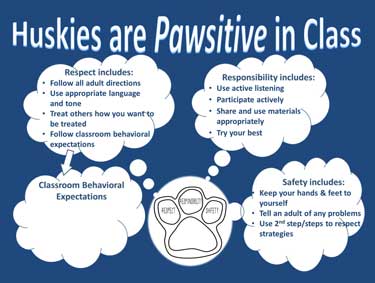
A significant step for the committee was its understanding of how difficult it may be for kids to understand abstract concepts, and the subsequent creation of descriptions for what these behaviors look like in various environments: on the bus, in the classroom, in the cafeteria, at recess, in the hallways, and in bathrooms. For example, in the classroom, “responsibility” means using active listening as well as sharing and using materials appropriately. “Respect” in the hallways means silence when passing as a class, and in the cafeteria it means following all adult directions. What “safety” looks like in all situations is using “2nd Step” (K–2) or “Steps to Respect” (3–5), which are the anti-bullying guidelines that students have already learned.
While doing its research, the committee unearthed a PTO cache of T-shirts with a husky logo. No one remembered when this mascot had been adopted or when it had been abandoned, but the committee readily readopted the husky. They saw it as a way to connect positive behavior to school spirit, embodied in a mascot.
Anyone in the school can award anyone else a “paws” for demonstrating positive behavior in one of the the three areas of respect, responsibility, and safety, says Frederick. Students collect the paws slips they receive and can enter them in gradewide drawings once a month. The winners will receive extra recess or lunch in the office.
Associate Principal Josh Myler has designed kid-friendly reminder posters for the classroom and other areas around school (see photo above). Frederick will roll out the new program at a schoolwide assembly, and teachers will show an in-house video featuring huskies and “paws”itive behavior. The video is available on the school website.
The PTO will have the husky T-shirts for sale, and it recently bought adult-sized shirts for faculty members who ordered them. When students were surveyed about the new plans, they were surprised to hear that they were huskies but overwhelmingly in favor of the whole program, said Frederick.
Learning to deal with conflict
When asked about the use of extrinsic rewards to encourage good behavior, Frederick cited the research supporting this approach. She says that because elementary kids are just learning how to navigate their social worlds and how to resolve conflicts, this is the perfect time to focus on specific examples of safe, responsible, respectful behavior. The intermittent rewards—sometimes you receive a paws, sometimes you may act the same and not get a paws, and the random drawing, where you may or may not win a privilege—help children to internalize good behavior.
Asked about the need for such a program, Frederick replies that it’s not that there is widespread misbehavior, it’s just that “we want to have consistency of expectations and ensure that unstructured time is safe.” It’s important “to keep in the forefront the respectful behaviors we all want our children to exhibit.”
Frederick is optimistic that having the whole school involved, being clear and consistent about what these positive behaviors look like, and connecting positive behavior to the mascot and school spirit will ensure the success of the program.
The complet descriptions for positive behaviors are available at the new school website. Go to hildreth.psharvard.org. Click on “For Parents” and under Documents select “HES Handbook.” The pertinent material is on pages 19 and 20.